



Click image to see more details
-
-

-
-
-
+7
Product Info Summary
| SKU: | PA1367 |
|---|---|
| Size: | 100 μg/vial |
| Reactive Species: | Human, Mouse, Rat |
| Host: | Rabbit |
| Application: | IHC, WB |
Customers Who Bought This Also Bought

Product info
Product Name
Anti-Connexin 32/GJB1 Antibody Picoband®
SKU/Catalog Number
PA1367
BA1592 is an alternative SKU for this antibody, used in previous lots.
Size
100 μg/vial
Form
Lyophilized
Description
Boster Bio Anti-Connexin 32/GJB1 Antibody catalog # PA1367. Tested in IHC, WB applications. This antibody reacts with Human, Mouse, Rat. The brand Picoband indicates this is a premium antibody that guarantees superior quality, high affinity, and strong signals with minimal background in Western blot applications. Only our best-performing antibodies are designated as Picoband, ensuring unmatched performance.
Storage & Handling
Store at -20˚C for one year from date of receipt. After reconstitution, at 4˚C for one month. It can also be aliquotted and stored frozen at -20˚C for six months. Avoid repeated freeze-thaw cycles.
Cite This Product
Anti-Connexin 32/GJB1 Antibody Picoband® (Boster Biological Technology, Pleasanton CA, USA, Catalog # PA1367)
Host
Rabbit
Contents
Each vial contains 4mg Trehalose, 0.9mg NaCl, 0.2mg Na2HPO4, 0.01mg NaN3.
Clonality
Polyclonal
Isotype
Rabbit IgG
Immunogen
A synthetic peptide corresponding to a sequence in the middle region of human Connexin 32/GJB1, identical to the related mouse and rat sequences.
Cross-reactivity
No cross-reactivity with other proteins
Reactive Species
PA1367 is reactive to GJB1 in Human, Mouse, Rat
Observed Molecular Weight
50 kDa
Calculated molecular weight
32.0 kDa
Background of GJB1
Gap junction beta-1 protein (GJB1), also known as connexin 32 (Cx32) is a transmembrane protein that in humans is encoded by the GJB1 gene. This gene encodes a member of the gap junction protein family. The gap junction proteins are membrane-spanning proteins that assemble to form gap junction channels that facilitate the transfer of ions and small molecules between cells. According to sequence similarities at the nucleotide and amino acid levels, the gap junction proteins are divided into two categories, alpha and beta. Mutations in this gene cause X-linked Charcot-Marie-Tooth disease, an inherited peripheral neuropathy. Alternatively spliced transcript variants encoding the same protein have been found for this gene.
Antibody Validation
Boster validates all antibodies on WB, IHC, ICC, Immunofluorescence, and ELISA with known positive control and negative samples to ensure specificity and high affinity, including thorough antibody incubations.
Application & Images
Applications
PA1367 is guaranteed for IHC, WB Boster Guarantee
Recommend Dilution
| Application | Dilution | Species |
|---|---|---|
| Immunohistochemistry (Paraffin-embedded Section) | 0.5-1μg/ml | Human, Mouse, Rat |
| Western blot | 0.1-0.5μg/ml | Human, Rat, Mouse |
Tested application
Suggested blocking solution with 5% non-fat milk or BSA; (*)Recommended protein loading: 20-40 µg per lane
Use TE buffer pH 9.0 for antigen retrieval; (*) citrate buffer pH 6.0 is an alternative.
Validation Images & Assay Conditions
Click image to see more details
Anti-Connexin 32/GJB1 antibody, PA1367, Western blotting
Lane 1: Rat Cardiac Muscle Tissue Lysate
Lane 2: Rat Cardiac Muscle Tissue Lysate
Lane 3: Rat Skeletal Muscle Tissue Lysate
Lane 4: Rat Brain Tissue Lysate
Lane 5: MCF-7 Cell Lysate
Lane 6: HELA Cell Lysate
Lane 7: SMMC Cell Lysate
Lane 8: JURKAT Cell Lysate
Lane 9: COLO320 Cell Lysate
Click image to see more details
Anti-Connexin 32/GJB1 antibody, PA1367, IHC(P)
IHC(P):Rat Kidney Tissue
Click image to see more details
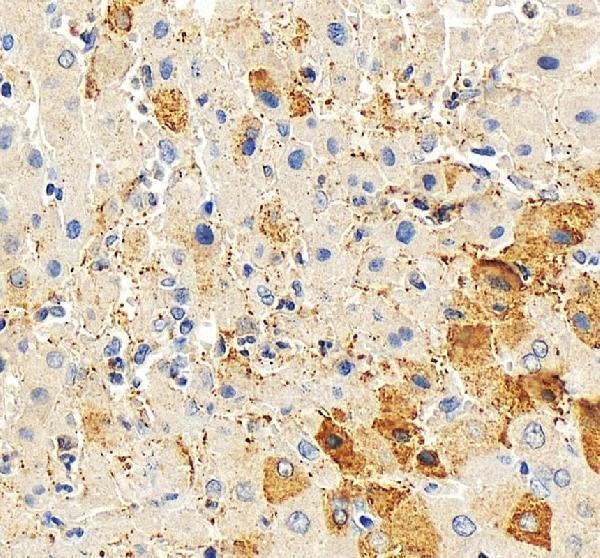
IHC analysis of Connexin-32/GJB1 using anti-Connexin-32/GJB1 antibody (PA1367).
Connexin-32/GJB1 was detected in a paraffin-embedded section of human liver tissue. Heat mediated antigen retrieval was performed in EDTA buffer (pH 8.0, epitope retrieval solution). The tissue section was blocked with 10% goat serum. The tissue section was then incubated with 2 μg/ml rabbit anti-Connexin-32/GJB1 Antibody (PA1367) overnight at 4°C. Peroxidase Conjugated Goat Anti-rabbit IgG was used as secondary antibody and incubated for 30 minutes at 37°C. The tissue section was developed using HRP Conjugated Rabbit IgG Super Vision Assay Kit (Catalog # SV0002) with DAB as the chromogen.
Click image to see more details
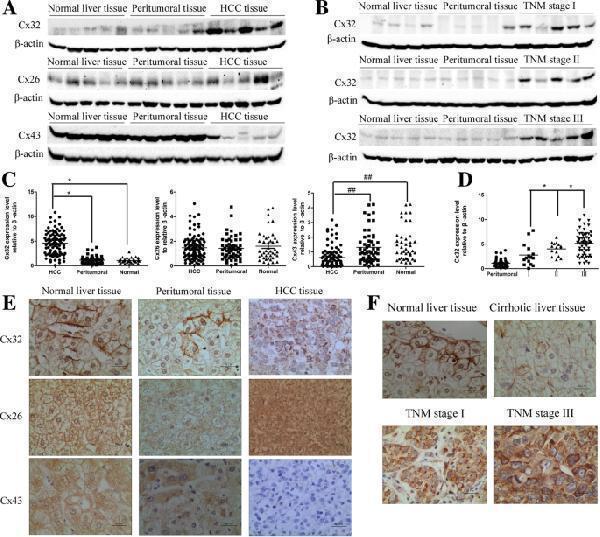
Expression and distribution of Cx32, Cx26 and Cx43 in patients with HCC. a. The protein expression levels of Cx32, Cx26 and Cx43 were determined by western blot analysis. β-actin was used as the loading control. b. The expression of Cx32 was correlated with increased TNM stages, as revealed by western blot analysis. β-actin was used as the loading control. c . Statistical analysis of the relative expression levels of Cxs in HCC tissues, peritumoral tissues, and normal liver tissues. ** , P < 0.01; ## , P < 0.01. d. Statistical analysis of the relative expression levels of Cx32 in peritumoral tissues and HCC tissues with different TNM stages. * , P < 0.05. e. Representative IHC staining of Cx32, Cx26 and Cx43 protein in normal liver tissues (left panels), peritumoral tissues (middle panels) and HCC tissues (right panels) (400×). Scale bars: 50 μm. f. Representative IHC staining of Cx32 in normal liver tissues, cirrhotic tissues and early and advanced HCC tissues (400×). Scale bars: 50 μm
Index in PubMed under a CC BY license. PMID: 30947731
Click image to see more details
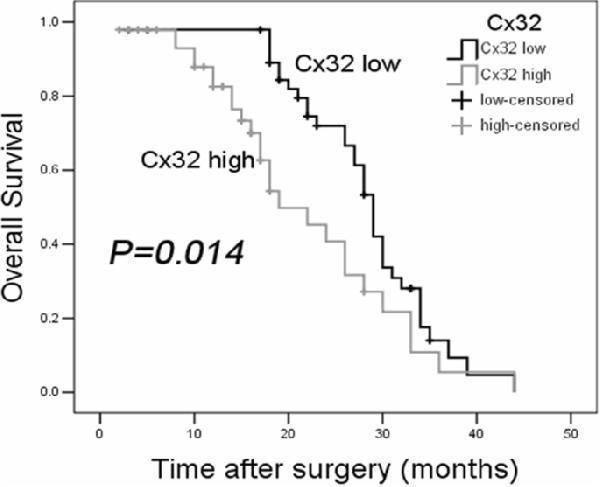
Kaplan-Meier analysis. Patients in the low Cx32 group ( n = 48) had significantly longer overall survival (OS) times than those in the high Cx32 group ( n = 48) ( P = 0.014, log-rank test)
Index in PubMed under a CC BY license. PMID: 30947731
Click image to see more details
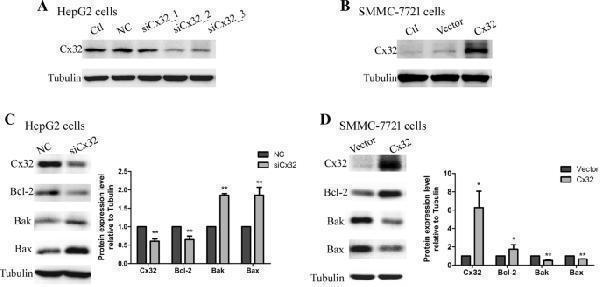
Cx32 regulates the expression of Bcl-2 family proteins in HCC cell lines. a. Cx32 expression was knocked down in HepG2 cells by siRNA transfection. siCx32_2 showed the greatest efficiency in reducing Cx32 expression. b. Transient plasmid transfection into SMMC-7721 cells induced Cx32 overexpression. c. Silencing Cx32 expression in HepG2 cells increased the expression levels of Bax and Bak but decreased the expression level of Bcl-2 ( n = 3). ** , P < 0.01 versus NC. d. Overexpression of Cx32 in SMMC-7721 cells caused the upregulation of Bcl-2 expression and the downregulation of Bax and Bak expression (n = 3). ** , P < 0.01 versus Vector
Index in PubMed under a CC BY license. PMID: 30947731
Click image to see more details
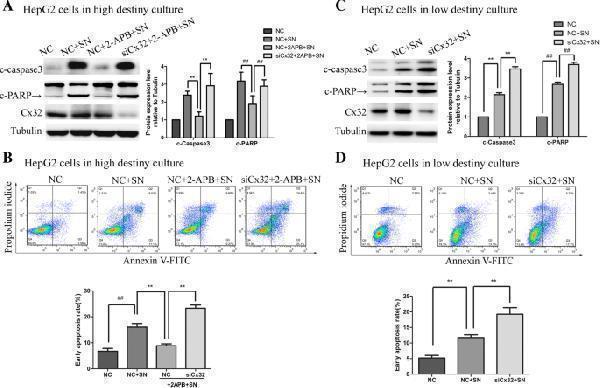
Cx32 exerts an anti-apoptotic effect on HepG2 cells in a GJ-independent manner. a. When GJ function was inhibited by pretreatment with 2-APB (50 μm, 2 h), knockdown of Cx32 promoted the SN-induced increase in the levels of cleaved-caspase3 and cleaved-PRAR in HepG2 cells, as revealed by western blot analysis (n = 3). ** , P < 0.01; ## , P < 0.01. b. Silencing the expression of Cx32 promoted SN-induced apoptosis in HepG2 cells when GJ function was inhibited by 2-APB, as assessed by flow cytometry (n = 3). ## , P < 0.01 versus NC; ** , P < 0.01 versus NC + 2-APB + SN. c. When GJs were physically eliminated by low-density culture conditions, Cx32 silencing enhanced the SN-induced increase in the levels of cleaved-caspase3 and cleaved-PARP in HepG2 cells, as revealed by western blot analysis (n = 3). ** , P < 0.01; ## , P < 0.01. d. Cx32 silencing facilitated SN-induced apoptosis in HepG2 cells in low-density culture, as assessed by flow cytometry (n = 3). ** , P < 0.01 versus NC + SN
Index in PubMed under a CC BY license. PMID: 30947731
Click image to see more details
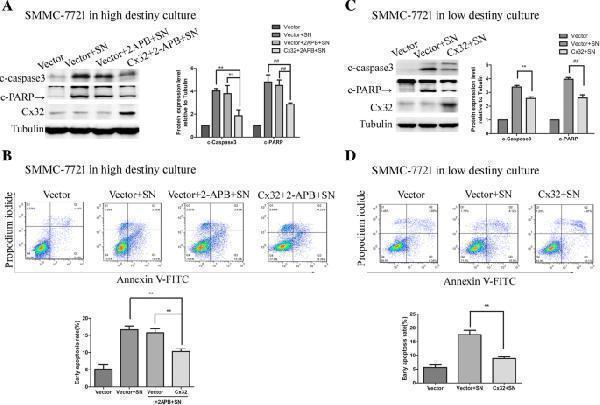
Overexpressed Cx32 exerts an anti-apoptotic effect on SMMC-7721 cells in a GJ-independent manner. a. When GJ function was inhibited by pretreatment with 2-APB, overexpression of Cx32 alleviated the SN-induced increase in the levels of cleaved-caspase3 and cleaved-PARP in SMMC-7721 cells, as revealed by western blot analysis (n = 3). ** , P < 0.01; ## , P < 0.01. b. Upregulation of Cx32 expression suppressed SN-induced apoptosis in SMMC-7721 cells when GJ function was inhibited by 2-APB, as revealed by flow cytometry ( n = 3). ** , P < 0.01 versus Cx32 + 2-APB + SN. c. When GJ were physically eliminated by low-density culture conditions, Cx32 overexpression reduced SN-induced increase in the levels of cleaved-caspase3 and cleaved-PARP in SMMC-7721 cells ( n = 3). ** , P < 0.01; ## , P < 0.01. d. Upregulation of Cx32 expression inhibited SN-induced apoptosis in SMMC-7721 cells in low-density culture, as revealed by flow cytometry ( n = 3). ** , P < 0.01 versus Cx32 + SN
Index in PubMed under a CC BY license. PMID: 30947731
Click image to see more details
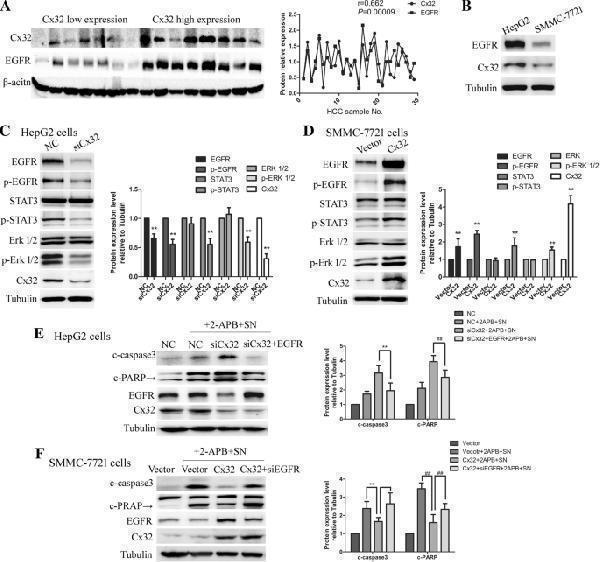
Cx32 exerts anti-apoptotic effects by activating EGFR signaling pathway. a. In 30 HCC specimens, the expression of EGFR was significantly correlated with the expression of Cx32 ( r = 0.662, P < 0.01) . b. The expression level of EGFR was significantly higher in HepG2 cells than in SMMC-7721 cells. c and d. The effects of Cx32 knockdown or overexpression on the EGFR signaling pathway in HepG2 cells and SMMC-7721 cells were determined by western blot analysis ( n = 3, respectively). ** , P < 0.01 versus HepG2 NC ( c ) or SMMC-7721 Vector ( d ). e . In rescue experiments, cotransfection of siRNA-Cx32 and EGFR-expression vectors into HepG2 cells reversed the pro-apoptotic effects of Cx32 knockdown. ** , P < 0.01; ## , P < 0.01. f. In rescue experiments, cotransfection of Cx32 expression vectors and siRNA-EGFR into SMMC-7721 cells reversed the anti-apoptotic effects of Cx32 overexpression. ** , P < 0.01; ## , P < 0.01
Index in PubMed under a CC BY license. PMID: 30947731
Click image to see more details
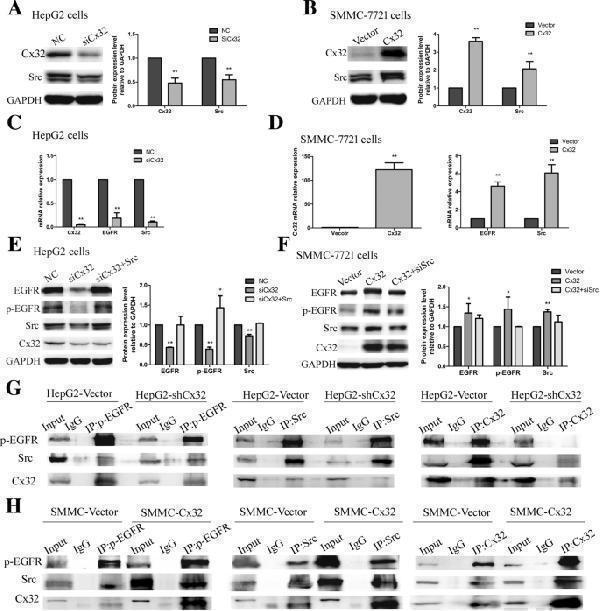
Cx32 upregulates the expression and activation of EGFR by binding with Src. a and b. In HCC cell lines, silencing or overexpressing Cx32 caused Src downregulation or upregulation, respectively. ** , P < 0.01 versus HepG2 NC ( a ) or SMMC-7721 Vector ( b ). c . Silencing Cx32 by siCx32 transfection caused a decrease in the EGFR and Src mRNA levels in HepG2 cells, as determined by qPCR. GAPDH was used as the loading control. ** , P < 0.01 versus NC. d . Overexpression of Cx32 in SMMC-7721 cells upregulated the mRNA levels of Cx32 (left panel), EGFR and Src (right panel), as determined by qPCR. GAPDH was used as the loading control. ** , P < 0.01 versus Vector. e . The decrease in the levels of EGFR, p-EGFR and Src mediated by siCx32 was reversed by cotransfection of the Src overexpression vector in HepG2 cells. ** , P < 0.01 versus NC. f. The increase in the levels of EGFR, p-EGFR and Src induced by Cx32 overexpression was rescued by cotransfection of siSrc in SMMC-7721 cells. ** , P < 0.01 versus Vector. g and h. Cx32, p-EGFR and Src interacted with each other, as detected by CO-IP experiments in HepG2 cells ( g ) and SMMC-7721 cells ( h ). Lysate supernatants incubated without antibody, termed Input, were used as the positive control, and proteins precipitated by IgG were used as the negative control
Index in PubMed under a CC BY license. PMID: 30947731
Click image to see more details
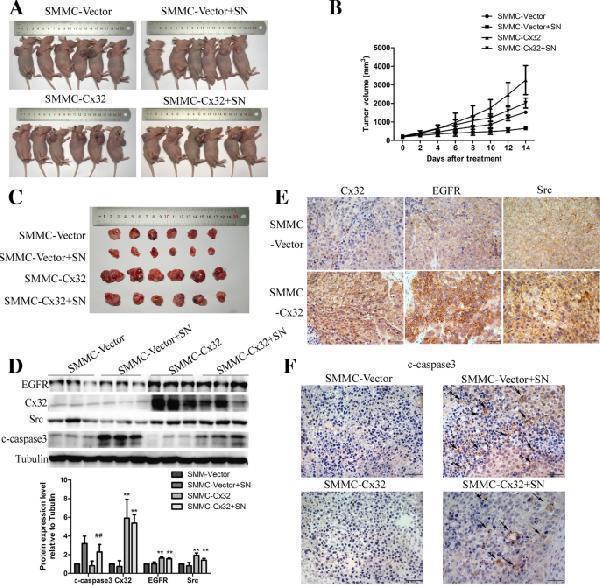
Overexpression of Cx32 promotes the proliferation of SMMC-7721 cells and protects cells from SN-induced apoptosis in vivo. a. Representative images of the nude xenograft model. b. Tumor growth curves. Overexpression of Cx32 promoted the tumor growth in nude mice and significantly reduced the growth suppression mediated by intragastric injection of SN (0.5 mg/kg). c. Representative images of tumors from the sacrificed nude mice. d. Representative images of IHC for Cx32, EGFR and Src in tumors generated from SMMC-Vector and SMMC-Cx32 cells. Scale bars: 50 μm. e. Overexpression of Cx32 inhibited the SN-induced increase in the levels of cleaved-caspase3 by increasing the levels of EGFR and Src. ## , P < 0.01 vs Vector +SN. ** , P < 0.01 versus Vector. f. Representative images of IHC for cleaved-caspase3 in each group. Overexpression of Cx32 inhibited the SN-induced increase in the level of cleaved-caspase3. Scale bars: 50 μm
Index in PubMed under a CC BY license. PMID: 30947731
Specific Publications For Anti-Connexin 32/GJB1 Antibody Picoband® (PA1367)
Loading publications
Recommended Resources
Here are featured tools and databases that you might find useful.
- Boster's Pathways Library
- Protein Databases
- Bioscience Research Protocol Resources
- Data Processing & Analysis Software
- Photo Editing Software
- Scientific Literature Resources
- Research Paper Management Tools
- Molecular Biology Software
- Primer Design Tools
- Bioinformatics Tools
- Phylogenetic Tree Analysis
Customer Reviews
Have you used Anti-Connexin 32/GJB1 Antibody Picoband®?
Share your experimental results or join a short interview to earn up to $1,000 in product credits or other rewards.
0 Reviews For Anti-Connexin 32/GJB1 Antibody Picoband®
Customer Q&As
Have a question?
Find answers in Q&As, reviews.
Can't find your answer?
Submit your question
4 Customer Q&As for Anti-Connexin 32/GJB1 Antibody Picoband®
Question
I am interested in to test anti-Connexin 32/GJB1 antibody PA1367 on human placenta skin for research purposes, then I may be interested in using anti-Connexin 32/GJB1 antibody PA1367 for diagnostic purposes as well. Is the antibody suitable for diagnostic purposes?
Verified Customer
Verified customer
Asked: 2019-12-11
Answer
The products we sell, including anti-Connexin 32/GJB1 antibody PA1367, are only intended for research use. They would not be suitable for use in diagnostic work. If you have the means to develop a product into diagnostic use, and are interested in collaborating with us and develop our product into an IVD product, please contact us for more discussions.
Boster Scientific Support
Answered: 2019-12-11
Question
I have a question about product PA1367, anti-Connexin 32/GJB1 antibody. I was wondering if it would be possible to conjugate this antibody with biotin. I would need it to be without BSA or sodium azide. I am planning on using a buffer exchange of sodium azide with PBS only. Would there be problems for me to conjugate the antibody and store it in -20 degrees in small aliquots?
Verified Customer
Verified customer
Asked: 2019-11-13
Answer
We do not recommend storing this antibody with PBS buffer only in -20 degrees. If you want to store it in -20 degrees it is best to add some cryoprotectant like glycerol. If you want carrier free PA1367 anti-Connexin 32/GJB1 antibody, we can provide it to you in a special formula with trehalose and/or glycerol. These molecules will not interfere with conjugation chemistry and provide a good level of protection for the antibody from degradation. Please be sure to specify this in your purchase order.
Boster Scientific Support
Answered: 2019-11-13
Question
I have attached the WB image, lot number and protocol we used for placenta skin using anti-Connexin 32/GJB1 antibody PA1367. Please let me know if you require anything else.
P. Yang
Verified customer
Asked: 2019-04-19
Answer
Thank you very much for the data. Our lab team are working to resolve this as quickly as possible, and we appreciate your patience and understanding! You have provided everything we needed. Please let me know if there is anything you need in the meantime.
Boster Scientific Support
Answered: 2019-04-19
Question
We are currently using anti-Connexin 32/GJB1 antibody PA1367 for mouse tissue, and we are well pleased with the WB results. The species of reactivity given in the datasheet says human, mouse, rat. Is it true that the antibody can work on primate tissues as well?
C. Banerjee
Verified customer
Asked: 2014-05-29
Answer
The anti-Connexin 32/GJB1 antibody (PA1367) has not been validated for cross reactivity specifically with primate tissues, though there is a good chance of cross reactivity. We have an innovator award program that if you test this antibody and show it works in primate you can get your next antibody for free. Please contact me if I can help you with anything.
Boster Scientific Support
Answered: 2014-05-29

