


Click image to see more details
-
-
-

-
-
+7
Product Info Summary
| SKU: | PB9427 |
|---|---|
| Size: | 100 μg/vial |
| Reactive Species: | Human, Mouse, Rat |
| Host: | Rabbit |
| Application: | WB |
Customers Who Bought This Also Bought

Product info
Product Name
Anti-Heparanase 1/HPSE Antibody Picoband®
SKU/Catalog Number
PB9427
PB0405 is an alternative SKU for this antibody, used in previous lots.
Size
100 μg/vial
Form
Lyophilized
Description
Boster Bio Anti-Heparanase 1/HPSE Antibody Picoband® catalog # PB9427. Tested in WB applications. This antibody reacts with Human, Mouse, Rat. The brand Picoband indicates this is a premium antibody that guarantees superior quality, high affinity, and strong signals with minimal background in Western blot applications. Only our best-performing antibodies are designated as Picoband, ensuring unmatched performance.
Storage & Handling
Store at -20˚C for one year from date of receipt. After reconstitution, at 4˚C for one month. It can also be aliquotted and stored frozen at -20˚C for six months. Avoid repeated freeze-thaw cycles.
Cite This Product
Anti-Heparanase 1/HPSE Antibody Picoband® (Boster Biological Technology, Pleasanton CA, USA, Catalog # PB9427)
Host
Rabbit
Contents
Each vial contains 4mg Trehalose, 0.9mg NaCl, 0.2mg Na2HPO4, 0.05mg NaN3.
Clonality
Polyclonal
Isotype
Rabbit IgG
Immunogen
A synthetic peptide corresponding to a sequence in the middle region of human Heparanase 1, different from the related mouse and rat sequences by eight amino acids.
Cross-reactivity
No cross-reactivity with other proteins
Reactive Species
PB9427 is reactive to HPSE in Human, Mouse, Rat
Observed Molecular Weight
61 kDa
Calculated molecular weight
61.1 kDa
Background of HPSE
Heparanase, also known as HPSE, is an enzyme that acts both at the cell-surface and within the extracellular matrix to degrade polymeric heparan sulfate molecules into shorter chain length oligosaccharides. Heparanase is an endo-beta-D-glucuronidase capable of cleaving heparan sulfate and has been implicated in inflammation and tumor angiogenesis and metastasis. The successful penetration of the endothelial cell layer that lines the interior surface of blood vessels is an important process in the formation of blood borne tumour metastases. Heparan sulfate proteoglycans are major constituents of this layer and it has been shown that increased metastatic potential corresponds with increased heparanase activity for a number of cell lines.
Antibody Validation
Boster validates all antibodies on WB, IHC, ICC, Immunofluorescence, and ELISA with known positive control and negative samples to ensure specificity and high affinity, including thorough antibody incubations.
Application & Images
Applications
PB9427 is guaranteed for WB Boster Guarantee
Recommend Dilution
| Application | Dilution | Species |
|---|---|---|
| Western blot | 0.1-0.5μg/ml | Human, Mouse, Rat |
Tested application
Suggested blocking solution with 5% non-fat milk or BSA; (*)Recommended protein loading: 20-40 µg per lane
Validation Images & Assay Conditions
Click image to see more details
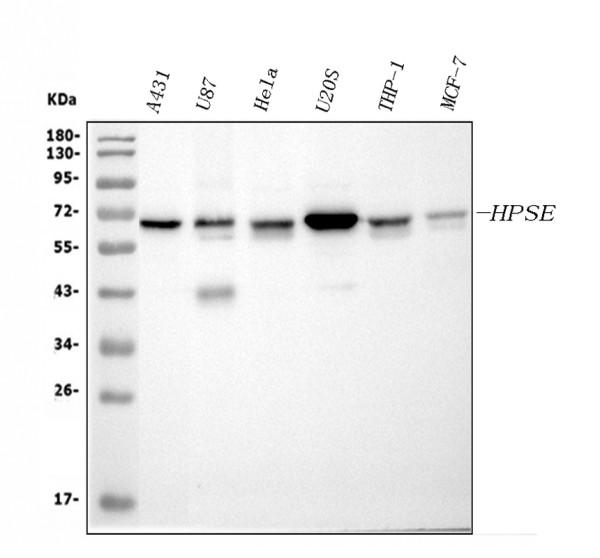
Western blot analysis of HPSE using anti-HPSE antibody (PB9427).
Electrophoresis was performed on a 10% SDS-PAGE gel at 80V (Stacking gel) / 120V (Resolving gel) for 2 hours. The sample well of each lane was loaded with 30 ug of sample under reducing conditions.
Lane 1: human A431 whole cell lysates,
Lane 2: human U87 whole cell lysates,
Lane 3: human Hela whole cell lysates,
Lane 4: human U2OS whole cell lysates,
Lane 5: human THP-1 whole cell lysates,
Lane 6: human MCF-7 whole cell lysates.
After electrophoresis, proteins were transferred to a nitrocellulose membrane at 150 mA for 50-90 minutes. Blocked the membrane with 5% non-fat milk/TBS for 1.5 hour at RT. The membrane was incubated with rabbit anti-HPSE antigen affinity purified polyclonal antibody (PB9427) at 0.5 μg/mL overnight at 4°C, then washed with TBS-0.1%Tween 3 times with 5 minutes each and probed with a goat anti-rabbit IgG-HRP secondary antibody (Catalog # BA1054) at a dilution of 1:5000 for 1.5 hour at RT. The signal is developed using an ECL Plus Western Blotting Substrate (Catalog # AR1196-200) with Tanon 5200 system. A specific band was detected for HPSE at approximately 61 kDa. The expected band size for HPSE is at 61 kDa.
Click image to see more details
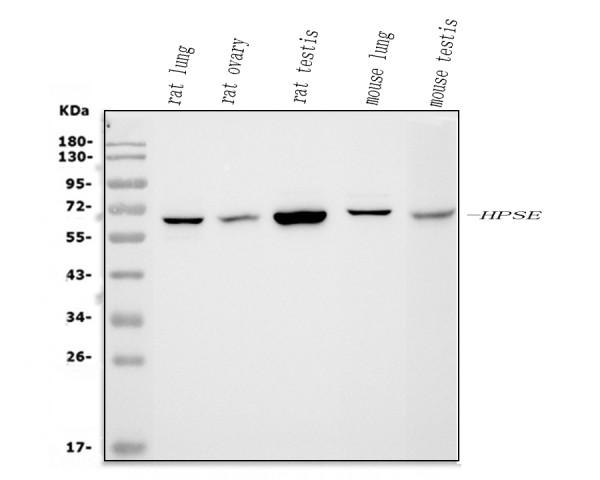
Western blot analysis of HPSE using anti-HPSE antibody (PB9427).
Electrophoresis was performed on a 10% SDS-PAGE gel at 80V (Stacking gel) / 120V (Resolving gel) for 2 hours. The sample well of each lane was loaded with 30 ug of sample under reducing conditions.
Lane 1: rat lung tissue lysates,
Lane 2: rat ovary tissue lysates,
Lane 3: rat testis tissue lysates,
Lane 4: mouse lung tissue lysates,
Lane 5: mouse testis tissue lysates.
After electrophoresis, proteins were transferred to a nitrocellulose membrane at 150 mA for 50-90 minutes. Blocked the membrane with 5% non-fat milk/TBS for 1.5 hour at RT. The membrane was incubated with rabbit anti-HPSE antigen affinity purified polyclonal antibody (PB9427) at 0.5 μg/mL overnight at 4°C, then washed with TBS-0.1%Tween 3 times with 5 minutes each and probed with a goat anti-rabbit IgG-HRP secondary antibody (Catalog # BA1054) at a dilution of 1:5000 for 1.5 hour at RT. The signal is developed using an ECL Plus Western Blotting Substrate (Catalog # AR1196-200) with Tanon 5200 system. A specific band was detected for HPSE at approximately 61 kDa. The expected band size for HPSE is at 61 kDa.
Click image to see more details
The expression of AKT protein in AGEs-induced macrophages. Cells were cultured with AGEs or pretreated with antibody against RAGE or HPA for 1 h before exposed to AGEs for 24 h. AKT and p-AKT protein expression is determined by Western blot analysis using anti-AKT and p-AKT antibody. The results represent the mean of six culture wells (mean ± SEM). * P < 0.05 compared to control and # P <0.05 compared to AGEs. All of the experiments were performed independently in triplicate.
Index in PubMed under a CC BY license. PMID: 23442498
Click image to see more details
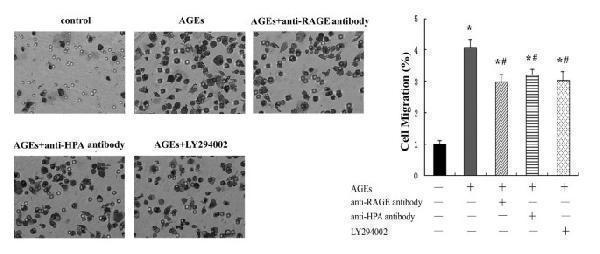
HPA, RAGE and PI3K/AKT pathway correlate with AGEs-induced macrophage migration. Cells were cultured with AGEs for 24 h with or without pre-treatment with LY294002, anti-HPA or RAGE antibody for 1 h. The migration was measured by transwell assays. Results were normalized to the number of macrophages that migrated in control group. The results represent the mean of six culture wells (mean ± SEM). *p < 0.05 compared to control and #p <0.05 compared to AGEs. All of the experiments were performed independently in triplicate.
Index in PubMed under a CC BY license. PMID: 23442498

Click image to see more details
AGEs up-regulates HPA mRNA, protein expression and secretion in macrophages via RAGE. Cells were cultured with AGEs for 24 h with or without pre-treatment with antibody against RAGE for 1 h. A , The levels of HPA mRNA were assessed with real time quantitative RT-PCR. B , The secretion of HPA in supernatant was measured by enzyme-linked immunosorbent assay (ELISA). C , The expression of HPA protein in macrophages was determined by Western blotting. The results represent the mean of six culture wells (mean ± SEM). *p < 0.05 compared to control and #p <0.05 compared to AGEs. All of the experiments were performed independently in triplicate.
Index in PubMed under a CC BY license. PMID: 23442498
Click image to see more details
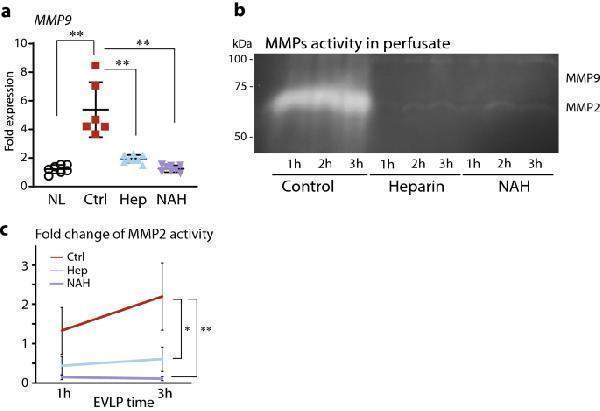
The effects of heparanase inhibition on MMP-2 and MMP-9 activity. ( a ) The mRNA expression of metalloprotease (MMP)-9 in lung grafts 2 h after transplantation. ( b ) Representative gelatin zymography of time-dependent changes in activity of secreted MMP-2 and MMP-9 in EVLP perfusate. Full length of gels and replications are shown in Supplemental Fig. . ( c ) MMP-2 activity quantitated and shown as fold change. *p < 0.05, **p < 0.01. NL native lungs, Ctrl control, Hep heparin, NAH N-acetyl heparin.
Index in PubMed under a CC BY license. PMID: 34112915

Click image to see more details
Viability analysis of Ana-1 macrophages after treatment with AGEs, LY294002, anti-RAGE or HPA antibody. Cell viability assay is performed using MTT assay. A , Cells (5 × 10 4 ) were treated with AGEs (0, 25, 50, 100, 200 and 400 mg/L) for 3, 6, 12, 24 h. B , Cells (5 × 10 4 ) were pretreated with LY294002 (7.5-120 μM) for 1 h before culture with 100 mg/L AGEs for 3, 6, 12, 24 h. C , Cells (5 × 10 4 ) were pretreated with anti-RAGE or HPA antibody for 1 h before culture with 100 mg/L AGEs for 3, 6, 12, 24 h. The results represent the mean of six culture wells (mean ± SEM). *p < 0.05, as compared to the control group. All of the experiments were performed independently in triplicate.
Index in PubMed under a CC BY license. PMID: 23442498
Click image to see more details
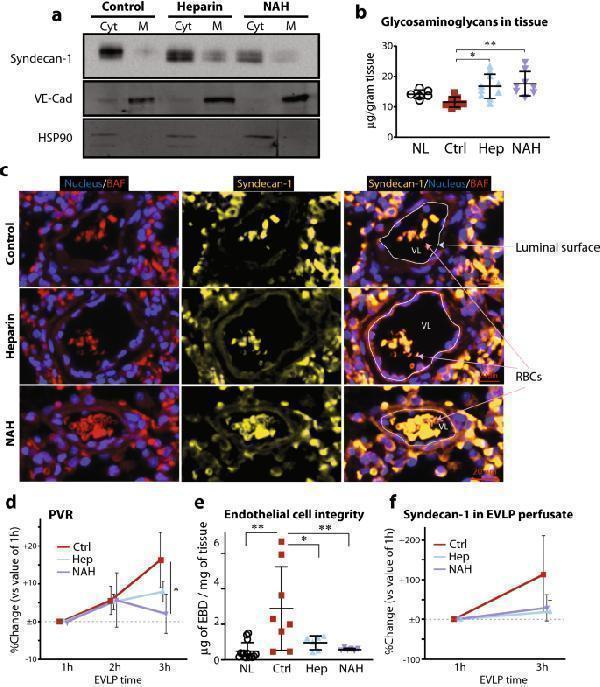
Assessment of endothelial glycocalyx and microvascular integrity in lung grafts after reperfusion. ( a ) Western blot of syendecan-1 in fractionated lung tissue 2 h after transplantation. Gel image depicts a single representative sample from each treatment group. Vascular endothelial cadherin (VE-Cad) and heat shock protein 90 (HSP90) were blotted as loading markers for the plasma membrane and cytosolic protein fractions, respectively. A full-length image of this blot and the blots showing multiple samples for each treatment group are shown in Supplemental Figs. – . Cyt cytosol protein fraction, M membrane protein fraction. ( b ) Glycosaminoglycan (GAG) content in the grafts 2 h after transplantation. ( c ) Syndecan-1 staining (yellow) in the peripheral vasculature (φ ~ 50 mm) of the grafts 2 h after transplantation. The endothelial luminal surface is indicated as a white line in the merged images (right column). Nuclei were stained using Hoechst 33342. BAF background autofluorescence, RBCs red blood cells, VL vascular lumen. ( d ) Pulmonary vascular resistance (PVR) of lung grafts during ex vivo lung perfusion (EVLP). Time-dependent fold changes from the values at 1 h are shown. n = 4–5 for each group. ( e ) Endothelial barrier integrity after EVLP was assessed by measuring the amount of Evans blue dye (EBD) retained in the tissue. ( f ) Time-dependent changes of syndecan-1 in the perfusate during EVLP. *p < 0.05, **p < 0.01. NL native lungs, Ctrl control lungs with eGC damage prior to transplant/EVLP, Hep lungs with eGC preserved by heparin treatment prior to transplant or EVLP, NAH lungs with eGC preserved by N-acetyl heparin treatment prior to transplant or EVLP.
Index in PubMed under a CC BY license. PMID: 34112915
Click image to see more details
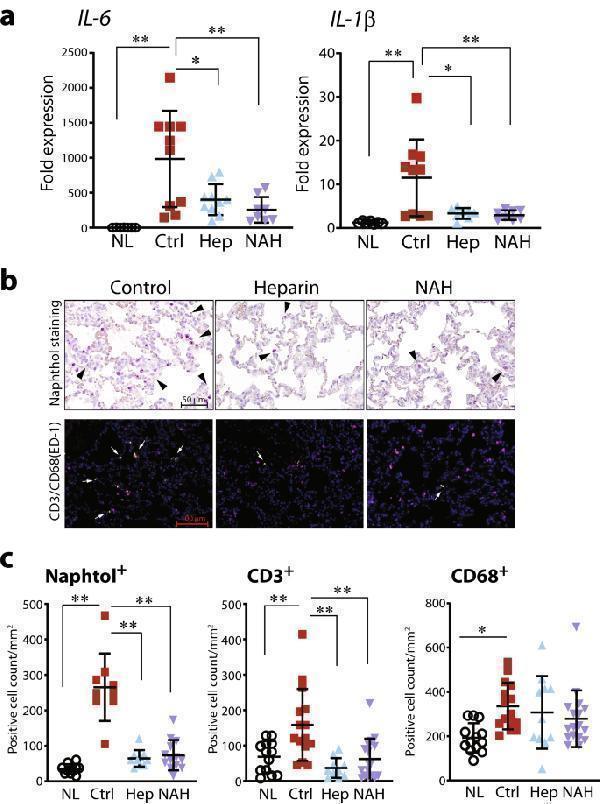
Endothelial glycocalyx influences the inflammation and inflammatory cell migration in lung grafts after transplantation. ( a ) Real-time RT-PCR for the mRNA of proinflammatory cytokines interleukin (IL)-6 and IL-1β . ( b ) The extravasation of neutrophils, T cells, and monocytes in the transplanted grafts were evaluated by specific staining of polymorphonuclear neutrophils (naphthol staining, positive cells indicated by black arrow heads), T cells (CD3 + -positive, indicated by white arrows) and macrophages (CD68 + -positive, purple staining), and ( c ) quantitated. *p < 0.05, **p < 0.01. NL native lungs, Ctrl control lungs with eGC damage prior to transplant, Hep lungs with eGC preserved by heparin prior to transplant, NAH lungs with eGC preserved by N-acetyl heparin prior to transplant.
Index in PubMed under a CC BY license. PMID: 34112915
Click image to see more details
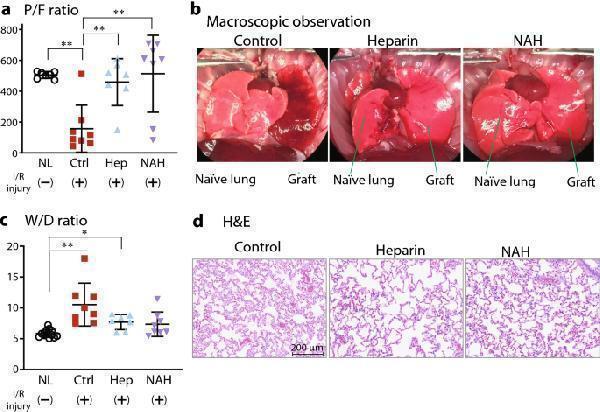
The effect of eGC damage in the lung grafts on the posttransplant graft function and quality. Grafts were evaluated 2 h after transplantation for ( a ) PaO2/FiO2 (P/F ratio), ( b ) macroscopic morphology (representative samples are shown), ( c ) Wet-to-dry (W/D) ratio, and ( d ) microscopic morphology (representative H&E stained samples are shown). *p < 0.05, **p < 0.01. NL native lungs, Ctrl control lungs with eGC damage prior to transplant, Hep lungs with eGC preserved by heparin prior to transplant, NAH lungs with eGC preserved by N-acetyl heparin prior to transplant, I/R injury ischemia reperfusion injury.
Index in PubMed under a CC BY license. PMID: 34112915
Click image to see more details
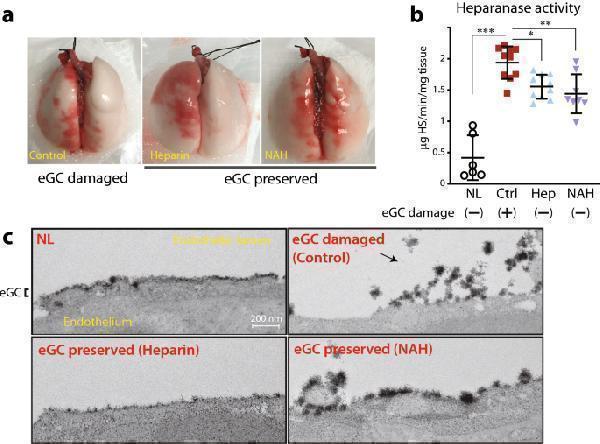
( a ) Representative images of rat lungs after procurement. ( b ) Heparanase activity was detected in tissue after procurement following 1 h of warm ischemia. ( c ) Ultrastructural images of the endothelial glycocalyx (eGC) from lung grafts after 1 h of warm ischemia obtained using transmission electron microscopy. The labeled glycocalyx appears as the darker cell surface layer; black arrow indicates glycocalyx desquamated from the surface of an endothelial cell. *p < 0.05, **p < 0.01. NL native lungs, Ctrl control lungs with eGC damage induced by 1 h of ischemia, Hep lungs with eGC preserved by heparin administration prior to 1 h of ischemia, NAH lungs with intact eGC preserved by N-acetyl heparin administration prior to 1 h of ischemia.
Index in PubMed under a CC BY license. PMID: 34112915
Specific Publications For Anti-Heparanase 1/HPSE Antibody Picoband® (PB9427)
Loading publications
Recommended Resources
Here are featured tools and databases that you might find useful.
- Boster's Pathways Library
- Protein Databases
- Bioscience Research Protocol Resources
- Data Processing & Analysis Software
- Photo Editing Software
- Scientific Literature Resources
- Research Paper Management Tools
- Molecular Biology Software
- Primer Design Tools
- Bioinformatics Tools
- Phylogenetic Tree Analysis
Customer Reviews
Have you used Anti-Heparanase 1/HPSE Antibody Picoband®?
Share your experimental results or join a short interview to earn up to $1,000 in product credits or other rewards.
0 Reviews For Anti-Heparanase 1/HPSE Antibody Picoband®
Customer Q&As
Have a question?
Find answers in Q&As, reviews.
Can't find your answer?
Submit your question
6 Customer Q&As for Anti-Heparanase 1/HPSE Antibody Picoband®
Question
Will anti-Heparanase 1/HPSE antibody PB9427 work for WB with kidney?
Verified Customer
Verified customer
Asked: 2020-04-24
Answer
According to the expression profile of kidney, HPSE is highly expressed in kidney. So, it is likely that anti-Heparanase 1/HPSE antibody PB9427 will work for WB with kidney.
Boster Scientific Support
Answered: 2020-04-24
Question
Is there a BSA free version of anti-Heparanase 1/HPSE antibody PB9427 available?
Verified Customer
Verified customer
Asked: 2020-02-03
Answer
Thanks for your recent telephone inquiry. I can confirm that some lots of this anti-Heparanase 1/HPSE antibody PB9427 are BSA free. For now, these lots are available and we can make a BSA free formula for you free of charge. It will take 3 extra days to prepare. If you require this antibody BSA free again in future, please do not hesitate to contact me and I will be pleased to check which lots we have in stock that are BSA free.
Boster Scientific Support
Answered: 2020-02-03
Question
Does PB9427 anti-Heparanase 1/HPSE antibody work on parafin embedded sections? If so, which fixation method do you recommend we use (PFA, paraformaldehyde, other)?
Verified Customer
Verified customer
Asked: 2019-08-08
Answer
As indicated on the product datasheet, PB9427 anti-Heparanase 1/HPSE antibody as been tested on WB. It is best to use PFA for fixation because it has better tissue penetration ability. PFA needs to be prepared fresh before use. Long term stored PFA turns into formalin, as the PFA molecules congregate and become formalin.
Boster Scientific Support
Answered: 2019-08-08
Question
We are currently using anti-Heparanase 1/HPSE antibody PB9427 for human tissue, and we are content with the WB results. The species of reactivity given in the datasheet says human, rat. Is it likely that the antibody can work on horse tissues as well?
J. Kulkarni
Verified customer
Asked: 2018-06-08
Answer
The anti-Heparanase 1/HPSE antibody (PB9427) has not been validated for cross reactivity specifically with horse tissues, but there is a good chance of cross reactivity. We have an innovator award program that if you test this antibody and show it works in horse you can get your next antibody for free. Please contact me if I can help you with anything.
Boster Scientific Support
Answered: 2018-06-08
Question
Thank you for helping with my inquiry over the phone. Here are the WB image, lot number and protocol we used for kidney using anti-Heparanase 1/HPSE antibody PB9427. Let me know if you need anything else.
N. Yang
Verified customer
Asked: 2018-04-19
Answer
Thank you for the data. You have provided everything we needed. Our lab team are working to resolve your inquiry as quickly as possible, and we appreciate your patience and understanding! Please let me know if there is anything you need in the meantime.
Boster Scientific Support
Answered: 2018-04-19
Question
Our lab want to know about to test anti-Heparanase 1/HPSE antibody PB9427 on rat kidney for research purposes, then I may be interested in using anti-Heparanase 1/HPSE antibody PB9427 for diagnostic purposes as well. Is the antibody suitable for diagnostic purposes?
Verified Customer
Verified customer
Asked: 2017-11-09
Answer
The products we sell, including anti-Heparanase 1/HPSE antibody PB9427, are only intended for research use. They would not be suitable for use in diagnostic work. If you have the means to develop a product into diagnostic use, and are interested in collaborating with us and develop our product into an IVD product, please contact us for more discussions.
Boster Scientific Support
Answered: 2017-11-09

