Product Info Summary
| SKU: | M00065 |
|---|---|
| Size: | 0.1 mg |
| Reactive Species: | Human, Primate |
| Host: | Mouse |
| Application: | Flow Cytometry, IP, IHC-F, ICC, WB |
Customers Who Bought This Also Bought
Product info
Product Name
Anti-Hu CD28 Purified Monoclonal Antibody
SKU/Catalog Number
M00065
Size
0.1 mg
Form
Liquid
Description
Boster Bio Anti-Hu CD28 Purified Monoclonal Antibody (Catalog# M00065). Tested in Flow Cytometry, IP, WB, IHC-F, ICC application(s). This antibody reacts with Primate, Human.
Storage & Handling
Store at 2-8°C. Do not freeze.
Cite This Product
Anti-Hu CD28 Purified Monoclonal Antibody (Boster Biological Technology, Pleasanton CA, USA, Catalog # M00065)
Host
Mouse
Contents
Phosphate buffered saline (PBS), pH 7.4, 15 mM sodium azide
Clonality
Monoclonal
Clone Number
CD28.2
Isotype
Mouse IgG1 kappa
Immunogen
DC28.1.3.3 murine T cell hybridoma transfected with human CD28 cDNA. The mouse monoclonal antibody CD28.2 recognizes an extracellular epitope of CD28, a disulfide-linked homodimeric type I glycoprotein (monomer of Mw 44 kDa) which is a critical costimulatory receptor of T cells.
Reactive Species
M00065 is reactive to CD28 in Human, Primate
Observed Molecular Weight
42 kDa
Calculated molecular weight
25.1 kDa
Background of CD28
CD28 is the critical T cell costimulatory receptor which provides to the cell the important second activation signal by binding CD80 and CD86 that are expressed by antigen presenting cells. Besides its costimulation role CD28 functions in preventing T cells from anergic hyporesponsive state or from undergoing premature apoptotic cell death. CD28 is also expressed on human fetal NK cells and some NK cell lines, whereas on murine NK cells the CD28 expression is much broader.
Antibody Validation
Boster validates all antibodies on WB, IHC, ICC, Immunofluorescence, and ELISA with known positive control and negative samples to ensure specificity and high affinity, including thorough antibody incubations.
Application & Images
Applications
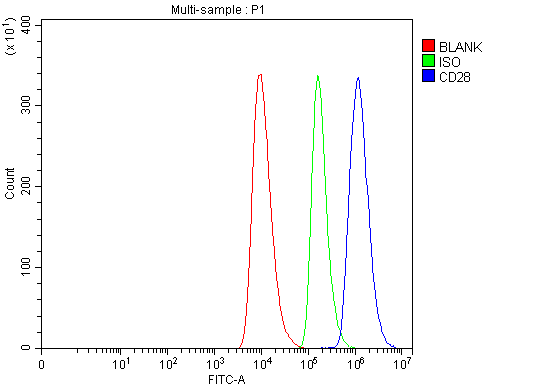
M00065 is guaranteed for Flow Cytometry, IP, IHC-F, ICC, WB Boster Guarantee
Assay Dilutions Recommendation
The recommendations below provide a starting point for assay optimization. The actual working concentration varies and should be decided by the user.
Flow cytometry: 1-12 µg/ml
Validation Images & Assay Conditions
Click image to see more details
Separation of human CD28 positive lymphocytes (red-filled) from neutrophil granulocytes (black-dashed) in flow cytometry analysis (surface staining) of human peripheral whole blood stained using anti-human CD28 (CD28.2) purified antibody (concentration in sample 1,6 µg/ml) GAM APC.
Click image to see more details
Flow cytometry surface staining pattern of human peripheral blood stained using anti-human CD28 (CD28.2) purified antibody (concentration in sample 1,6 µg/ml) GAM APC.
Click image to see more details
Western blotting analysis of human CD28 using mouse monoclonal antibody CD28.2 on lysates of Jurkat cells and THP1 cells (negative control) under reducing and non-reducing conditions. Nitrocellulose membrane was probed with 2 µg/ml of mouse monoclonal antibody followed by IRDye800-conjugated anti-mouse secondary antibody. CD28 was detected around 35-40 kDa.
Specific Publications For Anti-Hu CD28 Purified Monoclonal Antibody (M00065)
Loading publications
Recommended Resources
Here are featured tools and databases that you might find useful.
- Boster's Pathways Library
- Protein Databases
- Bioscience Research Protocol Resources
- Data Processing & Analysis Software
- Photo Editing Software
- Scientific Literature Resources
- Research Paper Management Tools
- Molecular Biology Software
- Primer Design Tools
- Bioinformatics Tools
- Phylogenetic Tree Analysis
Customer Reviews
Have you used Anti-Hu CD28 Purified Monoclonal Antibody?
Share your experimental results or join a short interview to earn up to $1,000 in product credits or other rewards.
0 Reviews For Anti-Hu CD28 Purified Monoclonal Antibody
Customer Q&As
Have a question?
Find answers in Q&As, reviews.
Can't find your answer?
Submit your question