



Click image to see more details
-
-
-
-
-
+5
Product Info Summary
| SKU: | A01309-1 |
|---|---|
| Size: | 100 μg/vial |
| Reactive Species: | Human, Mouse |
| Host: | Rabbit |
| Application: | ELISA, Flow Cytometry, WB |
Customers Who Bought This Also Bought

Product info
Product Name
Anti-KDM6B/JMJD3 Picoband® Antibody
SKU/Catalog Number
A01309-1
Size
100 μg/vial
Form
Lyophilized
Description
Boster Bio Anti-KDM6B/JMJD3 Picoband® Antibody catalog # A01309-1. Tested in ELISA, Flow Cytometry, WB applications. This antibody reacts with Human, Mouse. The brand Picoband indicates this is a premium antibody that guarantees superior quality, high affinity, and strong signals with minimal background in Western blot applications. Only our best-performing antibodies are designated as Picoband, ensuring unmatched performance.
Storage & Handling
Store at -20˚C for one year from date of receipt. After reconstitution, at 4˚C for one month. It can also be aliquotted and stored frozen at -20˚C for six months. Avoid repeated freeze-thaw cycles.
Cite This Product
Anti-KDM6B/JMJD3 Picoband® Antibody (Boster Biological Technology, Pleasanton CA, USA, Catalog # A01309-1)
Host
Rabbit
Contents
Each vial contains 4mg Trehalose, 0.9mg NaCl, 0.2mg Na2HPO4, 0.05mg NaN3.
Clonality
Polyclonal
Isotype
Rabbit IgG
Immunogen
E.coli-derived human KDM6B/JMJD3 recombinant protein (Position: R1127-R1643).
Cross-reactivity
No cross-reactivity with other proteins.
Reactive Species
A01309-1 is reactive to KDM6B in Human, Mouse
Observed Molecular Weight
177 kDa
Calculated molecular weight
176.6 kDa
Background of KDM6B
Lysine demethylase 6B is a protein that in humans is encoded by the KDM6B gene. It is mapped to 17p13.1. The protein encoded by this gene is a lysine-specific demethylase that specifically demethylates di- or tri-methylated lysine 27 of histone H3 (H3K27me2 or H3K27me3). H3K27 trimethylation is a repressive epigenetic mark controlling chromatin organization and gene silencing. This protein can also demethylate non-histone proteins such as retinoblastoma protein. Through its demethylation actvity this gene influences cellular differentiation and development, tumorigenesis, inflammatory diseases, and neurodegenerative diseases. This protein has two classical nuclear localization signals at its N-terminus. Alternative splicing results in multiple transcript variants encoding distinct isoforms.
Antibody Validation
Boster validates all antibodies on WB, IHC, ICC, Immunofluorescence, and ELISA with known positive control and negative samples to ensure specificity and high affinity, including thorough antibody incubations.
Application & Images
Applications
A01309-1 is guaranteed for ELISA, Flow Cytometry, WB Boster Guarantee
Recommend Dilution
| Application | Dilution | Species |
|---|---|---|
| Western blot | 0.25-0.5μg/ml | Human |
| Flow Cytometry (Fixed) | 1-3μg/1x106 cells | Human, Mouse |
| ELISA | 0.1-0.5μg/ml | - |
Note: For flow cytometry (FCM), validated for fixed cells only. Not validated for FACS or surface flow cytometry using live cells.
Tested application
Suggested blocking solution with 5% non-fat milk or BSA; (*)Recommended protein loading: 20-40 µg per lane
Validation Images & Assay Conditions
Click image to see more details
Western blot analysis of KDM6B using anti-KDM6B antibody (A01309-1).
Electrophoresis was performed on a 5-20% SDS-PAGE gel at 70V (Stacking gel) / 90V (Resolving gel) for 2-3 hours. The sample well of each lane was loaded with 50ug of sample under reducing conditions.
Lane 1: human K562 whole cell lysates,
Lane 2: human A375 whole cell lysates,
Lane 3: human HEK293 whole cell lysates,
Lane 4: human A431 whole cell lysates.
After Electrophoresis, proteins were transferred to a Nitrocellulose membrane at 150mA for 50-90 minutes. Blocked the membrane with 5% Non-fat Milk/ TBS for 1.5 hour at RT. The membrane was incubated with rabbit anti-KDM6B antigen affinity purified polyclonal antibody (Catalog # A01309-1) at 0.5 μg/mL overnight at 4°C, then washed with TBS-0.1%Tween 3 times with 5 minutes each and probed with a goat anti-rabbit IgG-HRP secondary antibody at a dilution of 1:5000 for 1.5 hour at RT. The signal is developed using an Enhanced Chemiluminescent detection (ECL) kit (Catalog # EK1002) with Tanon 5200 system. A specific band was detected for KDM6B at approximately 177KD. The expected band size for KDM6B is at 177KD.
Click image to see more details
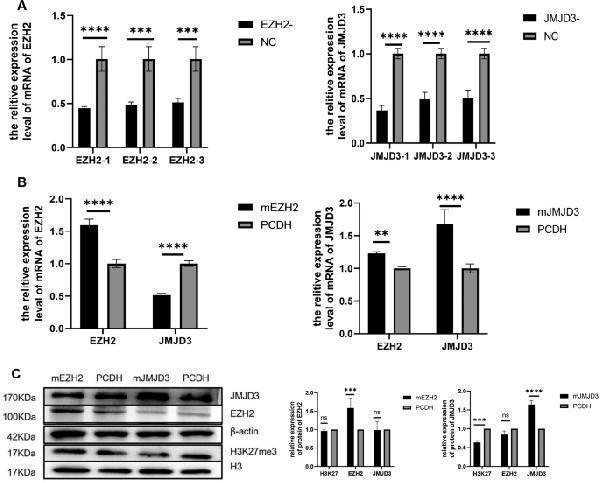
Expression levels of EZH2, JMJD3, H3K27me3 in spermatogonia. ( A ) qRT-PCR was used to detect the expression of EZH2 siRNA and JMJD3 siRNA in spermatogonia after interference. ( B ) measurements of EZH2 and JMJD3 mRNA levels in spermatogonia after overexpression. ( C ) The protein levels of EZH2, JMJD3 and H3K27me3 in spermatogonia were detected and statistically analyzed by Western blot. The membrane is lysed prior to hybridization with the antibody and the image has been cropped for a more aesthetically pleasing display. The full- length blots can be obtained from Additional file 2: Fig
Index in PubMed under a CC BY license. PMID: 38424516
Click image to see more details
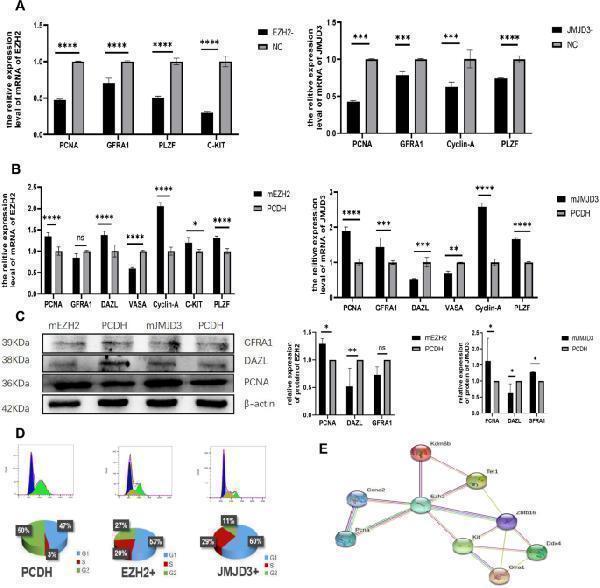
Effects of EZH2 interference or overexpression and JMJD3 interference or overexpression on self-renewal, proliferation and differentiation of spermatogonia. ( A ) The mRNA levels of PCNA, Cyclin-A, GFRA1, PLZF and C-KIT related to spermatogonia self-renewal and proliferation were changed after EZH2 and JMJD3 knockdown. ( B ) The expression of PCNA, cyclin-A, GFRA1, PLZF, C-KIT, DAZL and VASA was detected by qRT-PCR after EZH2 and JMJD3 overexpression. ( C ) The protein expression changes as well as statistical analysis of PCNA, DAZL and GFRA1 after EZH2 and JMJD3 overexpression. The membrane is lysed prior to hybridization with the antibody and the image has been cropped for a more aesthetically pleasing display. The full- length blots can be obtained from Additional file 2: Fig . ( D ) The cell cycle of EZH2 and JMJD3 overexpression cells was detected by flow cytometry. ( E ) Protein interaction network of EZH2, JMJD3 and spermatogonia self-renewal, proliferation and differentiation-related genes
Index in PubMed under a CC BY license. PMID: 38424516
Click image to see more details
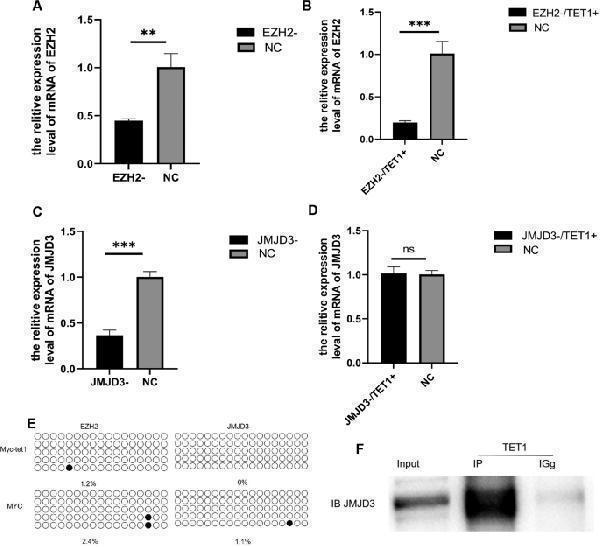
The manner in which EZH2, JMJD3 interacts with TET1 in spermatogonia. ( A ) The expression of EZH2 after EZH2 SiRNA in spermatogonia was detected by qRT-PCR. ( B ) qRT-PCR was used to detect the expression of EZH2 after co-transfection of EZH2 SiRNA and TET1 overexpression vector in spermatogonia. ( C ) The expression of JMJD3 in spermatogonia after JMJD3 SiRNA was detected by qRT-PCR. ( D ) qRT-PCR was used to detect the expression of JMJD3 after the co-transfection of JMJD3 SiRNA and TET1 overexpression vector in spermatogonia. ( E ) Bead plot of methylation sequencing results and methylation ratio after PCR amplification with primers designed for EZH2 and JMJD3(CpG-enriched region within the first 2000 bp of the promoter region), Filled circles represent methylated, empty circles represent unmethylated. ( F ) The JMJD3-TET1 protein interaction was detected by Co-IP technology. The membrane is lysed prior to hybridization with the antibody and the image has been cropped for a more aesthetically pleasing display. The full- length blots can be obtained from Additional file 2: Fig
Index in PubMed under a CC BY license. PMID: 38424516
Click image to see more details
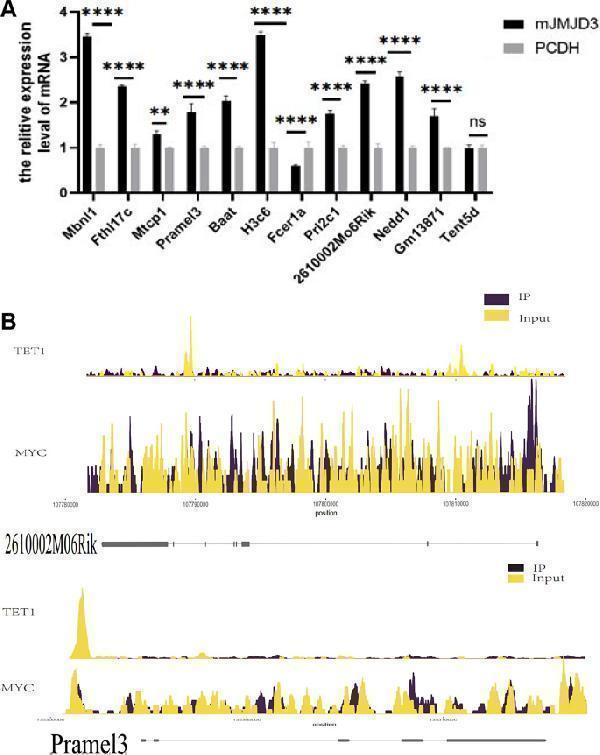
TET1 coordinates with H3K27me3 to target Pramel3 to promote its activation and expression. ( A ) qRT-PCR was used to detect the expression of genes enriched by Chip-seq after JMJD3 overexpression. ( B ) Peak plots of 2610002M06Rik and Pramel3 target genes obtained from TET1 overexpressing cells deposited with H3K27me3 antibody
Index in PubMed under a CC BY license. PMID: 38424516
Click image to see more details
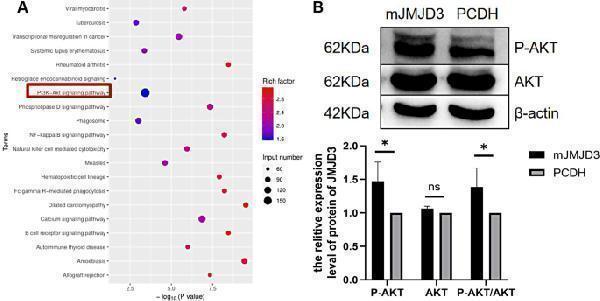
TET1-H3K27me3 regulated through PI3K-AKT pathway. ( A ) KEGG enrichment analysis. ( B ) Western blot was used to detect the protein expressions of AKT and P-AKT in the PI3K-AKT pathway after JMJD3 overexpression. The membrane is lysed prior to hybridization with the antibody and the image has been cropped for a more aesthetically pleasing display. The full- length blots can be obtained from Additional file 2: Fig.
Index in PubMed under a CC BY license. PMID: 38424516
Click image to see more details
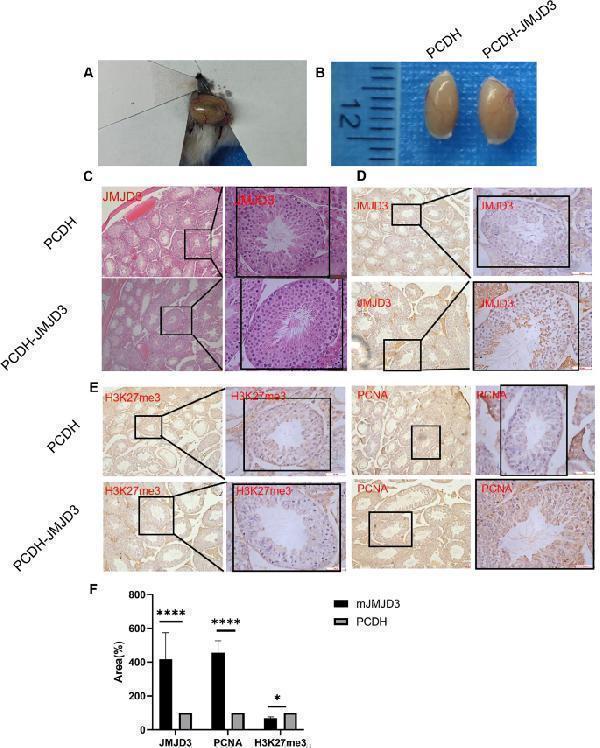
In vivo functional validation of JMJD3. ( A ) Spermatogenesis disorder model mice transplantation of control PCDH and JMJD3 Positive Cells. ( B ) Chart of comparison of control PCDH with testes transplanted with JMJD3 positive cells. ( C ) HE staining plot of JMJD3 overexpression versus control PCDH. ( D ) Expression of JMJD3 in testicular spermatogonia after overexpression of JMJD3. ( E ) Expression of H3K27me3 and PCNA in testicular spermatogonia after JMJD3 overexpression. ( F ) Statistical analysis of JMJD3 + cells/H3K27m3 + cells and PCNA + cells in immunohistochemistry. Scale bar = 50 μm. n = 3
Index in PubMed under a CC BY license. PMID: 38424516

Click image to see more details
Flow Cytometry analysis of K562 cells using anti-KDM6B antibody (A01309-1).
Overlay histogram showing K562 cells stained with A01309-1 (Blue line). To facilitate intracellular staining, cells were fixed with 4% paraformaldehyde and permeabilized with permeabilization buffer. The cells were blocked with 10% normal goat serum. And then incubated with rabbit anti-KDM6B Antibody (A01309-1, 1μg/1x106 cells) for 30 min at 20°C. DyLight®488 conjugated goat anti-rabbit IgG (BA1127, 5-10μg/1x106 cells) was used as secondary antibody for 30 minutes at 20°C. Isotype control antibody (Green line) was rabbit IgG (1μg/1x106) used under the same conditions. Unlabelled sample without incubation with primary antibody and secondary antibody (Red line) was used as a blank control.

Click image to see more details
Flow Cytometry analysis of HEPA1-6 cells using anti-KDM6B antibody (A01309-1).
Overlay histogram showing HEPA1-6 cells stained with A01309-1 (Blue line). To facilitate intracellular staining, cells were fixed with 4% paraformaldehyde and permeabilized with permeabilization buffer. The cells were blocked with 10% normal goat serum. And then incubated with rabbit anti-KDM6B Antibody (A01309-1, 1μg/1x106 cells) for 30 min at 20°C. DyLight®488 conjugated goat anti-rabbit IgG (BA1127, 5-10μg/1x106 cells) was used as secondary antibody for 30 minutes at 20°C. Isotype control antibody (Green line) was rabbit IgG (1μg/1x106) used under the same conditions. Unlabelled sample without incubation with primary antibody and secondary antibody (Red line) was used as a blank control.
Specific Publications For Anti-KDM6B/JMJD3 Picoband® Antibody (A01309-1)
Loading publications
Recommended Resources
Here are featured tools and databases that you might find useful.
- Boster's Pathways Library
- Protein Databases
- Bioscience Research Protocol Resources
- Data Processing & Analysis Software
- Photo Editing Software
- Scientific Literature Resources
- Research Paper Management Tools
- Molecular Biology Software
- Primer Design Tools
- Bioinformatics Tools
- Phylogenetic Tree Analysis
Customer Reviews
Have you used Anti-KDM6B/JMJD3 Picoband® Antibody?
Share your experimental results or join a short interview to earn up to $1,000 in product credits or other rewards.
0 Reviews For Anti-KDM6B/JMJD3 Picoband® Antibody
Customer Q&As
Have a question?
Find answers in Q&As, reviews.
Can't find your answer?
Submit your question

