

Click image to see more details
-

-
-
-
-
+2
Product Info Summary
| SKU: | M03989-1 |
|---|---|
| Size: | 0.1 mg |
| Reactive Species: | Dog, Human, Mouse, Pig, Rat, Nicotiana |
| Host: | Mouse |
| Application: | ELISA, IP, IHC-P, ICC, WB |
Customers Who Bought This Also Bought

Product info
Product Name
Anti-alpha-Tubulin Purified TUBA1A Monoclonal Antibody
SKU/Catalog Number
M03989-1
Size
0.1 mg
Form
Liquid
Description
Boster Bio Anti-alpha-Tubulin Purified TUBA1A Monoclonal Antibody (Catalog# M03989-1). Tested in IP, WB, IHC-P, ICC, ELISA application(s). This antibody reacts with Mouse, Rat, Pig, Nicotiana, Human, Dog.
Storage & Handling
Store at 2-8°C. Do not freeze.
Cite This Product
Anti-alpha-Tubulin Purified TUBA1A Monoclonal Antibody (Boster Biological Technology, Pleasanton CA, USA, Catalog # M03989-1)
Host
Mouse
Contents
Tris buffered saline (TBS), pH 8.0, 15 mM sodium azide
Clonality
Monoclonal
Clone Number
TU-16
Isotype
Mouse IgM
Immunogen
Porcine brain microtubule protein MTP-1. The antibody TU-16 reacts with alpha-tubulin of all tested species, under denaturing and non-denaturing conditions.
Cross-reactivity
This antibody does not cross-react with Thy-1.1 alloantigen.
Reactive Species
M03989-1 is reactive to TUBA1 in Dog, Human, Mouse, Pig, Rat, Nicotiana
Observed Molecular Weight
42 kDa
Calculated molecular weight
50.1 kDa
Background of TUBA1
The microtubules are intracellular dynamic polymers made up of evolutionarily conserved polymorphic alpha/beta-tubulin heterodimers and a large number of microtubule-associated proteins (MAPs). The microtubules consist of 13 protofilaments and have an outer diameter 25 nm. Microtubules have their intrinsic polarity; highly dynamic plus ends and less dynamic minus ends. Microtubules are required for vital processes in eukaryotic cells including mitosis, meiosis, maintenance of cell shape and intracellular transport. Microtubules are also necessary for movement of cells by means of flagella and cilia. In mammalian tissue culture cells microtubules have their minus ends anchored in microtubule organizing centers (MTOCs). The GTP (guanosintriphosphate) molecule is an essential for tubulin heterodimer to associate with other heterodimers to form microtubule. In vivo, microtubule dynamics vary considerably. Microtubule polymerization is reversible and a populations of microtubules in cells are on their minus ends either growing or shortening –; this phenomenon is called dynamic instability of microtubules. On a practical level, microtubules can easily be stabilized by the addition of non-hydrolysable analogues of GTP (eg. GMPPCP) or more commonly by anti-cancer drugs such as Taxol. Taxol stabilizes microtubules at room temperature for many hours. Using limited proteolysis by enzymes both tubulin subunits can be divided into N-terminal and C-terminal structural domains. The alpha-tubulin (relative molecular weight around 50 kDa) is globular protein that exists in cells as part of soluble alpha/beta-tubulin dimer or it is polymerized into microtubules. In different species it is coded by multiple tubulin genes that form tubulin classes (in human 6 genes). Expressed tubulin genes are named tubulin isotypes. Some of the tubulin isotypes are expressed ubiquitously, while some have more restricted tissue expression. Alpha-tubulin is also subject of numerous post-translational modifications. Tubulin isotypes and their posttranslational modifications are responsible for multiple tubulin charge variants - tubulin isoforms. Heterogeneity of alpha-tubulin is concentrated in C-terminal structural domain.
Antibody Validation
Boster validates all antibodies on WB, IHC, ICC, Immunofluorescence, and ELISA with known positive control and negative samples to ensure specificity and high affinity, including thorough antibody incubations.
Application & Images
Applications
M03989-1 is guaranteed for ELISA, IP, IHC-P, ICC, WB Boster Guarantee
Recommend Dilution
| Application | Dilution | Species |
|---|---|---|
| Western blotting: 1-2 μg/ml. This antibody can be used for Western blotting | but its alternative TU-02 (11-447-C100) gives better signal in this application. |
Validation Images & Assay Conditions
Click image to see more details
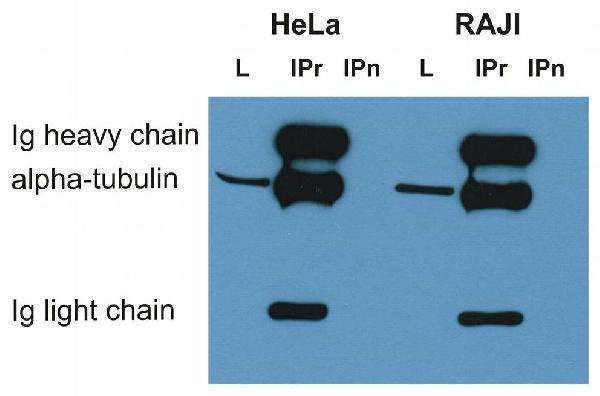
Immunoprecipitation of alpha-tubulin from HeLa and RAJI cell lysate by antibody TU-16 and its detection by antibody TU-01. IgM heavy chain (76-92 kDa) and IgM light chain (25-30 kDa) indicated. Mr of alpha tubulin is around 50 kDa.
L = lysate
IPr = immunoprecipitate (reducing conditions)
Click image to see more details
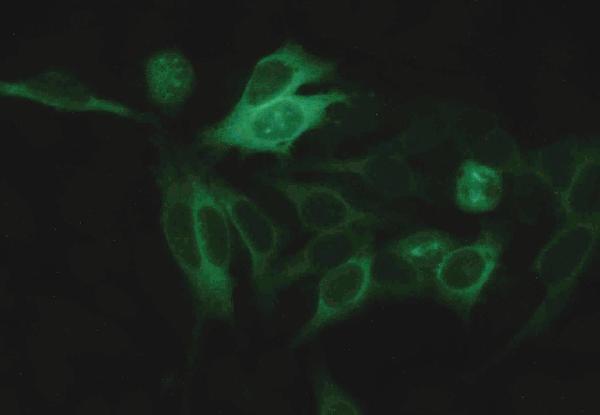
Immunocytochemistry staining of alpha-tubulin in Hep-2 cells using mouse monoclonal antibody TU-16 (diluted 1:400), detected with GAM IgG-Alexa Fluor®488 (diluted 1:200; green).
Click image to see more details
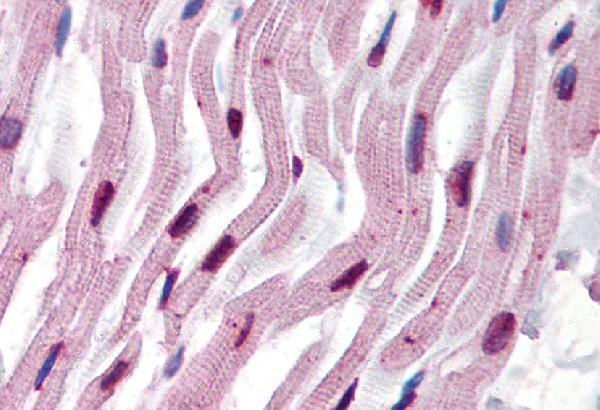
Immunohistochemistry staining of human heart (paraffin sections) using anti-alpha tubulin (TU-16). Commercially tested by LifeSpan BioSciences.
Click image to see more details
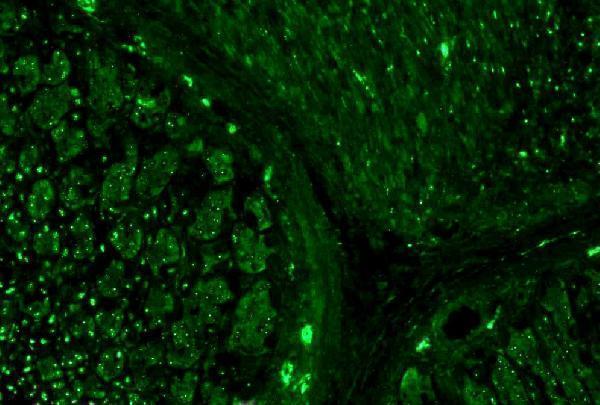
Immunohistochemistry staining (paraffin sections) of alpha-tubulin in human stomach using mouse monoclonal antibody TU-16 (diluted 1:400), detected with GAM IgG-Alexa Fluor®488 (diluted 1:200; green).
Click image to see more details
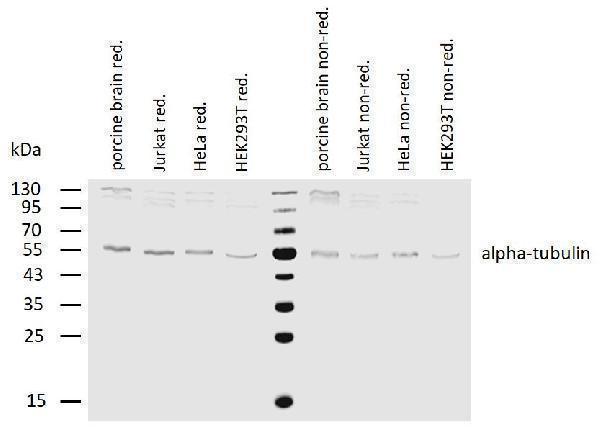
Western blotting analysis of human alpha-tubulin using mouse monoclonal antibody TU-16 on lysates of various cell lines and porcine brain under reducing and non-reducing conditions. Nitrocellulose membrane was probed with 2 µg/ml of mouse anti-alpha-tubulin monoclonal antibody followed by IRDye800-conjugated anti-mouse secondary antibody. A specific band was detected for alpha-tubulin at approximately 54 kDa, nonspecific minor bands above 100 kDa do not interfere with specific signal.
Click image to see more details
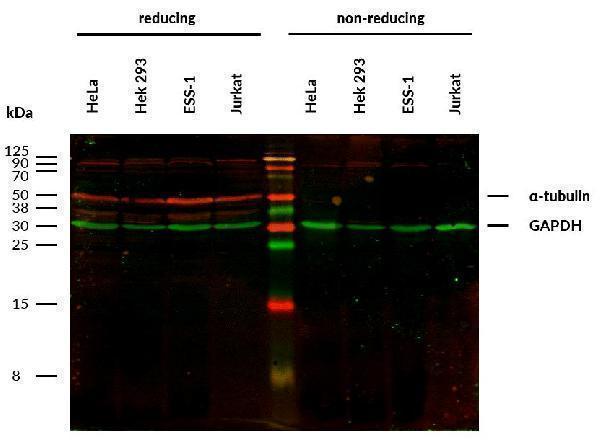
Anti-alpha-Tubulin Purified (TU-16) works in WB application under reducing conditions.
Western blotting analysis was performed on whole cell extracts (RIPA lysis buffer) of HeLa, HEK 293, ESS-1 and Jurkat cell lines mixed and heated (100°C, 5 min) with reducing (2-mercaptoethanol) or non-reducing SDS-loading buffer. Samples were resolved using 12% SDS-PAGE gel.
Nitrocellulose membrane blot was probed simultaneously with mouse IgM monoclonal antibody TU-16 (1 µg/ml) and mouse IgG1 anti-GAPDH monoclonal antibody FF26A (1 µg/ml) used as the loading control. Subclass-specific secondary antibodies IRDye 680RD Goat-anti-Mouse IgM (red) and IRDye 800CW Goat-anti-Mouse IgG (green) were used for multiplex fluorescent Western blot detection.
Alpha-tubulin was detected at ~50 kDa in all tested cell lines.
Specific Publications For Anti-alpha-Tubulin Purified TUBA1A Monoclonal Antibody (M03989-1)
Loading publications
Recommended Resources
Here are featured tools and databases that you might find useful.
- Boster's Pathways Library
- Protein Databases
- Bioscience Research Protocol Resources
- Data Processing & Analysis Software
- Photo Editing Software
- Scientific Literature Resources
- Research Paper Management Tools
- Molecular Biology Software
- Primer Design Tools
- Bioinformatics Tools
- Phylogenetic Tree Analysis
Customer Reviews
Have you used Anti-alpha-Tubulin Purified TUBA1A Monoclonal Antibody?
Share your experimental results or join a short interview to earn up to $1,000 in product credits or other rewards.
0 Reviews For Anti-alpha-Tubulin Purified TUBA1A Monoclonal Antibody
Customer Q&As
Have a question?
Find answers in Q&As, reviews.
Can't find your answer?
Submit your question

