


Click image to see more details
Product Info Summary
| SKU: | A01768-1 |
|---|---|
| Size: | 100 μg/vial |
| Reactive Species: | Human, Monkey, Mouse |
| Host: | Rabbit |
| Application: | WB |
Customers Who Bought This Also Bought

Product info
Product Name
Anti-Apg3/ATG3 Antibody Picoband®
SKU/Catalog Number
A01768-1
Size
100 μg/vial
Form
Lyophilized
Description
ATG3 is an E2-like enzyme in the ubiquitin-like ATG8/LC3 conjugation cascade that transfers LC3 from ATG7 and supports LC3 lipidation (autophagosome biogenesis; autophagy/mitophagy/nucleophagy). Assay context: WB using A01768-1 to track ATG3 abundance/processing alongside LC3 conversion readouts, often aligned to controlled lysis/normalization practices in Western blotting. Frequently interpreted with cellular energy-stress signaling nodes (e.g., AMPK axis) such as AMPK beta 1 (PRKAB1) when mapping autophagy induction states.
Storage & Handling
Store at -20˚C for one year from date of receipt. After reconstitution, at 4˚C for one month. It can also be aliquotted and stored frozen at -20˚C for six months. Avoid repeated freeze-thaw cycles.
Cite This Product
Anti-Apg3/ATG3 Antibody Picoband® (Boster Biological Technology, Pleasanton CA, USA, Catalog # A01768-1)
Host
Rabbit
Contents
Each vial contains 4 mg Trehalose, 0.9 mg NaCl and 0.2 mg Na2HPO4.
Clonality
Polyclonal
Isotype
Rabbit IgG
Immunogen
E.coli-derived human Apg3 recombinant protein (Position: M1-T244). Human Apg3 shares 96.7% and 96.3% amino acid (aa) sequence identity with mouse and rat Apg3, respectively.
Cross-reactivity
No cross-reactivity with other proteins.
Reactive Species
A01768-1 is reactive to ATG3 in Human, Monkey, Mouse
Observed Molecular Weight
36-40 kDa
Calculated molecular weight
35.9 kDa
Background of ATG3
This ATG3 gene encodes a ubiquitin-like-conjugating enzyme and is a component of ubiquitination-like systems involved in autophagy, the process of degradation, turnover and recycling of cytoplasmic constituents in eukaryotic cells. And the protein is known to play a role in regulation of autophagy during cell death. A pseudogene of this gene is located on chromosome 20. Alternative splicing results in multiple transcript variants encoding different isoforms.
Antibody Validation
Boster validates all antibodies on WB, IHC, ICC, Immunofluorescence, and ELISA with known positive control and negative samples to ensure specificity and high affinity, including thorough antibody incubations.
Application & Images
Applications
A01768-1 is guaranteed for WB Boster Guarantee
Assay Dilutions Recommendation
The recommendations below provide a starting point for assay optimization. The actual working concentration varies and should be decided by the user.
Western blot, 0.1-0.5μg/ml, Human, Monkey, Mouse
Positive Control
WB: human K562 whole cell, human Raji whole cell, monkey COS-7 whole cell, human Hela whole cell, mouse NIH/3T3 whole cell
Validation Images & Assay Conditions
Click image to see more details
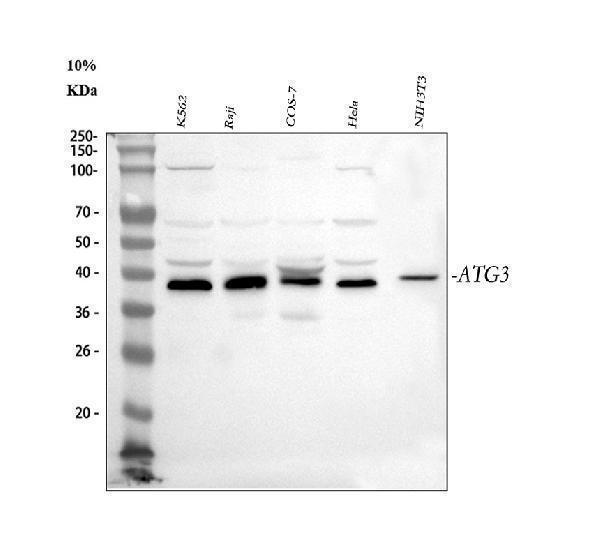
Western blot analysis of Apg3 using anti-Apg3 antibody (A01768-1).
Electrophoresis was performed on a 5-20% SDS-PAGE gel at 70V (Stacking gel) / 90V (Resolving gel) for 2-3 hours. The sample well of each lane was loaded with 30 ug of sample under reducing conditions.
Lane 1: human K562 whole cell lysates,
Lane 2: human Raji whole cell lysates,
Lane 3: monkey COS-7 whole cell lysates,
Lane 4: human Hela whole cell lysates,
Lane 5: mouse NIH/3T3 whole cell lysates.
After electrophoresis, proteins were transferred to a nitrocellulose membrane at 150 mA for 50-90 minutes. Blocked the membrane with 5% non-fat milk/TBS for 1.5 hour at RT. The membrane was incubated with rabbit anti-Apg3 antigen affinity purified polyclonal antibody (Catalog # A01768-1) at 0.25 μg/mL overnight at 4°C, then washed with TBS-0.1%Tween 3 times with 5 minutes each and probed with a goat anti-rabbit IgG-HRP secondary antibody at a dilution of 1:5000 for 1.5 hour at RT. The signal is developed using an Enhanced Chemiluminescent detection (ECL) kit (Catalog # EK1002) with Tanon 5200 system. A specific band was detected for Apg3 at approximately 36-40 kDa. The expected band size for Apg3 is at 36 kDa.
Specific Publications For Anti-Apg3/ATG3 Antibody Picoband® (A01768-1)
Loading publications
Recommended Resources
Here are featured tools and databases that you might find useful.
- Boster's Pathways Library
- Protein Databases
- Bioscience Research Protocol Resources
- Data Processing & Analysis Software
- Photo Editing Software
- Scientific Literature Resources
- Research Paper Management Tools
- Molecular Biology Software
- Primer Design Tools
- Bioinformatics Tools
- Phylogenetic Tree Analysis
Customer Reviews
Have you used Anti-Apg3/ATG3 Antibody Picoband®?
Share your experimental results or join a short interview to earn up to $1,000 in product credits or other rewards.
0 Reviews For Anti-Apg3/ATG3 Antibody Picoband®
Customer Q&As
Have a question?
Find answers in Q&As, reviews.
Can't find your answer?
Submit your question
5 Customer Q&As for Anti-Apg3/ATG3 Antibody Picoband®
Question
Is a blocking peptide available for product anti-Apg3/ATG3 antibody (A01768-1)?
Verified Customer
Verified customer
Asked: 2020-03-31
Answer
We do provide the blocking peptide for product anti-Apg3/ATG3 antibody (A01768-1). If you would like to place an order for it please contact support@bosterbio.com and make a special request.
Boster Scientific Support
Answered: 2020-03-31
Question
Do you have a BSA free version of anti-Apg3/ATG3 antibody A01768-1 available?
Verified Customer
Verified customer
Asked: 2019-10-28
Answer
We appreciate your recent telephone inquiry. I can confirm that some lots of this anti-Apg3/ATG3 antibody A01768-1 are BSA free. For now, these lots are available and we can make a BSA free formula for you free of charge. It will take 3 extra days to prepare. If you require this antibody BSA free again in future, please do not hesitate to contact me and I will be pleased to check which lots we have in stock that are BSA free.
Boster Scientific Support
Answered: 2019-10-28
Question
We are currently using anti-Apg3/ATG3 antibody A01768-1 for human tissue, and we are content with the WB results. The species of reactivity given in the datasheet says human. Is it true that the antibody can work on goat tissues as well?
Verified Customer
Verified customer
Asked: 2019-08-12
Answer
The anti-Apg3/ATG3 antibody (A01768-1) has not been tested for cross reactivity specifically with goat tissues, though there is a good chance of cross reactivity. We have an innovator award program that if you test this antibody and show it works in goat you can get your next antibody for free. Please contact me if I can help you with anything.
Boster Scientific Support
Answered: 2019-08-12
Question
I have a question about product A01768-1, anti-Apg3/ATG3 antibody. I was wondering if it would be possible to conjugate this antibody with biotin. I would need it to be without BSA or sodium azide. I am planning on using a buffer exchange of sodium azide with PBS only. Would there be problems for me to conjugate the antibody and store it in -20 degrees in small aliquots?
Verified Customer
Verified customer
Asked: 2019-07-26
Answer
We do not advise storing this antibody with PBS buffer only in -20 degrees. If you want to store it in -20 degrees it is best to add some cryoprotectant like glycerol. If you want carrier free A01768-1 anti-Apg3/ATG3 antibody, we can provide it to you in a special formula with trehalose and/or glycerol. These molecules will not interfere with conjugation chemistry and provide a good level of protection for the antibody from degradation. Please be sure to specify this in your purchase order.
Boster Scientific Support
Answered: 2019-07-26
Question
See below the WB image, lot number and protocol we used for lung lymph using anti-Apg3/ATG3 antibody A01768-1. Please let me know if you require anything else.
N. Parker
Verified customer
Asked: 2018-08-20
Answer
Thank you very much for the data. Our lab team are working to resolve this as quickly as possible, and we appreciate your patience and understanding! You have provided everything we needed. Please let me know if there is anything you need in the meantime.
Boster Scientific Support
Answered: 2018-08-20

