Product Info Summary
| SKU: | PA1669 |
|---|---|
| Size: | 100 μg/vial |
| Reactive Species: | Human, Mouse, Rat |
| Host: | Rabbit |
| Application: | IF, IHC, ICC, WB |
Customers Who Bought This Also Bought
Product info
Product Name
Anti-NF-kB p65/RELA Antibody Picoband®
SKU/Catalog Number
PA1669
BA0610 is an alternative SKU for this antibody, used in previous lots.
Size
100 μg/vial
Form
Lyophilized
Description
Boster Bio Anti-NF-kB p65/RELA Antibody catalog # PA1669. Tested in IF, IHC, ICC, WB applications. This antibody reacts with Human, Mouse, Rat. The brand Picoband indicates this is a premium antibody that guarantees superior quality, high affinity, and strong signals with minimal background in Western blot applications. Only our best-performing antibodies are designated as Picoband, ensuring unmatched performance.
Storage & Handling
Store at -20˚C for one year from date of receipt. After reconstitution, at 4˚C for one month. It can also be aliquotted and stored frozen at -20˚C for six months. Avoid repeated freeze-thaw cycles.
Cite This Product
Anti-NF-kB p65/RELA Antibody Picoband® (Boster Biological Technology, Pleasanton CA, USA, Catalog # PA1669)
Host
Rabbit
Contents
Each vial contains 4 mg Trehalose, 0.9 mg NaCl and 0.2 mg Na2HPO4.
Clonality
Polyclonal
Isotype
Rabbit IgG
Immunogen
A synthetic peptide corresponding to a sequence in the middle region of human NF-kB p65, identical to the related rat and mouse sequences.
Cross-reactivity
No cross-reactivity with other proteins
Reactive Species
PA1669 is reactive to RELA in Human, Mouse, Rat
Observed Molecular Weight
65-70 kDa
Calculated molecular weight
60.2 kDa
Background of RELA
RELA (V-REL AVIAN RETICULOENDOTHELIOSIS VIRAL ONCOGENE HOMOLOG A), also called NFKB3 or NFKB, p65 SUBUNIT. NFKB1 or NFKB2 is bound to REL, RELA, or RELB to form the NFKB complex. The NFKB complex is inhibited by I-kappa-B proteins, which inactivate NFKB by trapping it in the cytoplasm. The p65 (RELA) heterodimer is the most abundant form of NFKB. And the RELA gene is located on 11q13.1. RELA is a nonhistone substrate of HDAC3 and that IKBA-dependent nuclear export of the HDAC3-deacetylated RELA replenishes the depleted cytoplasmic pool of latent NFKB-IKBA complexes for subsequent NFKB responses. RELA nucleocytoplasmic redistribution coincided with export of PPARG, and immunoprecipitation analysis indicated that PPARG-RELA association was dependent on the PPARG C-terminal ligand-binding domain. IKK-dependent phosphorylation of RELA on ser468 enhanced binding of GCN5 to RELA and RELA ubiquitination.
Antibody Validation
Boster validates all antibodies on WB, IHC, ICC, Immunofluorescence, and ELISA with known positive control and negative samples to ensure specificity and high affinity, including thorough antibody incubations.
Application & Images
Applications
PA1669 is guaranteed for IF, IHC, ICC, WB Boster Guarantee
Assay Dilutions Recommendation
The recommendations below provide a starting point for assay optimization. The actual working concentration varies and should be decided by the user.
Western blot, 0.1-0.5μg/ml, Human, Mouse, Rat
Immunohistochemistry (Paraffin-embedded Section), 2-5μg/ml, Human
Immunocytochemistry/Immunofluorescence , 5μg/ml, Human, -
Positive Control
WB: human HT1080 whole cell lysates, human Hela whole cell lysates, human Raji whole cell lysates, human HepG2 whole cell lysates, rat PC-12 whole cell lysates, rat C6 whole cell lysates, mouse NIH/3T3 whole cell lysates, mouse Ana-1 whole cell lysates
IHC: human breast cancer tissue
ICC/IF: U20S cell
Validation Images & Assay Conditions
Click image to see more details
Western blot analysis of NF-kB p65/RELA using anti-NF-kB p65/RELA antibody (PA1669).
Electrophoresis was performed on a 5-20% SDS-PAGE gel at 70V (Stacking gel) / 90V (Resolving gel) for 2-3 hours. The sample well of each lane was loaded with 30 ug of sample under reducing conditions.
Lane 1: human HT1080 whole cell lysates,
Lane 2: human Hela whole cell lysates,
Lane 3: human Raji whole cell lysates,
Lane 4: human HepG2 whole cell lysates,
Lane 5: rat PC-12 whole cell lysates,
Lane 6: rat C6 whole cell lysates,
Lane 7: mouse NIH/3T3 whole cell lysates,
Lane 8: mouse Ana-1 whole cell lysates.
After electrophoresis, proteins were transferred to a nitrocellulose membrane at 150 mA for 50-90 minutes. Blocked the membrane with 5% non-fat milk/TBS for 1.5 hour at RT. The membrane was incubated with rabbit anti-NF-kB p65/RELA antigen affinity purified polyclonal antibody (Catalog # PA1669) at 0.5 μg/mL overnight at 4°C, then washed with TBS-0.1%Tween 3 times with 5 minutes each and probed with a goat anti-rabbit IgG-HRP secondary antibody at a dilution of 1:5000 for 1.5 hour at RT. The signal is developed using an Enhanced Chemiluminescent detection (ECL) kit (Catalog # EK1002) with Tanon 5200 system. A specific band was detected for NF-kB p65/RELA at approximately 65-70 kDa. The expected band size for NF-kB p65/RELA is at 60 kDa.
Click image to see more details
IHC analysis of NF-kB p65/RELA using anti-NF-kB p65/RELA antibody (PA1669).
NF-kB p65/RELA was detected in a paraffin-embedded section of human breast cancer tissue. Heat mediated antigen retrieval was performed in EDTA buffer (pH 8.0, epitope retrieval solution). The tissue section was blocked with 10% goat serum. The tissue section was then incubated with 2 μg/ml rabbit anti-NF-kB p65/RELA Antibody (PA1669) overnight at 4°C. Peroxidase Conjugated Goat Anti-rabbit IgG was used as secondary antibody and incubated for 30 minutes at 37°C. The tissue section was developed using HRP Conjugated Rabbit IgG Super Vision Assay Kit (Catalog # SV0002) with DAB as the chromogen.
Click image to see more details
IF analysis of NF-kB p65/RELA using anti-NF-kB p65/RELA antibody (PA1669).
NF-kB p65/RELA was detected in an immunocytochemical section of U20S cells. Enzyme antigen retrieval was performed using IHC enzyme antigen retrieval reagent (AR0022) for 15 mins. The cells were blocked with 10% goat serum. And then incubated with 5 μg/mL rabbit anti-NF-kB p65/RELA Antibody (PA1669) overnight at 4°C. Cy3 Conjugated Goat Anti-Rabbit IgG (BA1032) was used as secondary antibody at 1:500 dilution and incubated for 30 minutes at 37°C. The section was counterstained with DAPI. Visualize using a fluorescence microscope and filter sets appropriate for the label used.
Click image to see more details
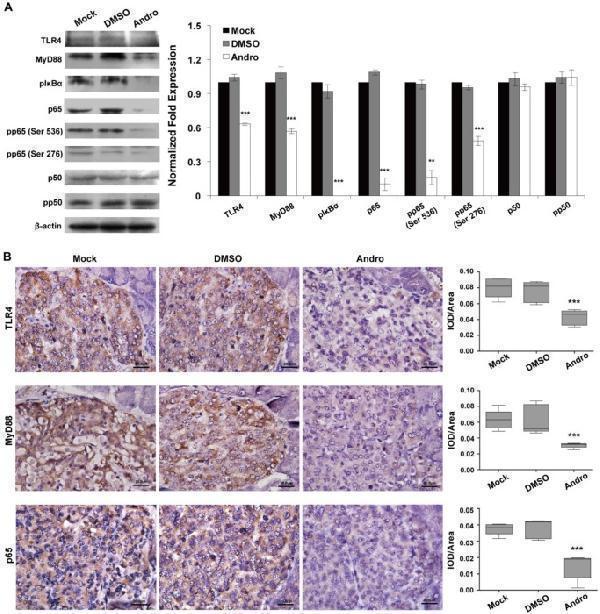
Andro targets TLR4/NF-κB signaling in insulinoma. Andro can significantly inhibited the protein expression of TLR4, MyD88, phosphorylated IκBα, p65, phosphorylated p65 (Ser536), and phosphorylated p65 (Ser276) of TLR4/NF-κB signaling pathway in tumor tissues of RIP1-Tag2 mice compared with control groups. Immunohistochemical staining showed that Andro also inhibited the expression of TLR4 (B), MyD88 (C) and p65 (D) in tumor tissues of RIP1-Tag2 mice compared with control groups. Bar, 20 μm. *** P < 0.001.
Index in PubMed under a CC BY license. PMID: 24719558
Click image to see more details
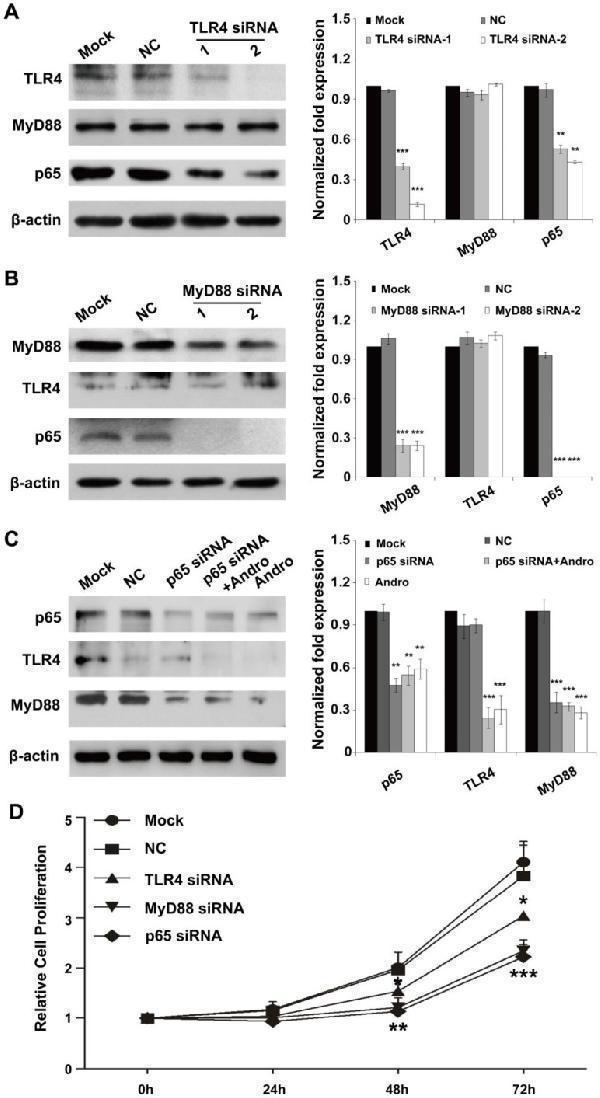
TLR4/NF-κB signaling pathway is the dominant functional target of andrographolide . (A) TLR4 deficient could only slightly inhibit the expression of p65 and cannot suppress the expression of MyD88. (B) The inhibition of MyD88 result the reduction of p65 but not TLR4 (C) p65 deficient could inhibit the expression of MyD88 but not TLR4. (D) The inhibition of TLR4, MyD88 and p65 can both suppressed cell proliferation. n=12, * P < 0.05, ** P < 0.01 and *** P < 0.001.
Index in PubMed under a CC BY license. PMID: 24719558
Click image to see more details
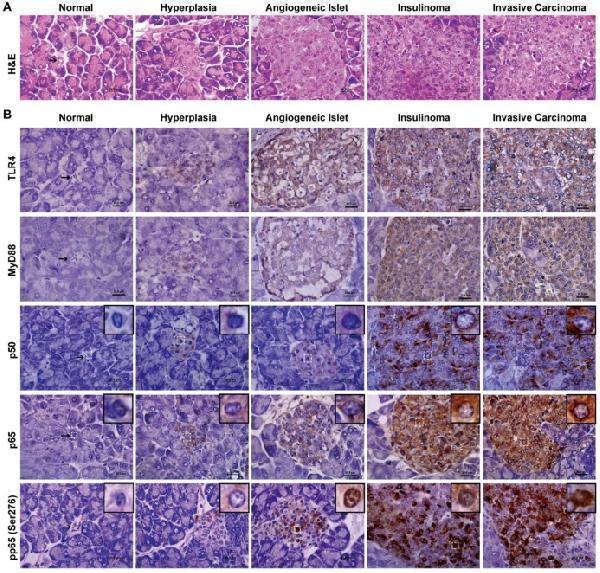
The expression and activation of TLR4/NF-κB signaling is increased during insulinoma development. (A) The classification of insulinoma. The H&E staining defined the stages of insulinoma. (B) The immunohistochemical staining of TLR4, MyD88, p50, p65 and phosphorylated p65 (Ser276) at the stage of normal, hyperplasia, angiogenic islet, insulinoma, and invasive carcinoma in RIP1-Tag2 mice. Results are representative of at least 3 tissue samples in a from more than 3 mice for each stage. Bar, 20 μm.
Index in PubMed under a CC BY license. PMID: 24719558
Click image to see more details
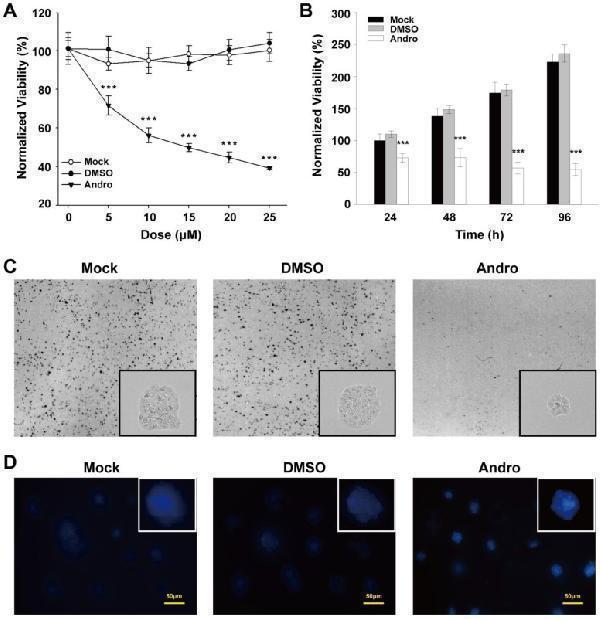
Andro suppresses cell proliferation and clonogenicity and induces cell apoptosis in β-TC-6 cells. (A) The cells were treated with various doses of Andro for 48 hours, and the cell viability was quantified by MTT assay. (B) The cells were treated with the IC 50 dose of Andro, and relative cell viability was measured using the MTT assay at the indicated times. (C) The clonogenicity ability of β-TC-6 was significantly suppressed by Andro compared with control groups. Representative photomicrographs are shown. (D) Andro induces cell apoptosis in β-TC-6 cells that treated with the IC 50 dose of Andro for 48 h. Cells were stained with Hoechst 33342 and apoptotic cells were identified by condensation and fragmentation of nuclei using inverted light microscope. All values are presented for the mean ± s.d., n=12; *** P < 0.001.
Index in PubMed under a CC BY license. PMID: 24719558
Click image to see more details
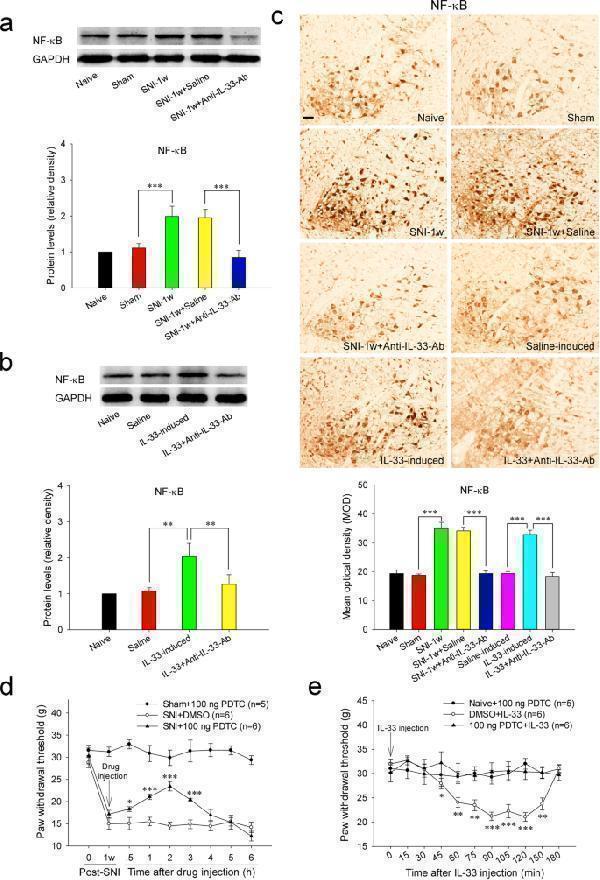
Red nucleus IL-33 facilitates the early development of mononeuropathic pain by activating NF-κB signaling pathway. A Western blotting showed an upregulated NF-κB in the RN at 1 week post-SNI, intrarubral administration of anti-IL-33 antibody restrained the overexpression of NF-κB ( n = 6 per group, F = 12.766, P < 0.001). B Western blotting showed that intrarubral injection of IL-33 stimulated the protein expression of NF-κB in naive rats ( n = 6 per group, F = 7.497, P = 0.003). C Immunohistochemistry demonstrated that NF-κB was increased in the RN of SNI rats ( F = 41.250, P < 0.001) and IL-33-induced hypersensitivity rats ( F = 34.509, P < 0.001) ( n = 4 per group). D Intrarubral injection of NF-κB inhibitor PDTC at 1 week post-injury attenuated SNI-induced mononeuropathic pain compared to DMSO control ( n = 5–6 per group, F = 135.298, P < 0.001). E PDTC pre-injected into the RN, 30 min ahead of IL-33 administration, relieved IL-33-evoked mechanical hypersensitivity compared to DMSO control ( n = 5-6 per group, F = 97.341, P < 0.001). * P < 0.05, ** P < 0.01, and *** P < 0.001. Scale bars = 50 μm
Index in PubMed under a CC BY license. PMID: 34225736
Click image to see more details
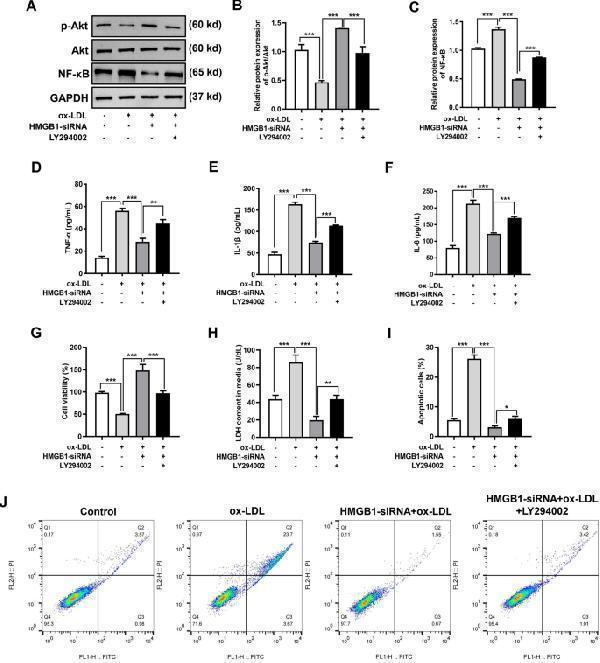
Inhibition of PI3K-Akt pathway promoted the role of HMGB1. HUVECs were pretreated with 10 μM LY294002 for 1 h. A Representative protein bands showing the expression of Akt, Akt phosphorylation, and NF-κB in HUVECs. GAPDH served as a loading control. Original images of western blots were shown in Additional file : Supplementary Fig. 1I–K. B The protein quantification ratio of P-Akt/Akt. C Relative protein expression levels of NF-κB. Quantitation of D TNF-α, E IL-1β, and F IL-6 in the supernatant of HUVECs was performed by ELISA. G Cell viability in each group detected using a CCK8 assay. H Cytotoxicity detected using a LDH kit. I The percentage of apoptotic cells in each group in J was calculated. J Representative flow cytometry profiles of different treatment groups. ‘+’ was added, ‘−‘ was blank. * p < 0.05, ** p < 0.01, and *** p < 0.001
Index in PubMed under a CC BY license. PMID: 36544080
Click image to see more details
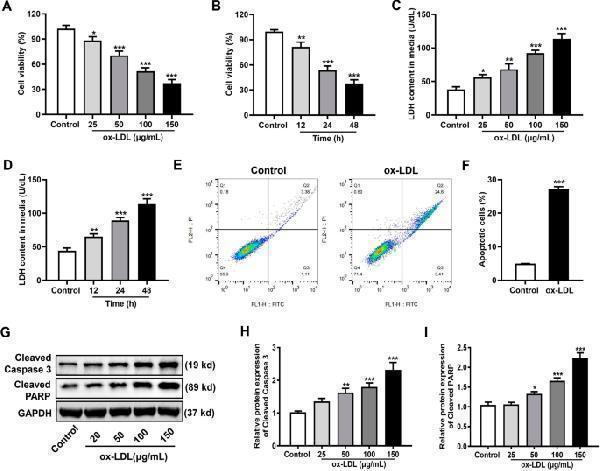
Changes in viability and apoptosis rate of HUVECs during ox-LDL-induced damage. A Cell viability after treatment with different concentrations of ox-LDL (25, 50, 100, or 150 μg/mL) detected using a CCK8 kit. B Cell viability at different time points (12, 24, or 48 h) when HUVECs were cultured with 100 μg/mL ox-LDL. C Cell cytotoxicity after treatment with different concentrations of ox-LDL detected using a LDH kit. D Cell cytotoxicity at different time points when HUVECs were cultured with 100 μg/mL ox-LDL. E Representative flow cytometry profiles of the control and ox-LDL groups. The HUVECs in the control group were untreated and the ox-LDL group was treated with 100 μg/mL ox-LDL for 24 h. F Percentage of apoptotic cells. G Representative western blot images of Cleaved Caspase-3 and Cleaved PARP expression. Original images of western blots are shown in Additional file : Supplementary Fig. 1A–C. The relative protein expression levels of H Cleaved Caspase-3 and I Cleaved PARP. Each experiment was independently repeated three times and the data were expressed as means ± SEM. * p < 0.05, ** p < 0.01, and *** p < 0.001 versus Control
Index in PubMed under a CC BY license. PMID: 36544080
Specific Publications For Anti-NF-kB p65/RELA Antibody Picoband® (PA1669)
Loading publications
Recommended Resources
Here are featured tools and databases that you might find useful.
- Boster's Pathways Library
- Protein Databases
- Bioscience Research Protocol Resources
- Data Processing & Analysis Software
- Photo Editing Software
- Scientific Literature Resources
- Research Paper Management Tools
- Molecular Biology Software
- Primer Design Tools
- Bioinformatics Tools
- Phylogenetic Tree Analysis
Customer Reviews
Have you used Anti-NF-kB p65/RELA Antibody Picoband®?
Share your experimental results or join a short interview to earn up to $1,000 in product credits or other rewards.
0 Reviews For Anti-NF-kB p65/RELA Antibody Picoband®
Customer Q&As
Have a question?
Find answers in Q&As, reviews.
Can't find your answer?
Submit your question