Product Info Summary
| SKU: | P00059-1 |
|---|---|
| Size: | 100 μl |
| Reactive Species: | Human, Mouse |
| Host: | Rabbit |
| Application: | IF, IHC, ICC, WB |
Customers Who Bought This Also Bought
Product info
Product Name
Anti-Phospho-Smad3 (S423 + S425) Rabbit Monoclonal Antibody
SKU/Catalog Number
P00059-1
BM4033 is an alternative SKU for this antibody, used in previous lots.
Size
100 μl
Form
Liquid
Description
Boster Bio Anti-Phospho-Smad3 (S423 + S425) Rabbit Monoclonal Antibody catalog # P00059-1. Tested in WB, IHC, ICC/IF applications. This antibody reacts with Human, Mouse.
Storage & Handling
Store at -20°C for one year. For short term storage and frequent use, store at 4°C for up to one month. Avoid repeated freeze-thaw cycles.
Cite This Product
Anti-Phospho-Smad3 (S423 + S425) Rabbit Monoclonal Antibody (Boster Biological Technology, Pleasanton CA, USA, Catalog # P00059-1)
Host
Rabbit
Contents
Rabbit IgG in stabilizing components, phosphate buffered saline, pH 7.4, 150mM NaCl, 0.02% sodium azide and 50% glycerol.
*This antibody is supplied in a stabilized formulation.
Compatibility with conjugation reactions depends on the chemistry of the conjugation method used.
For conjugation methods that are not compatible with the stabilizing components present in this formulation, a carrier-free antibody format is required.
Clonality
Monoclonal
Clone Number
AHO-19
Isotype
Rabbit IgG
Immunogen
A synthesized peptide derived from human Phospho-Smad3 (S423 + S425)
Reactive Species
P00059-1 is reactive to SMAD3 in Human, Mouse
Observed Molecular Weight
55 kDa
Calculated molecular weight
48.1 kDa
Antibody Validation
Boster validates all antibodies on WB, IHC, ICC, Immunofluorescence, and ELISA with known positive control and negative samples to ensure specificity and high affinity, including thorough antibody incubations.
Application & Images
Applications
P00059-1 is guaranteed for IF, IHC, ICC, WB Boster Guarantee
Assay Dilutions Recommendation
The recommendations below provide a starting point for assay optimization. The actual working concentration varies and should be decided by the user.
WB 1:500-1:2000
IHC 1:50-1:200
ICC/IF 1:50-1:200
Positive Control
IHC: human gastric adenocarcinoma tissue
ICC/IF: A549 cell
Validation Images & Assay Conditions
Click image to see more details
All lanes use the Antibody at 1:1K dilution for 1 hour at room temperature.
Click image to see more details
All lanes use the Antibody at 1:1K dilution for 1 hour at room temperature.
Click image to see more details
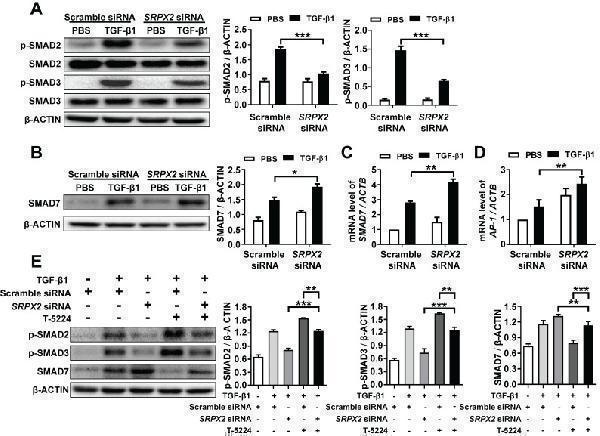
SRPX2 regulated TGF-β/SMADs signaling pathways by AP1 and SMAD7. A: Results for Western blot analysis of p-SMAD2, SMAD2, p-SMAD3 and SMAD3 expression in HPFs following TGF-β1 stimulation. B-C : Western blot (B) and RT-PCR (C) analysis of SMAD7 expression in HPFs following TGF-β1 induction. D : Expression of AP1 in HPFs after TGF-β1 stimulation. E : Western blot results for analysis of the levels of P-SMAD2, P-SMAD3 and SMAD7 in HPFs pre-treated with T-5224 (an inhibitor for AP-1) treatment following TGF-β1 induction. The data are represented as the mean ± SEM of three independent experiments. *, p < 0.05; **, p < 0.01; ***, p < 0.001.
Index in PubMed under a CC BY license. PMID: 34093874
Click image to see more details
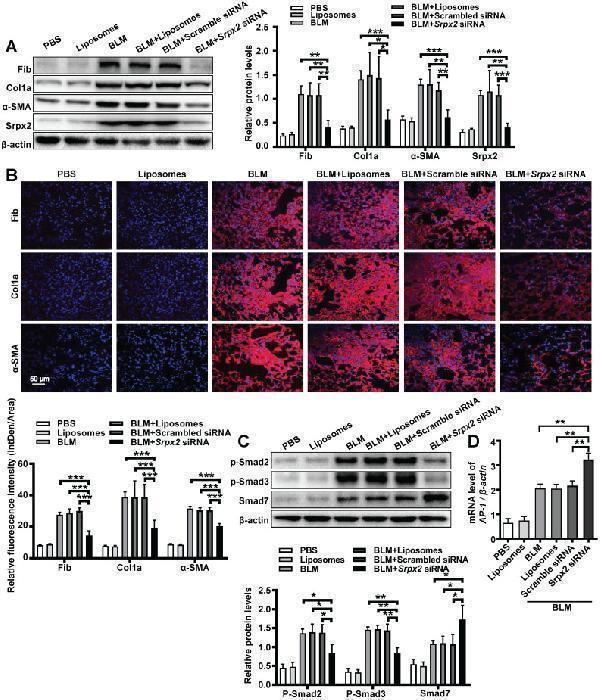
Srpx2 promoted FMT in BLM-induced pulmonary fibrosis. A : Western blot analysis of Fibronectin, Col1a1, α-SMA and Srpx2 expression in mice after BLM induction with Scrambled or Srpx2 siRNA-loaded liposomes. B : Representative images of immunostaining of Fibronectin, Col1a1 and α-SMA in the mice lung sections. The nuclei were stained blue by DAPI, and the images were taken under original magnification ×400. C : Western blot analysis of p-Smad2, p-Smad3 and Smad7 expression in mice after BLM induction. D : RT-PCR analysis of AP-1 expression in mice in each group. Six mice were included in each study group. The data are represented as the mean ± SEM. *, p < 0.05; **, p < 0.01; ***, p < 0.001.
Index in PubMed under a CC BY license. PMID: 34093874
Click image to see more details
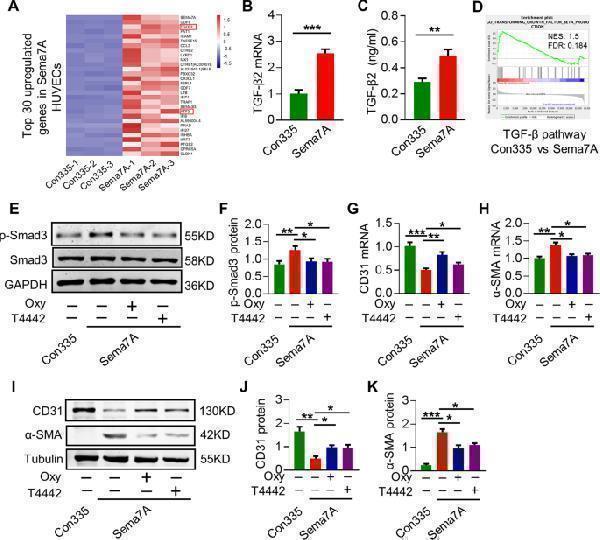
TGF-β2 gene expression and TGF-Smad signaling are augmented in Sema7A-HUVECs. a The top 30 upregulated genes in Sema7A-HUVECs compared with Con335-HVUECs. b TGF-β2 mRNA level was analyzed by qPCR normalized to GAPDH. Fold changes are shown. Data are mean ± SEM, N = 3, *** p < 0.001. c The concentration of TGF-β2 in cell supernatant was detected by ELISA. N = 10. Unpaired two-tailed Student’s t tests was used to analysis the data. Data are mean ± SEM, ** p < 0.01. d GSEA based on gene ontology (GO) pathway database showed TGF-β signaling pathway was enrich in Sema7A-HUVECs. e , f Cells were treated with Oxymatrine (Oxy) (20 μmol/l) or T4442 (1 μg/ml) and the lysates were analyzed by western blotting for Smad3 phosphorylation, normalized to total Smad3. Data are mean ± SEM, N = 3, * p < 0.05; ** p < 0.01. g , h CD31 and α-SMA mRNA in cells treated with inhibitors were analyzed by qPCR normalized to GAPDH. Fold changes are shown. Data are mean ± SEM, N = 3, * p < 0.05; ** p < 0.01; *** p < 0.001. i – k CD31 and α-SMA proteins in cells treated with inhibitors were analysis by western blotting, normalized to tubulin. Data are mean ± SEM, N = 3, * p < 0.05; ** p < 0.01; *** p < 0.001. T4442: TGF-β2 blocking antibody; Oxymatrine (Oxy): TGF/Smad signaling pathway inhibitor.
Index in PubMed under a CC BY license. PMID: 32826874
Click image to see more details
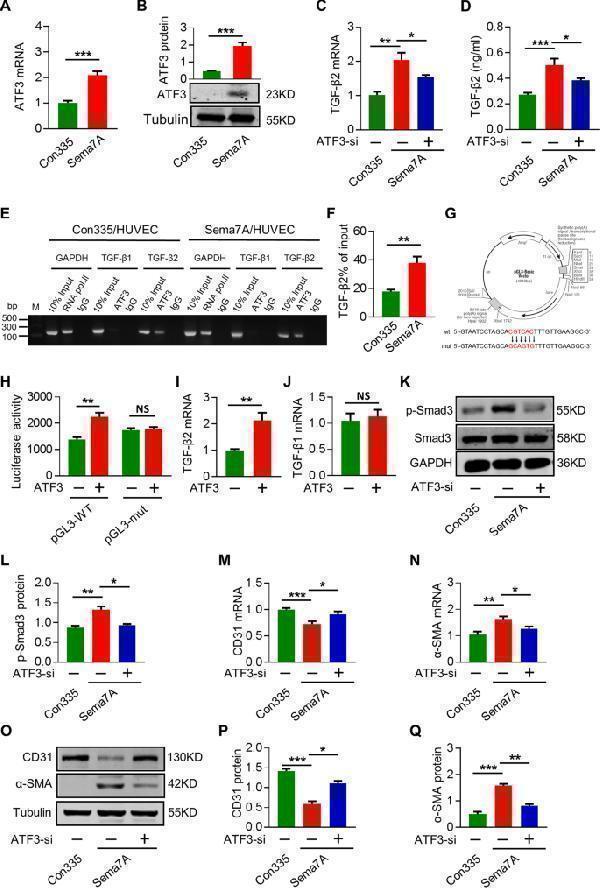
Inhibition of ATF3 reduced TGF-β2 expression and Sema7A-induced EndMT. a ATF3 mRNA level was analyzed by qPCR normalized to GAPDH. Fold changes are shown. Data are mean ± SEM, N = 3, *** p < 0.001 b ATF3 protein expression were analyzed by western blotting, normalized to tubulin. Data are mean ± SEM, N = 3, *** p < 0.001. c TGF-β2 mRNA level was analyzed by qPCR normalized to GAPDH. Fold changes are shown. Data are mean ± SEM, N = 3, * p < 0.05; ** p < 0.01. d The concentration of TGF-β2 in cell supernatant was detected by ELISA among Con335-HUVECs, Sema7A-HUVECs, and Sema7A-HUVECs + ATF3-siRNA. N = 10. Data are mean ± SEM, * p < 0.05; *** p < 0.001. e Chip-qPCR product in agarose gel electrophoresis. f Chip-qPCR TGF-β2 percentage of input in con335-HUVECs and Sema7A - HUVECs were analyzed by qPCR normalized to IgG. Data are mean ± SEM, N = 3, ** p < 0.01. g Schematic graph of the constructed reporter plasmid. TGF-β2 mut indicates the TGF-β2 mutation promoter region in ATF3 binding site. The mutated nucleotides in TGF-β2 fragments are in red letters. h Luciferase reporter assays were performed on HEK 293 T cells. Data are mean ± SEM, N = 3, ** p < 0.01 vs negative control. i , j ATF3-overexpression plasmid was transfected to HUVECs, and the mRNA levels of TGF - β2 and TGF-β1 were performed by qPCR normalized to GAPDH. Fold changes are shown. Data are mean ± SEM, N = 3, ** p < 0.01. k , l P-Smad3 protein in cells treated with siRNA was analyzed by Western blotting, normalized to total Smad3. Data are mean ± SEM, N = 3, * p < 0.05; ** p < 0.01. m – q CD31 and α-SMA RNA and proteins in cells treated with siRNA or control was analyzed by qPCR and western blotting. Data are mean ± SEM, N = 3, * p < 0.05; ** p < 0.01; *** p < 0.001.
Index in PubMed under a CC BY license. PMID: 32826874
Click image to see more details
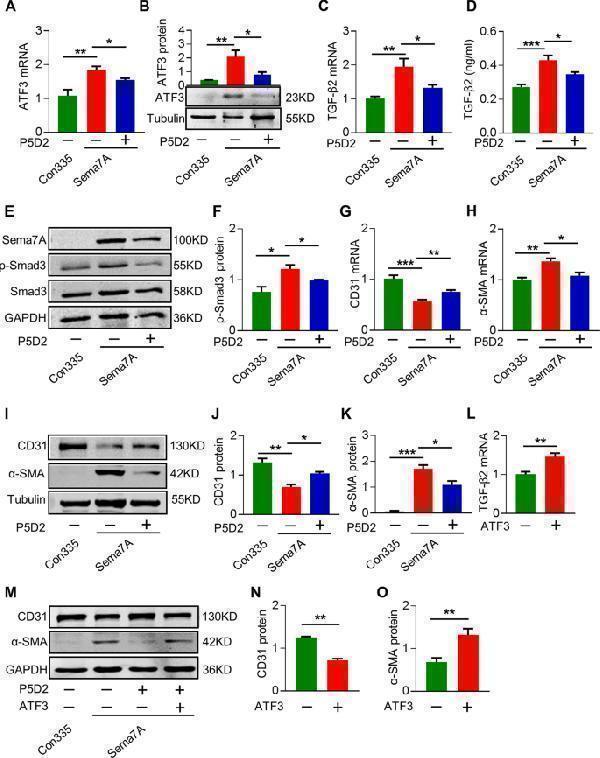
Β1 integrin mediates Sema7A signal to TGF-β2 via ATF3. a Cells were treated with β1 integrin antibody (P5D2), and ATF3 mRNA level was analyzed by qPCR normalized to GAPDH. Fold changes are shown. Data are mean ± SEM, N = 3, * p < 0.05; ** p < 0.0.1. b ATF3 protein expression was analyzed by western blotting, normalized to tubulin. Data are mean ± SEM, N = 3, * p < 0.05; ** p < 0.01. c TGF-β2 mRNA level was analyzed by qPCR normalized to GAPDH. Fold changes are shown. Data are mean ± SEM, N = 3, * p < 0.05; ** p < 0.0.1. d The concentration of TGF-β2 in cell supernatant was detected by ELISA for Con335-HUVECs, Sema7A-HUVECs, and Sema7A-HUVECs + P5D2. Data are mean ± SEM, N = 10, * p < 0.05; *** p < 0.001. e , f Smad3 phosphorylation were analyzed by western blotting, normalized to total Smad3. Data are mean ± SEM, N = 3, * p < 0.05. g , h CD31 and α-SMA mRNA level were analyzed by qPCR normalized to GAPDH. Fold changes are shown. Data are mean ± SEM, N = 3, * p < 0.05; ** p < 0.01; *** p < 0.001. i – k CD31 and α-SMA proteins were analyzed by western blotting, normalized to tubulin. Data are mean ± SEM, N = 3, * p < 0.05; ** p < 0.01; *** p < 0.001. l ATF3 overexpression plasmid was transfected into P5D2 incubated Sema7A-HUVECs, and TGF-β2 mRNA expression in Sema7A-HUVECs + P5D2 and Sema7A-HUVECs + P5D2 + ATF3 were analyzed by qPCR normalized to GAPDH. Fold changes are shown. Data are mean ± SEM, N = 3, ** p < 0.01. m – o CD31 and α-SMA protein expressions were analyzed by western blotting, normalized to GAPDH. Data are mean ± SEM, N = 3, ** p < 0.01 (Sema7A-HUVECs + P5D2 vs Sema7A-HUVECs + P5D2 + ATF3). P5D2 β1 integrin antibody.
Index in PubMed under a CC BY license. PMID: 32826874
Click image to see more details
Western blot analysis of Phospho-Smad3 (S423/S425) expression in A549 cell lysate treated with TGF-?1.
Click image to see more details
All lanes use the Antibody at 1:1K dilution for 1 hour at room temperature.
Click image to see more details
All lanes use the Antibody at 1:1K dilution for 1 hour at room temperature.
Click image to see more details
Immunohistochemical analysis of paraffin-embedded human gastric adenocarcinoma, using Phospho-Smad3 (S423 + S425) Antibody.
Click image to see more details
Immunofluorescent analysis of A549 cells treated with TGFβ , using Phospho-Smad3 (S423 + S425) Antibody.
Specific Publications For Anti-Phospho-Smad3 (S423 + S425) Rabbit Monoclonal Antibody (P00059-1)
Loading publications
Recommended Resources
Here are featured tools and databases that you might find useful.
- Boster's Pathways Library
- Protein Databases
- Bioscience Research Protocol Resources
- Data Processing & Analysis Software
- Photo Editing Software
- Scientific Literature Resources
- Research Paper Management Tools
- Molecular Biology Software
- Primer Design Tools
- Bioinformatics Tools
- Phylogenetic Tree Analysis
Customer Reviews
Have you used Anti-Phospho-Smad3 (S423 + S425) Rabbit Monoclonal Antibody?
Share your experimental results or join a short interview to earn up to $1,000 in product credits or other rewards.
0 Reviews For Anti-Phospho-Smad3 (S423 + S425) Rabbit Monoclonal Antibody
Customer Q&As
Have a question?
Find answers in Q&As, reviews.
Can't find your answer?
Submit your question
6 Customer Q&As for Anti-Phospho-Smad3 (S423 + S425) Rabbit Monoclonal Antibody
Question
We are currently using anti-Phospho-Smad3 (S423 + S425) Rabbit Monoclonal antibody P00059-1 for human tissue, and we are content with the IF results. The species of reactivity given in the datasheet says human, mouse. Is it true that the antibody can work on pig tissues as well?
Verified Customer
Verified customer
Asked: 2019-11-13
Answer
The anti-Phospho-Smad3 (S423 + S425) Rabbit Monoclonal antibody (P00059-1) has not been tested for cross reactivity specifically with pig tissues, though there is a good chance of cross reactivity. We have an innovator award program that if you test this antibody and show it works in pig you can get your next antibody for free. Please contact me if I can help you with anything.
Boster Scientific Support
Answered: 2019-11-13
Question
My team were content with the WB result of your anti-Phospho-Smad3 (S423 + S425) Rabbit Monoclonal antibody. However we have seen positive staining in pancreas cytoplasm using this antibody. Is that expected? Could you tell me where is SMAD3 supposed to be expressed?
Verified Customer
Verified customer
Asked: 2019-09-19
Answer
Based on literature, pancreas does express SMAD3. Generally SMAD3 expresses in cytoplasm. Regarding which tissues have SMAD3 expression, here are a few articles citing expression in various tissues:
Brain, Pubmed ID: 14702039
Cervix carcinoma, Pubmed ID: 18669648
Colon carcinoma, Pubmed ID: 9464505
Erythroleukemia, Pubmed ID: 23186163
Pancreas, Pubmed ID: 15489334
Placenta, Pubmed ID: 8774881
Boster Scientific Support
Answered: 2019-09-19
Question
Do you have a similar anti-pSMAD3 antibodies from a different host species than rabbit for double immunostaining?
Verified customer
Asked: 2019-05-06
Answer
Unfortunately, we currently do not provide anti-phospho-SMAD3 antibodies from a different host species than rabbit.
Boster Scientific Support
Answered: 2019-05-06
Question
We ordered your anti-Phospho-Smad3 (S423 + S425) Rabbit Monoclonal antibody for IF on brain a few years ago. I am using human, and I plan to use the antibody for ICC next. We are interested in examining brain as well as erythroleukemia in our next experiment. Could you please give me some suggestion on which antibody would work the best for ICC?
Verified Customer
Verified customer
Asked: 2018-11-02
Answer
I looked at the website and datasheets of our anti-Phospho-Smad3 (S423 + S425) Rabbit Monoclonal antibody and I see that P00059-1 has been validated on human in both IF and ICC. Thus P00059-1 should work for your application. Our Boster satisfaction guarantee will cover this product for ICC in human even if the specific tissue type has not been validated. We do have a comprehensive range of products for ICC detection and you can check out our website bosterbio.com to find out more information about them.
Boster Scientific Support
Answered: 2018-11-02
Question
We have seen staining in mouse cervix carcinoma. What should we do? Is anti-Phospho-Smad3 (S423 + S425) Rabbit Monoclonal antibody supposed to stain cervix carcinoma positively?
Verified Customer
Verified customer
Asked: 2018-08-30
Answer
According to literature cervix carcinoma does express SMAD3. According to Uniprot.org, SMAD3 is expressed in amniotic fluid, placenta, colon carcinoma, brain, pancreas, cervix carcinoma, erythroleukemia, among other tissues. Regarding which tissues have SMAD3 expression, here are a few articles citing expression in various tissues:
Brain, Pubmed ID: 14702039
Cervix carcinoma, Pubmed ID: 18669648
Colon carcinoma, Pubmed ID: 9464505
Erythroleukemia, Pubmed ID: 23186163
Pancreas, Pubmed ID: 15489334
Placenta, Pubmed ID: 8774881
Boster Scientific Support
Answered: 2018-08-30
Question
We need using your anti-Phospho-Smad3 (S423 + S425) Rabbit Monoclonal antibody for immune system development studies. Has this antibody been tested with western blotting on a549 cells? We would like to see some validation images before ordering.
Verified Customer
Verified customer
Asked: 2018-02-02
Answer
We appreciate your inquiry. This P00059-1 anti-Phospho-Smad3 (S423 + S425) Rabbit Monoclonal antibody is tested on a549 cells. It is guaranteed to work for IF, IHC, ICC, WB in human, mouse. Our Boster guarantee will cover your intended experiment even if the sample type has not been be directly tested.
Boster Scientific Support
Answered: 2018-02-02