Product Info Summary
| SKU: | M01463-1 |
|---|---|
| Size: | 80 µl |
| Reactive Species: | Human, Mouse, Rat |
| Host: | Mouse |
| Application: | IHC-P, WB |
Customers Who Bought This Also Bought
Product info
Product Name
Anti-RPTOR Antibody
SKU/Catalog Number
M01463-1
Size
80 µl
Description
Boster Bio Anti-RPTOR Antibody (Catalog # M01463-1). Tested in IHC-P, WB application(s). This antibody reacts with Human, Mouse, Rat.
Storage & Handling
Maintain refrigerated at 2-8°C for up to 2 weeks. For long-term storage, store at -20°C in small aliquots to prevent freeze-thaw cycles.
Cite This Product
Anti-RPTOR Antibody (Boster Biological Technology, Pleasanton CA, USA, Catalog # M01463-1)
Host
Mouse
Contents
Purified monoclonal antibody supplied in PBS with 0.09% (W/V) sodium azide.
Clonality
Monoclonal
Clone Number
1411CT316.2.151.34
Isotype
IgG1,k
Immunogen
This RPTOR antibody is generated from a mouse immunized with recombinant protein.
Reactive Species
M01463-1 is reactive to RPTOR in Human, Mouse, Rat
Calculated molecular weight
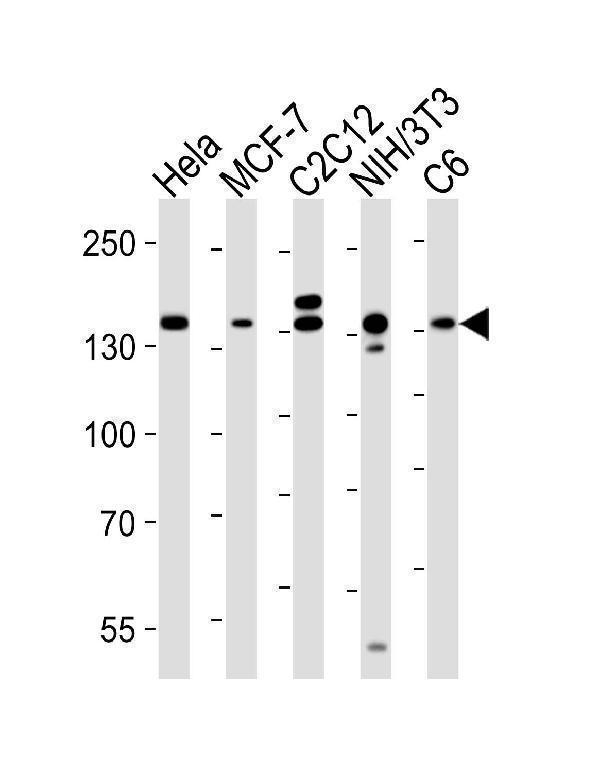
149.0 kDa
Background of RPTOR
Involved in the control of the mammalian target of rapamycin complex 1 (mTORC1) activity which regulates cell growth and survival, and autophagy in response to nutrient and hormonal signals; functions as a scaffold for recruiting mTORC1 substrates. mTORC1 is activated in response to growth factors or amino acids. Growth factor-stimulated mTORC1 activation involves a AKT1- mediated phosphorylation of TSC1-TSC2, which leads to the activation of the RHEB GTPase that potently activates the protein kinase activity of mTORC1. Amino acid-signaling to mTORC1 requires its relocalization to the lysosomes mediated by the Ragulator complex and the Rag GTPases. Activated mTORC1 up-regulates protein synthesis by phosphorylating key regulators of mRNA translation and ribosome synthesis. mTORC1 phosphorylates EIF4EBP1 and releases it from inhibiting the elongation initiation factor 4E (eiF4E). mTORC1 phosphorylates and activates S6K1 at 'Thr-389', which then promotes protein synthesis by phosphorylating PDCD4 and targeting it for degradation. Involved in ciliogenesis.
Antibody Validation
Boster validates all antibodies on WB, IHC, ICC, Immunofluorescence, and ELISA with known positive control and negative samples to ensure specificity and high affinity, including thorough antibody incubations.
Application & Images
Applications
M01463-1 is guaranteed for IHC-P, WB Boster Guarantee
Assay Dilutions Recommendation
The recommendations below provide a starting point for assay optimization. The actual working concentration varies and should be decided by the user.
WB: 1:500-1:1000
IHC-P: 1:25
Validation Images & Assay Conditions
Click image to see more details
Western blot analysis of lysates from Hela, MCF-7, mouse C2C12, mouse NIH/3T3, rat C6 cell line (from left to right), using RPTOR Antibody. M01463-1 was diluted at 1:1000 at each lane. A goat anti-mouse IgG H&L (HRP) at 1:10000 dilution was used as the secondary antibody. Lysates at 20μg per lane.
Click image to see more details
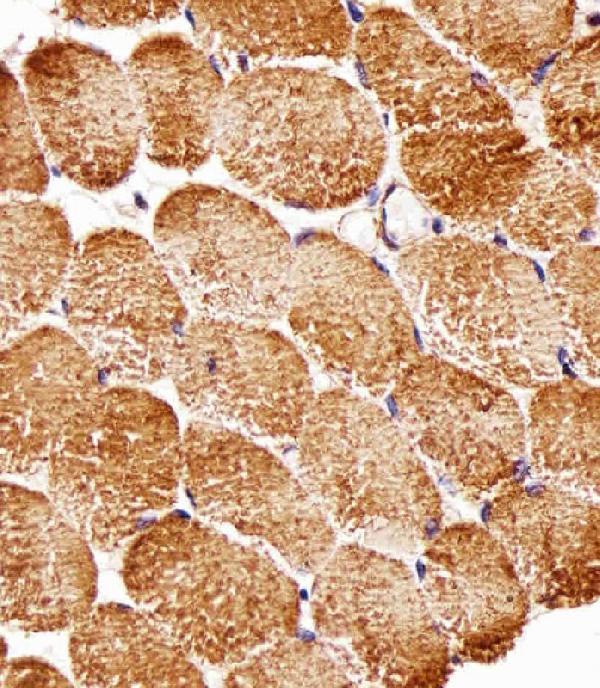
Immunohistochemical analysis of paraffin-embedded H. skeletal muscle section using RPTOR Antibody. M01463-1 was diluted at 1:25 dilution. A undiluted biotinylated goat polyvalent antibody was used as the secondary, followed by DAB staining.
Specific Publications For Anti-RPTOR Antibody (M01463-1)
Loading publications
Recommended Resources
Here are featured tools and databases that you might find useful.
- Boster's Pathways Library
- Protein Databases
- Bioscience Research Protocol Resources
- Data Processing & Analysis Software
- Photo Editing Software
- Scientific Literature Resources
- Research Paper Management Tools
- Molecular Biology Software
- Primer Design Tools
- Bioinformatics Tools
- Phylogenetic Tree Analysis
Customer Reviews
Have you used Anti-RPTOR Antibody?
Share your experimental results or join a short interview to earn up to $1,000 in product credits or other rewards.
0 Reviews For Anti-RPTOR Antibody
Customer Q&As
Have a question?
Find answers in Q&As, reviews.
Can't find your answer?
Submit your question