Product Info Summary
| SKU: | PA1570 |
|---|---|
| Size: | 100 μg/vial |
| Reactive Species: | Human, Mouse, Rat |
| Host: | Rabbit |
| Application: | IHC, WB |
Customers Who Bought This Also Bought
Product info
Product Name
Anti-C-terminal-binding protein 1 CtBP1 Antibody Picoband®
SKU/Catalog Number
PA1570
BA3167 is an alternative SKU for this antibody, used in previous lots.
Size
100 μg/vial
Form
Lyophilized
Description
Boster Bio Anti-C-terminal-binding protein 1 CtBP1 Antibody catalog # PA1570. Tested in IHC, WB applications. This antibody reacts with Human, Mouse, Rat. The brand Picoband indicates this is a premium antibody that guarantees superior quality, high affinity, and strong signals with minimal background in Western blot applications. Only our best-performing antibodies are designated as Picoband, ensuring unmatched performance.
Storage & Handling
Store at -20˚C for one year from date of receipt. After reconstitution, at 4˚C for one month. It can also be aliquotted and stored frozen at -20˚C for six months. Avoid repeated freeze-thaw cycles.
Cite This Product
Anti-C-terminal-binding protein 1 CtBP1 Antibody Picoband® (Boster Biological Technology, Pleasanton CA, USA, Catalog # PA1570)
Host
Rabbit
Contents
Each vial contains antibody formulated with stabilizing components, 0.9mg NaCl, 0.2mg Na2HPO4, 0.05mg Thimerosal, 0.05mg NaN3.
*This antibody is supplied in a stabilized formulation.
Compatibility with conjugation reactions depends on the chemistry of the conjugation method used.
For conjugation methods that are not compatible with the stabilizing components present in this formulation, a carrier-free antibody format is required.
Clonality
Polyclonal
Isotype
Rabbit IgG
Immunogen
A synthetic peptide corresponding to a sequence at the C-terminus of human CtBP1, different from the related rat and mouse sequences by one amino acid.
Cross-reactivity
No cross-reactivity with other proteins
Reactive Species
PA1570 is reactive to CTBP1 in Human, Mouse, Rat
Observed Molecular Weight
130 kDa
Calculated molecular weight
47.5 kDa
Background of CTBP1
CTBP1, C-terminal-binding protein 1, is a protein that in humans is encoded by the CTBP1 gene. The CtBP1 protein binds to the C-terminus of adenovirus E1A proteins. This gene is mapped to 4p16. This phosphoprotein is a transcriptional repressor (corepressor) and may play a role during cellular proliferation. This protein and the product of a second closely related gene, CTBP2, can dimerize. CtBP1 and CtBP2 preferentially associate with the E1A via a 5 amino acid motif, PLDLS, to repress E1A induced oncogenesis and cellular transformation. CtBP1 is expressed from embryo to adult, but CtBP2 is mainly expressed during embryogenesis. During skeletal and T cell development, CtBP1 and CtBP2 associate with the PLDLSL domain of delta EF1, a cellular zinc finger-homeodomain protein, and thereby enhances delta EF1-induced transcriptional silencing. In addition, CtBP complexes with CtIP, a 125 kDa protein that recognizes distinctly different protein motifs from CtBP. CtIP binds to the BRCT repeats within the breast cancer gene BRCA1 and enables CtBP to influence BRCA1 activity. Both proteins can also interact with a polycomb group protein complex which participates in regulation of gene expression during development. Alternative splicing of transcripts from this gene results in multiple transcript variants.
Antibody Validation
Boster validates all antibodies on WB, IHC, ICC, Immunofluorescence, and ELISA with known positive control and negative samples to ensure specificity and high affinity, including thorough antibody incubations.
Application & Images
Applications
PA1570 is guaranteed for IHC, WB Boster Guarantee
Assay Dilutions Recommendation
The recommendations below provide a starting point for assay optimization. The actual working concentration varies and should be decided by the user.
Immunohistochemistry (Paraffin-embedded Section), 0.5-1μg/ml, Human, Rat, Mouse
Western blot, 0.1-0.5μg/ml, Human, Rat, Mouse
Positive Control
WB: Rat Brain Tissue, Rat Testis Tissue, Rat Ovary Tissue, U87 Cell, SW620 Cell, HT1080 Cell, COLO32 Cell
IHC: Rat Brain Tissue
Validation Images & Assay Conditions
Click image to see more details
Anti-CtBP1 antibody, PA1570, Western blotting
Lane 1: Rat Brain Tissue Lysate
Lane 2: Rat Testis Tissue Lysate
Lane 3: Rat Ovary Tissue Lysate
Lane 4: U87 Cell Lysate
Lane 5: SW620 Cell Lysate
Lane 6: HT1080 Cell Lysate
Lane 7: COLO32 Cell Lysate
Click image to see more details
Anti-CtBP1 antibody, PA1570, IHC(P)
IHC(P): Rat Brain Tissue
Click image to see more details
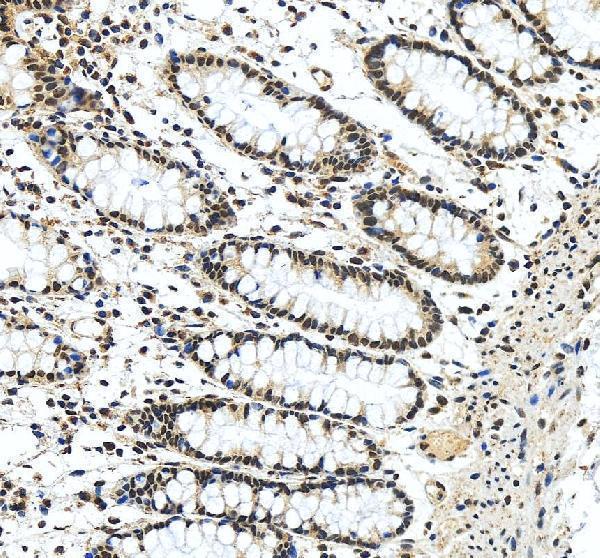
IHC analysis of CTBP1 using anti-CTBP1 antibody (PA1570).
CTBP1 was detected in a paraffin-embedded section of human colon tissue. Heat mediated antigen retrieval was performed in EDTA buffer (pH 8.0, epitope retrieval solution). The tissue section was blocked with 10% goat serum. The tissue section was then incubated with 2 μg/ml rabbit anti-CTBP1 Antibody (PA1570) overnight at 4°C. Peroxidase Conjugated Goat Anti-rabbit IgG was used as secondary antibody and incubated for 30 minutes at 37°C. The tissue section was developed using HRP Conjugated Rabbit IgG Super Vision Assay Kit (Catalog # SV0002) with DAB as the chromogen.
Specific Publications For Anti-C-terminal-binding protein 1 CtBP1 Antibody Picoband® (PA1570)
Loading publications
Recommended Resources
Here are featured tools and databases that you might find useful.
- Boster's Pathways Library
- Protein Databases
- Bioscience Research Protocol Resources
- Data Processing & Analysis Software
- Photo Editing Software
- Scientific Literature Resources
- Research Paper Management Tools
- Molecular Biology Software
- Primer Design Tools
- Bioinformatics Tools
- Phylogenetic Tree Analysis
Customer Reviews
Have you used Anti-C-terminal-binding protein 1 CtBP1 Antibody Picoband®?
Share your experimental results or join a short interview to earn up to $1,000 in product credits or other rewards.
0 Reviews For Anti-C-terminal-binding protein 1 CtBP1 Antibody Picoband®
Customer Q&As
Have a question?
Find answers in Q&As, reviews.
Can't find your answer?
Submit your question