Product Info Summary
| SKU: | PB9005 |
|---|---|
| Size: | 100 μg/vial |
| Reactive Species: | Rat |
| Host: | Rabbit |
| Application: | WB |
Customers Who Bought This Also Bought
Product info
Product Name
Anti-IL6 Antibody Picoband®
SKU/Catalog Number
PB9005
PB0061 is an alternative SKU for this antibody, used in previous lots.
Size
100 μg/vial
Form
Lyophilized
Description
Boster Bio Anti-IL6 Antibody Picoband® catalog # PB9005. Tested in WB applications. This antibody reacts with Rat. The brand Picoband indicates this is a premium antibody that guarantees superior quality, high affinity, and strong signals with minimal background in Western blot applications. Only our best-performing antibodies are designated as Picoband, ensuring unmatched performance.
Storage & Handling
Store at -20˚C for one year from date of receipt. After reconstitution, at 4˚C for one month. It can also be aliquotted and stored frozen at -20˚C for six months. Avoid repeated freeze-thaw cycles.
Cite This Product
Anti-IL6 Antibody Picoband® (Boster Biological Technology, Pleasanton CA, USA, Catalog # PB9005)
Host
Rabbit
Contents
Each vial contains antibody formulated with stabilizing components, 0.9 mg NaCl, 0.2 mg Na2HPO4, and 0.05 mg NaN3.
*This antibody is supplied in a stabilized formulation.
Compatibility with conjugation reactions depends on the chemistry of the conjugation method used.
For conjugation methods that are not compatible with the stabilizing components present in this formulation, a carrier-free antibody format is required.
Clonality
Polyclonal
Isotype
Rabbit IgG
Immunogen
E.coli-derived rat IL-6 recombinant protein (Position: F25-T211). Rat IL-6 shares 86% amino acid (aa) sequence identity with mouse IL-6.
Cross-reactivity
No cross-reactivity with other proteins
Reactive Species
PB9005 is reactive to Il6 in Rat
Observed Molecular Weight
25 kDa
Calculated molecular weight
24.4 kDa
Background of Il6
Interleukin-6 (IL-6) is a protein that in humans is encoded by the IL6 gene. IL-6 is an interleukin that acts as both a pro-inflammatory and anti-inflammatory cytokine. It is secreted by T cells and macrophages to stimulate immune response to trauma, especially burns or other tissue damage leading to inflammation. IL-6 is one of the most important mediators of fever and of the acute phase response. IL-6 is also essential for hybridoma growth and is found in many supplemental cloning media such as briclone. Bowcock et al. (1988) assigned the IL6 gene to chromosome 7p21. By in situ hybridization and Southern blot analysis of mouse-human hybrid cell lines, Sutherland et al. (1988) mapped the IL-6 gene to chromosome 7p15.
Antibody Validation
Boster validates all antibodies on WB, IHC, ICC, Immunofluorescence, and ELISA with known positive control and negative samples to ensure specificity and high affinity, including thorough antibody incubations.
Application & Images
Applications
PB9005 is guaranteed for WB Boster Guarantee
Assay Dilutions Recommendation
The recommendations below provide a starting point for assay optimization. The actual working concentration varies and should be decided by the user.
Western blot, 0.1-0.5μg/ml, Rat
Validation Images & Assay Conditions
Click image to see more details
Western blot analysis of IL6 using anti-IL6 antibody (PB9005).
Electrophoresis was performed on a 5-20% SDS-PAGE gel at 70V (Stacking gel) / 90V (Resolving gel) for 2-3 hours.
Lane 1: recombinant rat IL6 protein 0.5 ng.
After electrophoresis, proteins were transferred to a nitrocellulose membrane at 150 mA for 50-90 minutes. Blocked the membrane with 5% non-fat milk/TBS for 1.5 hour at RT. The membrane was incubated with rabbit anti-IL6 antigen affinity purified polyclonal antibody (Catalog # PB9005) at 0.5 μg/mL overnight at 4°C, then washed with TBS-0.1%Tween 3 times with 5 minutes each and probed with a goat anti-rabbit IgG-HRP secondary antibody at a dilution of 1:5000 for 1.5 hour at RT. The signal is developed using an Enhanced Chemiluminescent detection (ECL) kit (Catalog # EK1002) with Tanon 5200 system. A specific band was detected for IL6 at approximately 25 kDa. The expected band size for IL6 is at 25 kDa.
Click image to see more details
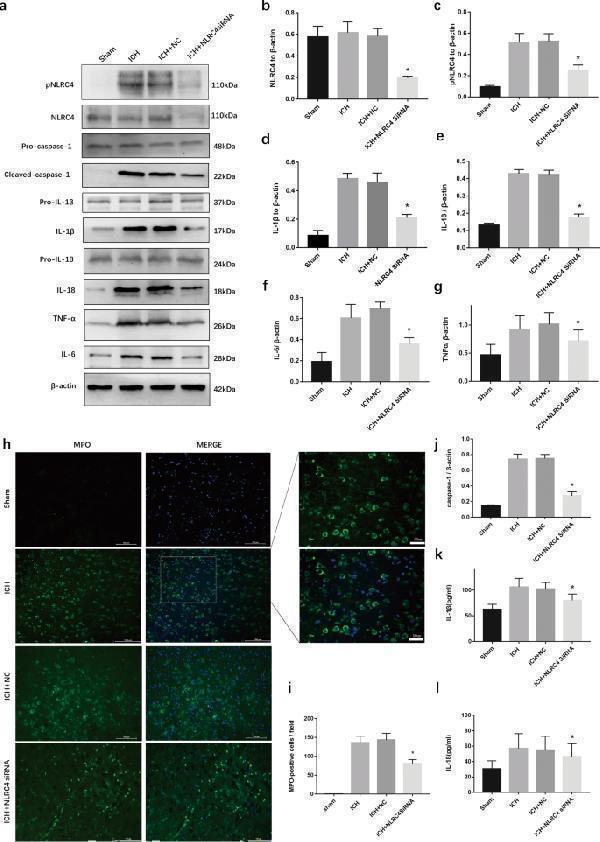
Inflammation response were reduced by NLRC4 siRNA after ICH. a – g , j Western blot assay to detect NLRC4, pNLRC4, Pro-IL-1β, IL-1β, Pro-caspase-1, caspase-1, Pro-IL-18, IL-18, TNF-α, and IL-6, ( k , l ) ELISA for IL–18 and IL–1β ( h , i ) Immunostaining for MPO-positive cells (×400 and ×200) at peri-hematoma area in sham, ICH, negative control siRNA, and NLRC4 siRNA groups at 72 h after ICH (six rats for each group). * P < 0.05, compared with ICH.
Index in PubMed under a CC BY license. PMID: 34848837
Click image to see more details
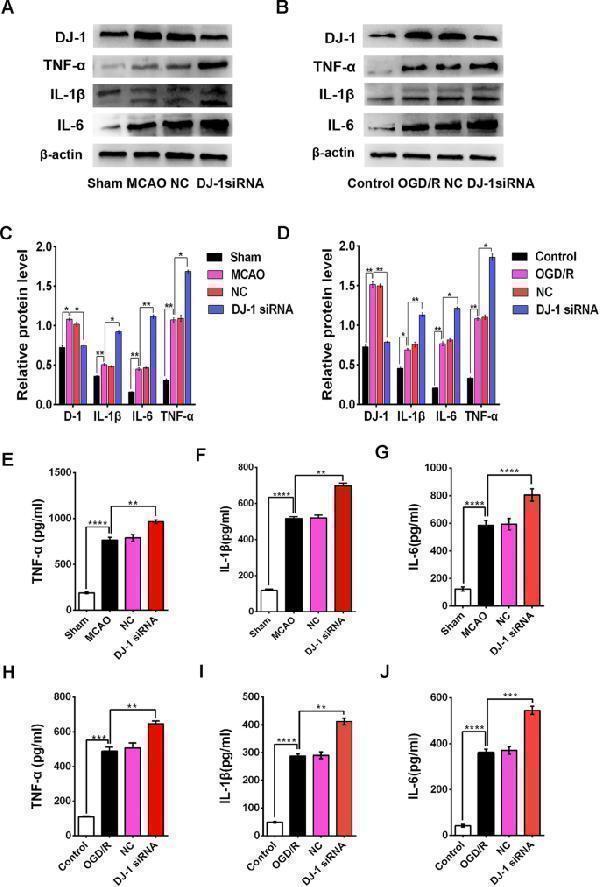
DJ-1 interference increased the expression of TNF-α, IL-1β, and IL-6 after cerebral I/R injury. a and c Western blot detecting DJ-1 and the cytokines TNF-α, IL-1β, and IL-6 in rats. b , d Western blot detecting DJ-1 and the cytokines TNF-α, IL-1β, and IL-6 in astrocytes. e–g Quantification of TNF-α, IL-1β, and IL-6 in rats by ELISA. h‑j Quantification of TNF-α, IL-1β, and IL-6 in astrocytes by ELISA. The data are expressed as the mean ± SEM. * p < 0.05, ** p < 0.01, *** p < 0.001, **** p < 0.0001. n = 6 per group
Index in PubMed under a CC BY license. PMID: 32151250
Click image to see more details
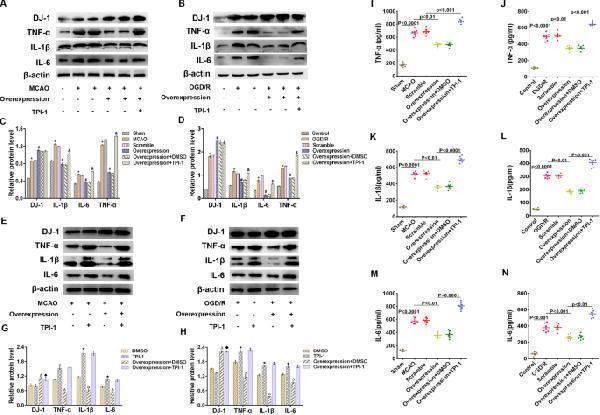
DJ-1 inhibited the expression of TNF-α, IL-1β, and IL-6 after cerebral I/R injury via SHP-1. a , c After virus and TPI-1 were used to overexpress DJ-1 and inhibit SHP-1, respectively, Western blotting was used to detect the cytokines IL-1β, IL-6, and TNF-α in rats. b , d After virus and TPI-1 were used to overexpress DJ-1 and inhibit SHP-1, respectively, Western blotting was used to detect the cytokines IL-1β, IL-6, and TNF-α in astrocytes. e , g After treatment with an SHP-1 inhibitor, Western blotting was used to detect the cytokines IL-1β, IL-6, and TNF-α in rats. f , h After treatment with an SHP-1 inhibitor, Western blotting was used to detect the cytokines IL-1β, IL-6, and TNF-α in astrocytes. i , k , m Quantification of TNF-α, IL-1β, and IL-6 in rats by ELISA. j , l , n Quantification of TNF-α, IL-1β, and IL-6 in astrocytes by ELISA. The data are expressed as the mean ± SEM. * p < 0.05 vs. the sham group; # p < 0.05 vs. the MCAO group; & p < 0.05 vs. the overexpression group; ★ p < 0.05 vs. the DMSO group; △ p < 0.05 vs. the DMSO group; ◆ p < 0.05 vs. the TPI-1 group. n = 6 per group. The data are expressed as the mean ± SEM. * p < 0.05 vs. the control group; # p < 0.05 vs. the OGD/R group; & p < 0.05 vs. the overexpression group; ★ p < 0.05 vs. the DMSO group; △ p < 0.05 vs. the DMSO group; ◆ p < 0.05 vs. the TPI-1 group. n = 6 per group. The groups in a and b and their corresponding groups in the statistical graphs are as follows: sham (−−−), MCAO or OGD/R (+−−), scramble (+−−), overexpression (++−), overexpression + DMSO (++−), and overexpression + TPI-1 (+++). The groups in e and f and the corresponding groups in the statistical graphs are as follows: DMSO (+−−), TPI-1 (+−+), overexpression + DMSO (++−), overexpression + TPI-1 (+++)
Index in PubMed under a CC BY license. PMID: 32151250
Click image to see more details
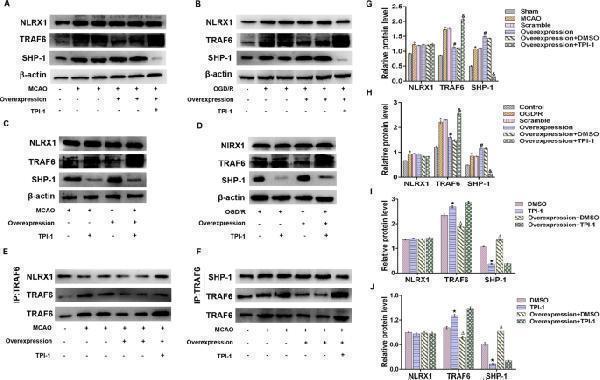
DJ-1 regulated the disassociation of NLRX1 from TRAF6 after cerebral I/R injury via SHP-1. a , g After virus and TPI-1 were used to overexpress DJ-1 and inhibit SHP-1, respectively, Western blotting was used to detect NLRX1, TRAF6, and SHP-1 in rats. b , h After virus and TPI-1 were used to overexpress DJ-1 and inhibit SHP-1, respectively, Western blotting was used to detect NLRX1, TRAF6, and SHP-1 in astrocytes. c , i After treatment with an SHP-1 inhibitor, Western blotting was used to detect the cytokines IL-1β, IL-6, and TNF-α in rats. d , j After treatment with an SHP-1 inhibitor, Western blotting was used to detect the cytokines IL-1β, IL-6, and TNF-α in astrocytes. e Immunoprecipitation and immunoblot analyses of NLRX1-TRAF6 in rats. f Immunoprecipitation and immunoblot analyses of SHP-1-TRAF6 in rats. The data are expressed as the mean ± SEM. * p < 0.05 vs. the sham group; # p < 0.05 vs. the MCAO group; & p < 0.05 vs. the overexpression group; ★ p < 0.05 vs. the DMSO group; △ p < 0.05 vs. the DMSO group. n = 6 per group. The data are expressed as the mean ± SEM. * p < 0.05 vs. the control group; # p < 0.05 vs. the OGD/R group; & p < 0.05 vs. the overexpression group; ★ p < 0.05 vs. the DMSO group; △ p < 0.05 vs. the DMSO group. n = 6 per group
Index in PubMed under a CC BY license. PMID: 32151250
Click image to see more details
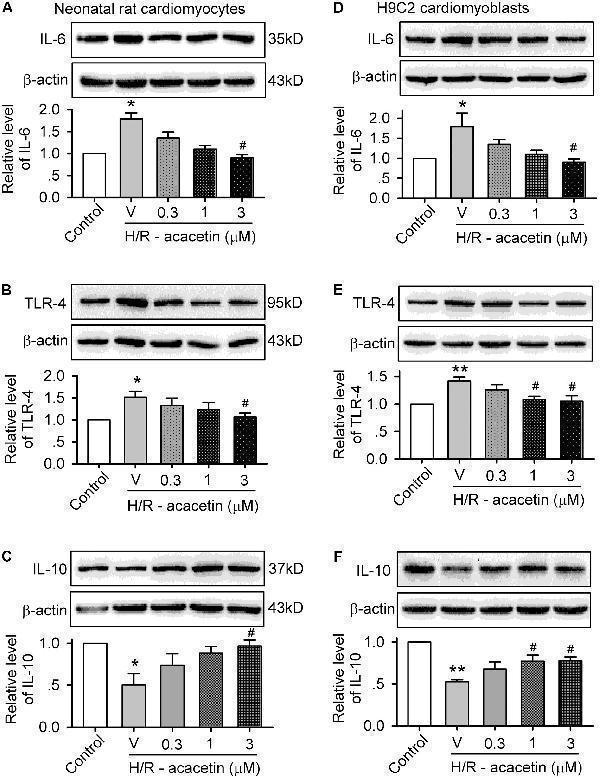
Effects of acacetin on inflammation-related cytokines in cells with hypoxia/reoxygenation exposure. Western blots and mean relative level of IL-6 (A) , TLR-4 (B) , IL-10 (C) in neonatal rat cardiomyocytes without (control) or with hypoxia/reoxygenation (H/R) exposure in the absence (V, vehicle) or presence of 0.3, 1, or 3 μM acacetin. Western blots and mean relative level of IL-6 (D) , TLR-4 (E) , IL-10 (F) in H9C2 cardiomyoblasts with the treatment used in (A–C) . Data were expressed as mean ± SEM and analyzed by one-way ANOVA followed by the Bonferroni-test ( n = 5 individual experiments, ∗ P < 0.05, ∗∗ P < 0.01 vs. control; # P < 0.05 vs. hypoxia/reoxygenation alone).
Index in PubMed under a CC BY license. PMID: 29867499
Click image to see more details
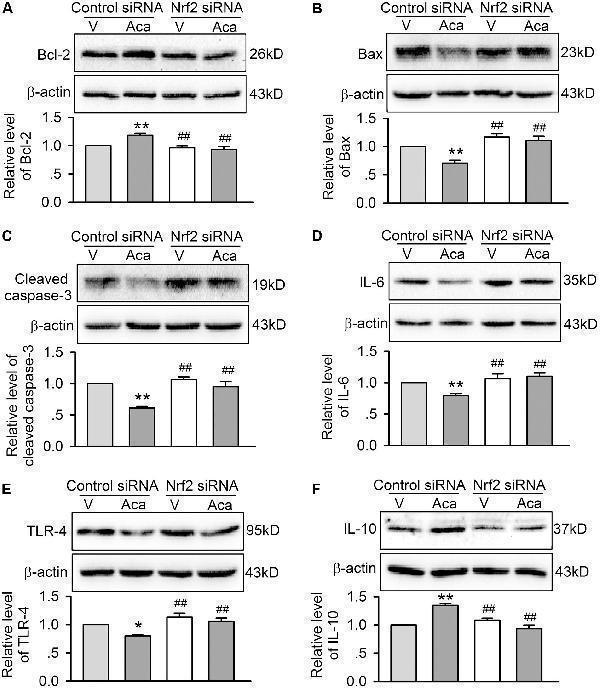
Effects of silencing Nrf2 on apoptosis- and inflammation-related proteins in cells with hypoxia/reoxygenation insult. Western blots and relative levels of Bcl-2 (A) , Bax (B) , and cleaved caspase-1 (C) in H9C2 cardiomyoblasts transfected with control siRNA or Nrf2 siRNA and subjected to hypoxia/reoxygenation insult in the absence (V, vehicle) or presence of 3 μM acacetin (Aca). Western blots and relative levels of IL-6 (D) , TRL-4 (E) , and IL-10 (F) in H9C2 cardiomyoblasts with the treatment used in (A–C) . Data were expressed as mean ± SEM and analyzed by one-way ANOVA followed by Bonferroni-test ( n = 5 individual experiments, ∗ P < 0.05, ∗∗ P < 0.01 vs. vehicle of control siRNA; ## P < 0.01 vs. control siRNA with acacetin).
Index in PubMed under a CC BY license. PMID: 29867499
Specific Publications For Anti-IL6 Antibody Picoband® (PB9005)
Loading publications
Recommended Resources
Here are featured tools and databases that you might find useful.
- Boster's Pathways Library
- Protein Databases
- Bioscience Research Protocol Resources
- Data Processing & Analysis Software
- Photo Editing Software
- Scientific Literature Resources
- Research Paper Management Tools
- Molecular Biology Software
- Primer Design Tools
- Bioinformatics Tools
- Phylogenetic Tree Analysis
Customer Reviews
Have you used Anti-IL6 Antibody Picoband®?
Share your experimental results or join a short interview to earn up to $1,000 in product credits or other rewards.
0 Reviews For Anti-IL6 Antibody Picoband®
Customer Q&As
Have a question?
Find answers in Q&As, reviews.
Can't find your answer?
Submit your question
3 Customer Q&As for Anti-IL6 Antibody Picoband®
Question
We have observed staining in rat fibroblast. What should we do? Is anti-IL6 antibody supposed to stain fibroblast positively?
Verified Customer
Verified customer
Asked: 2020-03-03
Answer
According to literature fibroblast does express IL6. According to Uniprot.org, IL6 is expressed in left coronary artery, fibroblast, lung, among other tissues. Regarding which tissues have IL6 expression, here are a few articles citing expression in various tissues:
Fibroblast, Pubmed ID: 3758081
Lung, Pubmed ID: 15489334
Boster Scientific Support
Answered: 2020-03-03
Question
My team were happy with the WB result of your anti-IL6 antibody. However we have seen positive staining in lung secreted. using this antibody. Is that expected? Could you tell me where is IL6 supposed to be expressed?
B. Miller
Verified customer
Asked: 2015-06-10
Answer
Based on literature, lung does express IL6. Generally IL6 expresses in secreted. Regarding which tissues have IL6 expression, here are a few articles citing expression in various tissues:
Fibroblast, Pubmed ID: 3758081
Lung, Pubmed ID: 15489334
Boster Scientific Support
Answered: 2015-06-10
Question
We are currently using anti-IL6 antibody PB9005 for rat tissue, and we are content with the WB results. The species of reactivity given in the datasheet says rat. Is it possible that the antibody can work on monkey tissues as well?
J. Miller
Verified customer
Asked: 2013-08-06
Answer
The anti-IL6 antibody (PB9005) has not been tested for cross reactivity specifically with monkey tissues, though there is a good chance of cross reactivity. We have an innovator award program that if you test this antibody and show it works in monkey you can get your next antibody for free. Please contact me if I can help you with anything.
Boster Scientific Support
Answered: 2013-08-06