

Click image to see more details
Product Info Summary
| SKU: | A00124 |
|---|---|
| Size: | 500ug |
| Reactive Species: | Mouse |
| Host: | Rabbit |
| Application: | ELISA, IF, IHC, WB |
Customers Who Bought This Also Bought

Product info
Product Name
Anti-Mouse IL-18 Antibody
SKU/Catalog Number
A00124
Size
500ug
Form
Liquid (sterile filtered)
Description
Boster Bio Anti-Mouse IL-18 Antibody (Catalog # A00124). Tested in IF, IHC applications. This antibody reacts with Mouse.
Storage & Handling
Store vial at -20°C prior to opening. Aliquot contents and freeze at -20°C or below for extended storage. Avoid cycles of freezing and thawing. Centrifuge product if not completely clear after standing at room temperature. This product is stable for several weeks at 4°C as an undiluted liquid. Dilute only prior to immediate use. Expiration date is one (1) year from date of opening. (Ship on dry ice.)
Cite This Product
Anti-Mouse IL-18 Antibody (Boster Biological Technology, Pleasanton CA, USA, Catalog # A00124)
Host
Rabbit
Contents
0.02 M Potassium Phosphate, 0.15 M Sodium Chloride, pH 7.2
Clonality
Polyclonal
Isotype
IgG
Immunogen
The whole rabbit serum used to produce this IgG fraction antibody was prepared by repeated immunizations with native 157 aa mouse IL-18 produced in E.coli.
Cross-reactivity
beta-Actin antibody is human, mouse, rat, rabbit, chicken, zebrafish and drosophila reactive.
Reactive Species
A00124 is reactive to IL18 in Mouse
Observed Molecular Weight
68 kDa
Calculated molecular weight
22.1 kDa
Background of IL18
Interleukin-18 (IL-18) is a member of the IL-1 cytokine family and was initially identified as an Interferon-g (IFN-g) inducing factor (IGIF). The IL-18 gene was originally cloned from liver cells and has since been shown to be produced by activated monocytes/ macrophages, Kupffer cells, keratinocytes, glucocorticoid-secreting adrenal cortex cells, osteoblasts and dendritic cells. IL-18 is a 24 kDa, non-glycosylated polypeptide that lacks a classical signal sequence and possesses a structure recognizably similar to IL-1. IL-18 is synthesized as a bio-inactive propeptide that undergoes proteolytic cleavage by either ICE (interleukin-1 beta converting enzyme) or another caspase to generate a mature, bioactive, 18 kDa molecule. In both the mature and propeptide forms, IL-18 shows 64% aa sequence identity from mouse to human. IL-18 does not appear to show any primary sequence similarity to any other known cytokines. Rat IL-18 has also been isolated, and found to be 194 aa in length with a 91% aa sequence identity to mouse IL-18. Human IL-18 has been found to induce the production of IFN-g and GM-CSF while inhibiting the production of IL-10 by PBMC. With respect to human T cells, IL-18 enhances Th1 cytokine production and stimulates cell proliferation via an IL-2-dependent pathway. Human IL-18 can also inhibit the synthesis of IgE by B cells. Thus, IL-18 plays an important role in immunological and inflammatory reactions. Currently, the bioactivity of human IL-18 is often determined by its capacity to augment the levels of IFN-g produced by T cells as measured in tissue culture supernatants.
Antibody Validation
Boster validates all antibodies on WB, IHC, ICC, Immunofluorescence, and ELISA with known positive control and negative samples to ensure specificity and high affinity, including thorough antibody incubations.
Application & Images
Applications
A00124 is guaranteed for ELISA, IF, IHC, WB Boster Guarantee
Recommend Dilution
| Application | Dilution | Species |
|---|---|---|
| ELISA: 1:1 | 000 - 1:5 | 000 |
| WB: 1:500 - 1:2 | 000 | |
| Anti-Mouse IL-18 has been tested in immunohistochemistry and immunofluorescence and is suitable for use in neutralizations | ELISA | and immunoblotting. Although untested, this reagent may be useful for radioimmunoassays, flow cytometry and immunoprecipitation. It recognizes the 18,000 MW mature (active) IL-18. Reactivity in other immunoassays is unknown. |
Validation Images & Assay Conditions
Click image to see more details
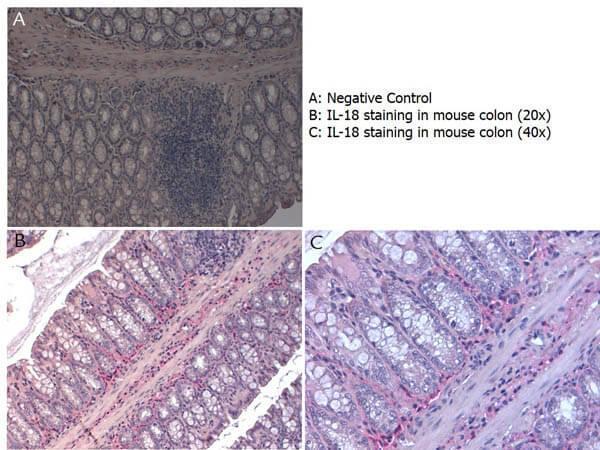
Immunohistochemistry with Rabbit anti-Mouse IL-18 antibody showing IL-18 staining in inflammatory cells of the mucous corium of mouse colon at 20x and 40x. Slide A is a negative control. Slides B and C show staining. Formalin fixed/paraffin embedded sections were subjected to heat induced epitope retrieval (HIER) at pH 6.2 and then incubated with mouse anti-IL-18 antibody at 4.0 µg/ml for 60 minutes. The reaction was developed using MACH 4 universal AP polymer detection system and visualized with WARP RED.
Click image to see more details
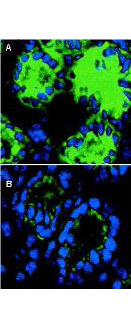
Immunofluorescence microscopy of IL-18 in mouse colon sections. The transversing portion of the large intestine from DSS-exposed (Panel A) and -unexposed mice (Panel B) was excised, rinsed in PBS, and frozen on isopentane cooled with liquid nitrogen. Frozen sections (5 µm) were cut on a Leica CM 1850 cryostat. The slides were fixed for 10 min in 4% paraformaldehyde, air-dried, and incubated for 20 min in PBS supplemented with 10% normal goat serum. Sections were incubated in a 1:50 dilution of Boster's rabbit anti-Mouse IL-18 antibody or 1 µg/ml nonimmune rabbit IgG (not shown) as negative control. The antibodies were diluted in PBS containing 1% bovine serum albumin. After an overnight incubation at 4°C, the sections were washed three times with 0.5% bovine serum albumin in PBS. The sections were then incubated with a secondary goat anti-rabbit antibody conjugated to Alexa488 (Molecular Probes) for 60 min at room temperature in the dark. Nuclei were counterstained blue using 1 µg/100 ml bisbenzimide. After staining, sections were washed and examined with the Leica DM RXA confocal laser scanning system and analyzed. Similar staining will occur with other systems.
Click image to see more details
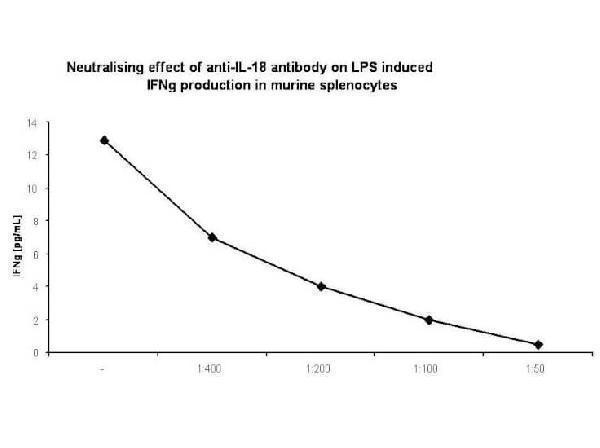
In-vitro neutralization. Spleens were aseptically removed and cell suspensions were prepared. Cells were washed twice and resuspended in RPMI supplemented with 10% FBS. For cytokine measurement, spleen cells were cultured at 5 mln/mL in 24-well, flat-bottom culture plates in the presence of several dilutions of rabbit anti-murine IL-18 antibody (1:400; 1:200; 1:100; 1:50) and 100 ng/mL of LPS (a phenol-extracted preparation from Escherichia coli 055:B5, Sigma Chemical Co). Cultures were incubated at 37°C in a humidified atmosphere with 5% CO2. At the end of the incubation period, cultures were frozen at -70°C and subjected to 3 freeze-thaw cycles to obtain total cytokine levels. Before assaying, samples were centrifuged for 10 minutes at 10,000g to remove debris.
Specific Publications For Anti-Mouse IL-18 Antibody (A00124)
Loading publications
Recommended Resources
Here are featured tools and databases that you might find useful.
- Boster's Pathways Library
- Protein Databases
- Bioscience Research Protocol Resources
- Data Processing & Analysis Software
- Photo Editing Software
- Scientific Literature Resources
- Research Paper Management Tools
- Molecular Biology Software
- Primer Design Tools
- Bioinformatics Tools
- Phylogenetic Tree Analysis
Customer Reviews
Have you used Anti-Mouse IL-18 Antibody?
Share your experimental results or join a short interview to earn up to $1,000 in product credits or other rewards.
0 Reviews For Anti-Mouse IL-18 Antibody
Customer Q&As
Have a question?
Find answers in Q&As, reviews.
Can't find your answer?
Submit your question
14 Customer Q&As for Anti-Mouse IL-18 Antibody
Question
Thank you for helping with my inquiry over the phone. Here are the WB image, lot number and protocol we used for lower esophagus mucosa using anti-Mouse IL-18 antibody A00124. Let me know if you need anything else.
Verified Customer
Verified customer
Asked: 2020-05-01
Answer
I appreciate the data. You have provided everything we needed. Our lab team are working to resolve your inquiry as quickly as possible, and we appreciate your patience and understanding! Please let me know if there is anything you need in the meantime.
Boster Scientific Support
Answered: 2020-05-01
Question
I see that the anti-Mouse IL-18 antibody A00124 works with IHC, what is the protocol used to produce the result images on the product page?
Verified Customer
Verified customer
Asked: 2020-04-01
Answer
You can find protocols for IHC on the "support/technical resources" section of our navigation menu. If you have any further questions, please send an email to support@bosterbio.com
Boster Scientific Support
Answered: 2020-04-01
Question
Is this A00124 anti-Mouse IL-18 antibody reactive to the isotypes of IL18?
Verified Customer
Verified customer
Asked: 2020-02-25
Answer
The immunogen of A00124 anti-Mouse IL-18 antibody is The whole rabbit serum used to produce this IgG fraction antibody was prepared by repeated immunizations with native 157 aa mouse IL-18 produced in E.coli. Could you tell me which isotype you are interested in so I can help see if the immunogen is part of this isotype?
Boster Scientific Support
Answered: 2020-02-25
Question
My lab would like to test anti-Mouse IL-18 antibody A00124 on mouse lower esophagus mucosa for research purposes, then I may be interested in using anti-Mouse IL-18 antibody A00124 for diagnostic purposes as well. Is the antibody suitable for diagnostic purposes?
Verified Customer
Verified customer
Asked: 2020-01-14
Answer
The products we sell, including anti-Mouse IL-18 antibody A00124, are only intended for research use. They would not be suitable for use in diagnostic work. If you have the means to develop a product into diagnostic use, and are interested in collaborating with us and develop our product into an IVD product, please contact us for more discussions.
Boster Scientific Support
Answered: 2020-01-14
Question
My colleagues were content with the WB result of your anti-Mouse IL-18 antibody. However we have been able to see positive staining in urinary bladder secreted. using this antibody. Is that expected? Could you tell me where is IL18 supposed to be expressed?
Verified Customer
Verified customer
Asked: 2019-12-19
Answer
Based on literature, urinary bladder does express IL18. Generally IL18 expresses in secreted. Regarding which tissues have IL18 expression, here are a few articles citing expression in various tissues:
Liver, Pubmed ID: 8666798, 15326478
Peripheral blood, Pubmed ID: 10653850
Urinary bladder, Pubmed ID: 15489334
Boster Scientific Support
Answered: 2019-12-19
Question
Please see the WB image, lot number and protocol we used for lower esophagus mucosa using anti-Mouse IL-18 antibody A00124. Please let me know if you require anything else.
Verified Customer
Verified customer
Asked: 2019-10-15
Answer
Thank you very much for the data. Our lab team are working to resolve this as quickly as possible, and we appreciate your patience and understanding! You have provided everything we needed. Please let me know if there is anything you need in the meantime.
Boster Scientific Support
Answered: 2019-10-15
Question
We have observed staining in mouse urinary bladder. Any tips? Is anti-Mouse IL-18 antibody supposed to stain urinary bladder positively?
Verified Customer
Verified customer
Asked: 2019-06-20
Answer
According to literature urinary bladder does express IL18. According to Uniprot.org, IL18 is expressed in lower esophagus mucosa, liver, urinary bladder, peripheral blood, among other tissues. Regarding which tissues have IL18 expression, here are a few articles citing expression in various tissues:
Liver, Pubmed ID: 8666798, 15326478
Peripheral blood, Pubmed ID: 10653850
Urinary bladder, Pubmed ID: 15489334
Boster Scientific Support
Answered: 2019-06-20
Question
Will A00124 anti-Mouse IL-18 antibody work on parafin embedded sections? If so, which fixation method do you recommend we use (PFA, paraformaldehyde, other)?
Verified Customer
Verified customer
Asked: 2019-06-18
Answer
It shows on the product datasheet, A00124 anti-Mouse IL-18 antibody as been validated on IHC. It is best to use PFA for fixation because it has better tissue penetration ability. PFA needs to be prepared fresh before use. Long term stored PFA turns into formalin, as the PFA molecules congregate and become formalin.
Boster Scientific Support
Answered: 2019-06-18
Question
Is a blocking peptide available for product anti-Mouse IL-18 antibody (A00124)?
Verified Customer
Verified customer
Asked: 2019-01-14
Answer
We do provide the blocking peptide for product anti-Mouse IL-18 antibody (A00124). If you would like to place an order for it please contact support@bosterbio.com and make a special request.
Boster Scientific Support
Answered: 2019-01-14
Question
I was wanting to use your anti-Mouse IL-18 antibody for IHC for mouse lower esophagus mucosa on frozen tissues, but I want to know if it has been tested for this particular application. Has this antibody been tested and is this antibody a good choice for mouse lower esophagus mucosa identification?
Verified Customer
Verified customer
Asked: 2019-01-01
Answer
It shows on the product datasheet, A00124 anti-Mouse IL-18 antibody has been tested for IHC on mouse tissues. We have an innovator award program that if you test this antibody and show it works in mouse lower esophagus mucosa in IHC-frozen, you can get your next antibody for free.
Boster Scientific Support
Answered: 2019-01-01
Question
We are currently using anti-Mouse IL-18 antibody A00124 for mouse tissue, and we are satisfied with the IHC results. The species of reactivity given in the datasheet says mouse. Is it true that the antibody can work on zebrafish tissues as well?
Verified Customer
Verified customer
Asked: 2018-11-13
Answer
The anti-Mouse IL-18 antibody (A00124) has not been tested for cross reactivity specifically with zebrafish tissues, but there is a good chance of cross reactivity. We have an innovator award program that if you test this antibody and show it works in zebrafish you can get your next antibody for free. Please contact me if I can help you with anything.
Boster Scientific Support
Answered: 2018-11-13
Question
Is there a BSA free version of anti-Mouse IL-18 antibody A00124 available?
Verified Customer
Verified customer
Asked: 2017-12-05
Answer
We appreciate your recent telephone inquiry. I can confirm that some lots of this anti-Mouse IL-18 antibody A00124 are BSA free. For now, these lots are available and we can make a BSA free formula for you free of charge. It will take 3 extra days to prepare. If you require this antibody BSA free again in future, please do not hesitate to contact me and I will be pleased to check which lots we have in stock that are BSA free.
Boster Scientific Support
Answered: 2017-12-05
Question
I have a question about product A00124, anti-Mouse IL-18 antibody. I was wondering if it would be possible to conjugate this antibody with biotin. I would need it to be without BSA or sodium azide. I am planning on using a buffer exchange of sodium azide with PBS only. Would there be problems for me to conjugate the antibody and store it in -20 degrees in small aliquots?
E. Jha
Verified customer
Asked: 2014-07-08
Answer
We do not recommend storing this antibody with PBS buffer only in -20 degrees. If you want to store it in -20 degrees it is best to add some cryoprotectant like glycerol. If you want carrier free A00124 anti-Mouse IL-18 antibody, we can provide it to you in a special formula with trehalose and/or glycerol. These molecules will not interfere with conjugation chemistry and provide a good level of protection for the antibody from degradation. Please be sure to specify this in your purchase order.
Boster Scientific Support
Answered: 2014-07-08
Question
Will anti-Mouse IL-18 antibody A00124 work for IHC with lower esophagus mucosa?
C. Baker
Verified customer
Asked: 2013-10-08
Answer
According to the expression profile of lower esophagus mucosa, IL18 is highly expressed in lower esophagus mucosa. So, it is likely that anti-Mouse IL-18 antibody A00124 will work for IHC with lower esophagus mucosa.
Boster Scientific Support
Answered: 2013-10-08

