Product Info Summary
| SKU: | P01388 |
|---|---|
| Size: | 100 μl |
| Reactive Species: | Human, Mouse, Rat |
| Host: | Rabbit |
| Application: | IP, IF, IHC, ICC, WB |
Customers Who Bought This Also Bought
Product info
Product Name
Anti-Phospho-TrkB (Y817) NTRK2 Rabbit Monoclonal Antibody
SKU/Catalog Number
P01388
BM4437 is an alternative SKU for this antibody, used in previous lots.
Size
100 μl
Form
Liquid
Description
Boster Bio Anti-Phospho-TrkB (Y817) NTRK2 Rabbit Monoclonal Antibody catalog # P01388. Tested in WB, IHC, ICC/IF, IP applications. This antibody reacts with Human, Mouse, Rat.
Storage & Handling
Store at -20°C for one year. For short term storage and frequent use, store at 4°C for up to one month. Avoid repeated freeze-thaw cycles.
Cite This Product
Anti-Phospho-TrkB (Y817) NTRK2 Rabbit Monoclonal Antibody (Boster Biological Technology, Pleasanton CA, USA, Catalog # P01388)
Host
Rabbit
Contents
Rabbit IgG in stabilizing components, phosphate buffered saline, pH 7.4, 150mM NaCl, 0.02% sodium azide and 50% glycerol.
*This antibody is supplied in a stabilized formulation.
Compatibility with conjugation reactions depends on the chemistry of the conjugation method used.
For conjugation methods that are not compatible with the stabilizing components present in this formulation, a carrier-free antibody format is required.
Clonality
Monoclonal
Clone Number
EGA-14
Isotype
Rabbit IgG
Immunogen
A synthesized peptide derived from human Phospho-TrkB (Y817)
Reactive Species
P01388 is reactive to NTRK2 in Human, Mouse, Rat
Observed Molecular Weight
130 kDa
Calculated molecular weight
92.0 kDa
Antibody Validation
Boster validates all antibodies on WB, IHC, ICC, Immunofluorescence, and ELISA with known positive control and negative samples to ensure specificity and high affinity, including thorough antibody incubations.
Application & Images
Applications
P01388 is guaranteed for IP, IF, IHC, ICC, WB Boster Guarantee
Assay Dilutions Recommendation
The recommendations below provide a starting point for assay optimization. The actual working concentration varies and should be decided by the user.
WB 1:500-2000
IHC 1:50-200
ICC/IF 1:50-200
IP 1:30
Positive Control
WB: rat brain tissue, mouse brain tissue, SH-SY5Y cell
IHC: mouse brain cancer tissue
Validation Images & Assay Conditions
Click image to see more details
Western blot analysis of TrkB using anti-TrkB antibody (P01388).
Electrophoresis was performed on a 5-20% SDS-PAGE gel at 70V (Stacking gel) / 90V (Resolving gel) for 2-3 hours. The sample well of each lane was loaded with 30 ug of sample under reducing conditions.
Lane 1: rat brain tissue lysates,
Lane 2: mouse brain tissue lysates.
After electrophoresis, proteins were transferred to a nitrocellulose membrane at 150 mA for 50-90 minutes. Blocked the membrane with 5% non-fat milk/TBS for 1.5 hour at RT. The membrane was incubated with rabbit anti-TrkB antigen affinity purified monoclonal antibody (Catalog # P01388) at 1:500 overnight at 4°C, then washed with TBS-0.1%Tween 3 times with 5 minutes each and probed with a goat anti-rabbit IgG-HRP secondary antibody at a dilution of 1:500 for 1.5 hour at RT. The signal is developed using an Enhanced Chemiluminescent detection (ECL) kit (Catalog # EK1002) with Tanon 5200 system. A specific band was detected for TrkB at approximately 130 kDa. The expected band size for TrkB is at 92 kDa.
Click image to see more details
Western blot analysis of Phospho-TrkB (Y817) expression in SH-SY5Y cell lysate treated with BDNF.
Click image to see more details
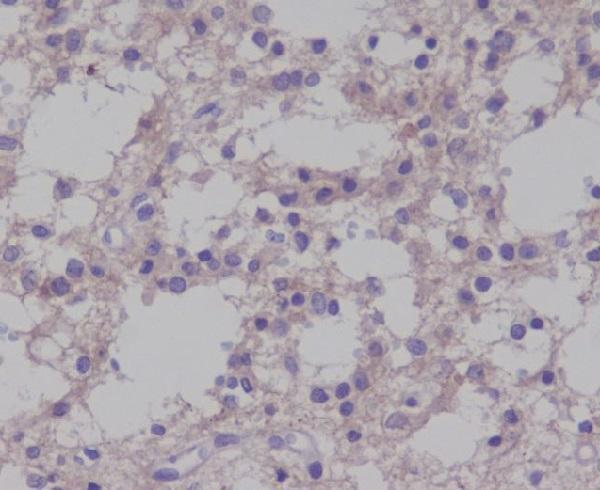
Immunohistochemical analysis of paraffin-embedded mouse brain cancer, using Phospho-TrkB (Y817) Antibody.
Click image to see more details
Immunofluorescent analysis using the Antibody at 1:50 dilution.
Click image to see more details
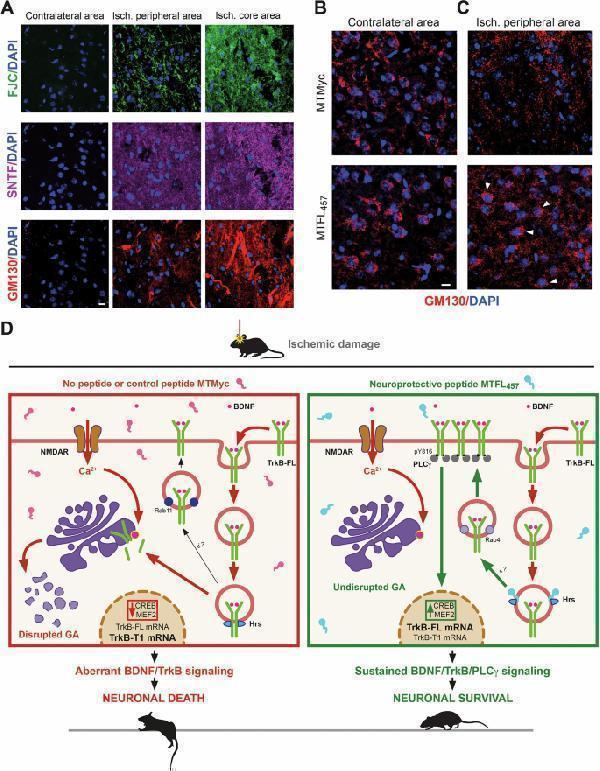
Effect of brain ischemia on GA stability, MTFL 457 regulation, and proposed model. A Strong association between neuronal degeneration and serum protein leakage after ischemic damage. Immunohistochemistry of brain coronal sections from animals sacrificed 5 h after insult was performed with an antibody recognizing a calpain-generated neoepitope in spectrin N-terminal fragment (SNTF, magenta), labeling cells where this protease is overactive, and a mouse antibody recognizing GM130 (red). Neurodegeneration was also detected by Fluoro-Jade C (FJC) staining (green). Three different tissue areas were compared: the ischemic core, an area peripheral to the infarct core, and the equivalent area of the contralateral hemisphere. Leakage of mouse immunoglobulins due to early blood-brain barrier (BBB) breakage after the ischemic insult, detected by the secondary anti-mouse antibody (see Fig. S ), was observed in the neurodegenerating tissue and strongly interfered with GM130 detection. B , C GM130 staining after preincubation of coronal sections with an anti-mouse IgG (Fab specific) antibody to improve detection. Animals were retro-orbitally injected with peptides MTMyc or MTFL 457 (10 nmol/g) 10 min after damage initiation and sacrificed 5 h later. Comparison of the contralateral ( B ) and the ischemic peripheral areas ( C ). Representative images correspond to single sections. Scale bar: 10 µm. D Model of TrkB-FL regulation in excitotoxicity and MTFL 457 action. Endocytosis of neurotrophin receptor TrkB-FL is promoted by excitotoxicity in neurons treated with control peptide MTMyc or without treatment (left panel). In endosomes, TrkB-FL interacts with the protein Hrs and is retrogradely transported to the Golgi apparatus (GA), where activation of organelle-associated proteinases would be responsible for receptor processing by calpain and regulated intramembrane proteolysis (RIP). Although partial recycling back to the membrane might occur via mechanisms similar to those found after BDNF activation, there is a strong decrease in BDNF/TrkB-FL signaling and CREB/MEF2 promoter activities, causing transcriptional changes that favor neuronal death. In parallel, the GA is disrupted, a hallmark common to many neurodegenerative diseases (NDDs). The neuroprotective peptide MTFL 457 interferes with the TrkB-FL/Hrs interaction induced by excitotoxicity, receptor retrograde transport and processing, as well as GA fragmentation (right panel). We propose that interference by MTFL 457 with the TrkB-FL/Hrs interaction might favor rapid recycling back to the membrane, similar to that of isoform TrkB-T1, sustained BDNF/TrkB-FL/PLCγ signaling, and promotion of neuronal survival.
Index in PubMed under a CC BY license. PMID: 40883288
Click image to see more details
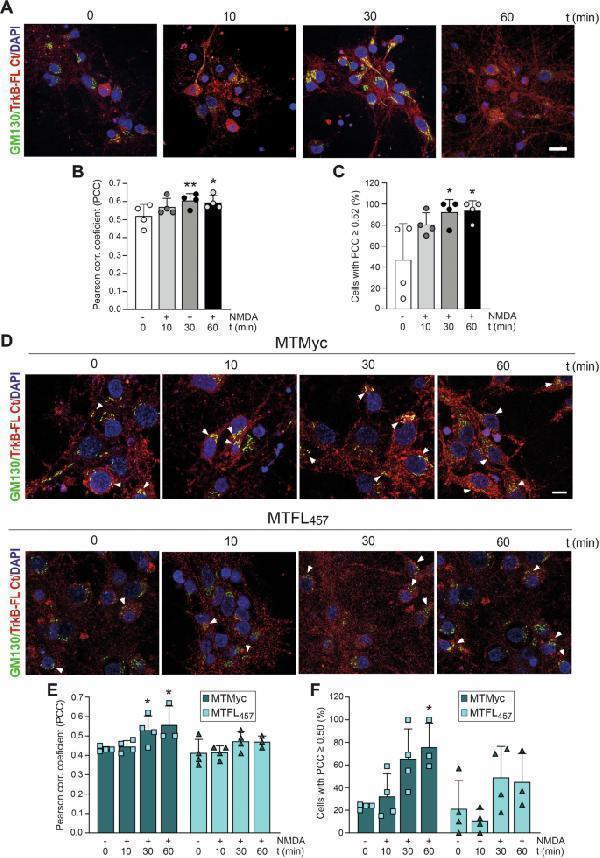
Effect of excitotoxicity on TrkB-FL transport to the Golgi complex and regulation by MTFL 457 action. Cortical neurons were treated with NMDA for the indicated times and analyzed by immunofluorescence with antibodies specific for the Golgi matrix protein GM130 (green) and TrkB-FL Ct (red); nuclear staining was performed with DAPI (blue). Excitotoxicity was induced in the absence of peptides ( A – C ) or after preincubation with MTMyc and MTFL 457 (25 μM, 30 min) ( D – F ). A , D Representative images obtained by confocal microscopy corresponding to single sections, showing channels fused. Scale bar: 20 μm. B , E Mean PCC values ± SD (0-30 min, n = 4; 60 min, n = 3) for TrkB-FL and GM130 colocalization. Statistical analysis was performed using a generalized linear model followed by a post-hoc Fisher’s LSD test (* P < 0.05, ** P < 0.01, compared to basal conditions without peptide or with MTMyc, respectively). C , F Percentage of cells showing, at different treatment times, a PCC ≥ 0.52 ( C ), the value obtained for TrkB-FL/GM130 colocalization in basal conditions in the absence of peptide, or ≥ 0.50 ( F ). Statistical analysis was performed by one-way ANOVA followed by a Bonferroni post hoc test (* P < 0.05, compared to basal conditions without peptide or with MTMyc, respectively; 0–30 min, n = 4; 60 min, n = 3). For each independent experiment, a minimum of 80 different neurons were analyzed.
Index in PubMed under a CC BY license. PMID: 40883288
Click image to see more details
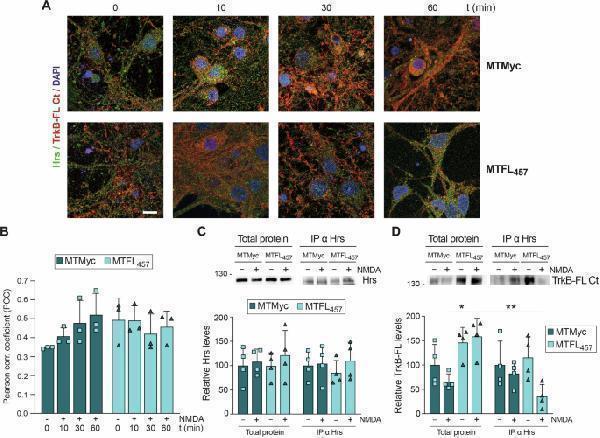
Regulation by MTFL 457 of the TrkB-FL/Hrs interaction induced by excitotoxicity. A Cortical neurons were preincubated with MTMyc and MTFL 457 (25 μM, 30 min) and treated with NMDA for the indicated times. Cells were analyzed by immunofluorescence with antibodies for Hrs (green) and TrkB-FL Ct (red), together with DAPI staining (blue). Representative confocal microscopy images correspond to single sections and show the fused channels. Scale bar: 10 μm. B Mean values ± SD of Pearson correlation coefficient (PCC; n = 3). For each independent experiment, a minimum of 80 different neurons were analyzed. Statistical analysis was performed using a generalized linear model followed by a post-hoc Fisher’s LSD test ( P = 0.06, 0 vs. 60 min of NMDA treatment in MTMyc-cultures). C , D Analysis by immunoprecipitation of TrkB-FL/Hrs interaction. Cultures preincubated with cell-penetrating peptides (CPPs) as above were treated with NMDA for 30 min and compared to untreated cultures. Immunoprecipitation (IP) was performed with the Hrs antibody, and the immunoprecipitated proteins were analyzed by immunoblot using the same antibody ( C ) or TrkB-FL Ct ( D ). Total protein lysates and immunoprecipitated proteins were analyzed in parallel. Mean values ± SD ( n = 4) of Hrs and TrkB-FL levels relative to those found in cells preincubated with MTMyc and without NMDA are represented. Statistical analysis was performed using two-way ANOVA followed by a Bonferroni test (* P < 0.05, ** P < 0.01).
Index in PubMed under a CC BY license. PMID: 40883288
Click image to see more details
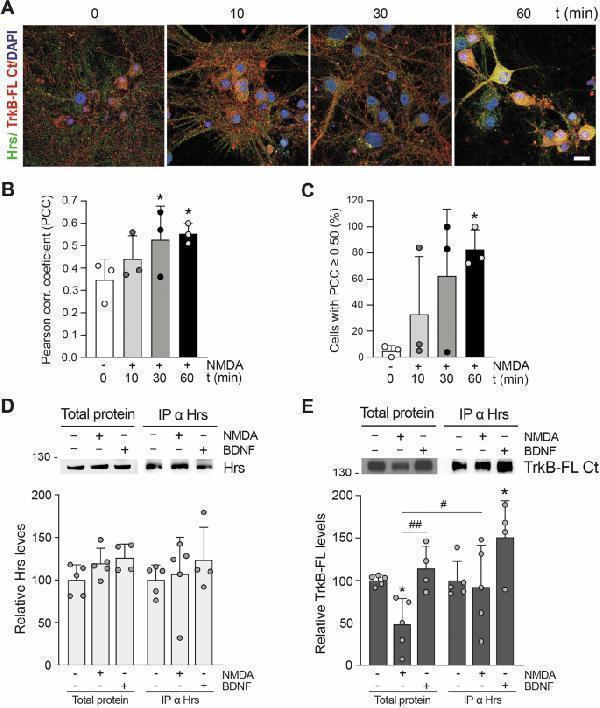
Effect of excitotoxicity on TrkB-FL interaction with endosomal protein Hrs. A – C Analysis by immunofluorescence of TrkB-FL/Hrs colocalization. A Cortical neurons were treated with NMDA for the indicated times and analyzed with antibodies specific for Hrs (green) and TrkB-FL Ct (red); nuclear staining was performed with DAPI (blue). Representative images obtained by confocal microscopy correspond to single sections and show the fused channels. Scale bar: 20 μm. B Mean values ± SD of Pearson correlation coefficient (PCC; n = 3). For each independent experiment, a minimum of 80 different neurons were analyzed. Statistical analysis was performed using a generalized linear model followed by a post-hoc Fisher’s LSD test (* P < 0.05, compared to untreated cultures). C Percentage of cells showing at different times of NMDA treatment a PCC ≥ 0.50, generally considered as a threshold for protein colocalization. Statistical analysis was performed as before ( * P < 0.05, compared to untreated cultures; n = 3). D , E Analysis by immunoprecipitation of TrkB-FL/Hrs interaction. Neuronal cultures were treated with NMDA (100 μM) or BDNF (100 ng/ml) for 30 min and compared to untreated cultures. Immunoprecipitation was performed with the Hrs antibody, and the immunoprecipitated proteins (IP) were analyzed by immunoblot using the same antibody ( D ) or TrkB-FL Ct ( E ). Total protein lysates were analyzed in parallel with the immunoprecipitated proteins. Mean values ± SD ( n = 5, except for BDNF-treated cells where n = 4) of Hrs and TrkB-FL levels in NMDA- or BDNF-treated cultures relative to untreated cells are represented for both total lysates and Hrs-immunoprecipitated proteins. Statistical analysis was performed as above ( *P < 0.05, compared to the respective untreated cultures; # P < 0.05 and ## P < 0.01, as indicated).
Index in PubMed under a CC BY license. PMID: 40883288
Click image to see more details
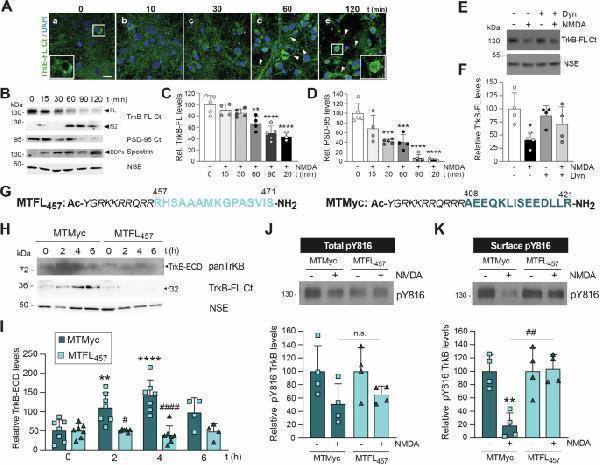
MTFL 457 preserves pY816-TrkB-FL at the cell surface, protecting it from proteolytic machinery activated secondarily by excitotoxicity. A – D Kinetics of TrkB-FL downregulation. Primary cortical cultures were treated with 100 μM NMDA and its co-agonist 10 μM glycine (hereafter referred to as ‘NMDA’). Immunofluorescence ( A ) and immunoblotting ( B ) used a C-terminal (C-ter) isoform-specific antibody (TrkB-FL Ct) recognizing both the full-length protein (FL) and the intracellular fragment (f32). A Shows TrkB-FL (green) and nuclei (blue, DAPI stain). Arrowheads indicate varicosities in neuronal projections. Scale bar: 20 μm. Insets show cell body details for untreated cells and cells treated with NMDA for 120 min. B Compares the decrease in TrkB-FL and formation of f32 with PSD-95 downregulation, detected using a C-terminal antibody (PSD-95 Ct). Calpain activation was confirmed by the accumulation of characteristic spectrin breakdown products (BDPs; 150 and 145 kDa). Neuron-specific enolase (NSE) served as a loading control for protein normalization. C , D Quantification of normalized TrkB-FL and PSD-95 levels, shown relative to levels in the absence of NMDA (control). Data are represented as means ± SD. Statistical analysis: one-way analysis of variance (ANOVA) followed by Bonferroni post hoc test (** P < 0.01, *** P < 0.001, **** P < 0.0001; 0-90 min, n = 5; 120 min, n = 3). E , F Effect of dynasore preincubation (80 μM, 30 min) on TrkB-FL levels after 2 h NMDA treatment. Data are means ± SD ( n = 4); statistical analysis as above (* P < 0.05). G Sequences of the cell-penetrating neuroprotective peptide (MTFL 457 ) and control peptide (MTMyc). Both contain Tat amino acids (aa) 47–57 (italic), followed by rat TrkB-FL aa 457-471 (light blue) or c-Myc aa 408-421 (dark blue), respectively. H , I Effect of peptide preincubation (25 μM, 30 min) on TrkB-FL shedding and processing during NMDA treatment. Culture media were analyzed using an antibody against the TrkB-FL extracellular domain (panTrkB), which recognizes the ectodomains (ECDs) of all isoforms (TrkB-ECD), to assess receptor shedding by metalloproteinase (MP) activation. Total lysates were analyzed with the TrkB-FL Ct antibody to evaluate TrkB-FL calpain processing via f32 production. Relative TrkB-ECD levels are shown as means ± SD (0-4 h, n = 7; 6 h, n = 4). Statistical analysis: two-way ANOVA followed by Bonferroni post hoc test (** P < 0.01, **** P < 0.0001, comparing each peptide + NMDA vs. peptide alone; # P < 0.05, #### P < 0.0001, comparing MTMyc vs. MTFL 457 at each time point). J , K Effect of NMDA on total and cell-surface pY816-TrkB-FL levels. Cultures were preincubated with peptides as above, then treated briefly with NMDA (1 h) to minimize receptor degradation. Cell-surface proteins were biotin-labeled and precipitated, then compared to corresponding total lysates. Data are represented as means ± SD ( n = 4). Statistical analysis: two-way ANOVA followed by Bonferroni post hoc test ( n.s . = n ot significant; ** P < 0.01, comparing NMDA vs. no NMDA; ## P < 0.01, comparing MTMyc + NMDA vs. MTFL 457 + NMDA).
Index in PubMed under a CC BY license. PMID: 40883288
Click image to see more details
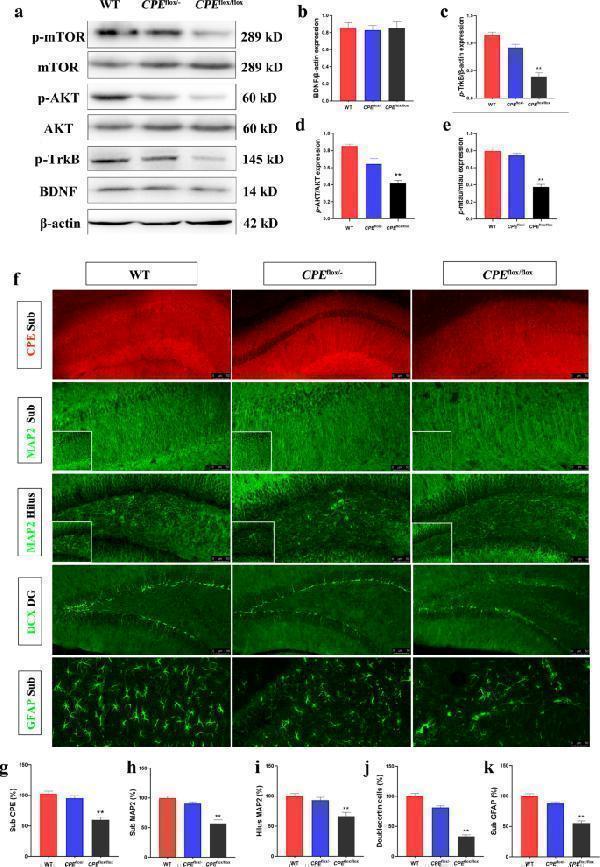
Decreased hippocampal dentate gyrus (DG) neurogenesis in CPE flox/flox mice. a – e Western blot analysis of p -TrkB, BDNF, p -mTOR, mTOR, p -AKT, and AKT levels in the hippocampus. f Immunofluorescence of CPE, MAP2, DCX, and GFAP; and the relative fluorescent intensities of g CPE in Sub, h MAP2 in Sub, i MAP2 in hilius, j DCX in DG, k GFAP in DG of WT, CPE flox/− , and CPE flox/flox mice at 100× and 400× (square in the panel). n = 6; * P < 0.05 and ** P < 0.01 compared with WT; values are mean ± SEM.
Index in PubMed under a CC BY license. PMID: 37100779
Specific Publications For Anti-Phospho-TrkB (Y817) NTRK2 Rabbit Monoclonal Antibody (P01388)
Loading publications
Recommended Resources
Here are featured tools and databases that you might find useful.
- Boster's Pathways Library
- Protein Databases
- Bioscience Research Protocol Resources
- Data Processing & Analysis Software
- Photo Editing Software
- Scientific Literature Resources
- Research Paper Management Tools
- Molecular Biology Software
- Primer Design Tools
- Bioinformatics Tools
- Phylogenetic Tree Analysis
Customer Reviews
Have you used Anti-Phospho-TrkB (Y817) NTRK2 Rabbit Monoclonal Antibody?
Share your experimental results or join a short interview to earn up to $1,000 in product credits or other rewards.
0 Reviews For Anti-Phospho-TrkB (Y817) NTRK2 Rabbit Monoclonal Antibody
Customer Q&As
Have a question?
Find answers in Q&As, reviews.
Can't find your answer?
Submit your question
5 Customer Q&As for Anti-Phospho-TrkB (Y817) NTRK2 Rabbit Monoclonal Antibody
Question
My lab would like using your anti-Phospho-TrkB (Y817) Rabbit Monoclonal antibody for modulating synaptic transmission studies. Has this antibody been tested with western blotting on mouse brain? We would like to see some validation images before ordering.
Verified Customer
Verified customer
Asked: 2019-08-28
Answer
I appreciate your inquiry. This P01388 anti-Phospho-TrkB (Y817) Rabbit Monoclonal antibody is tested on mouse brain. It is guaranteed to work for IP, IF, IHC, ICC, WB in human, mouse, rat. Our Boster guarantee will cover your intended experiment even if the sample type has not been be directly tested.
Boster Scientific Support
Answered: 2019-08-28
Question
We have been able to see staining in mouse amygdala. Any tips? Is anti-Phospho-TrkB (Y817) Rabbit Monoclonal antibody supposed to stain amygdala positively?
Verified Customer
Verified customer
Asked: 2019-04-15
Answer
Based on literature amygdala does express NTRK2. Based on Uniprot.org, NTRK2 is expressed in hypothalamus, hippocampus, brain, amygdala, plasma, among other tissues. Regarding which tissues have NTRK2 expression, here are a few articles citing expression in various tissues:
Amygdala, Pubmed ID: 14702039
Brain, Pubmed ID: 7823156, 15164053, 15489334
Hippocampus, Pubmed ID: 7789988, 7936202
Plasma, Pubmed ID: 16335952
Boster Scientific Support
Answered: 2019-04-15
Question
My team were well pleased with the WB result of your anti-Phospho-TrkB (Y817) Rabbit Monoclonal antibody. However we have been able to see positive staining in amygdala cell membrane using this antibody. Is that expected? Could you tell me where is NTRK2 supposed to be expressed?
Verified Customer
Verified customer
Asked: 2018-07-06
Answer
According to literature, amygdala does express NTRK2. Generally NTRK2 expresses in cell membrane. Regarding which tissues have NTRK2 expression, here are a few articles citing expression in various tissues:
Amygdala, Pubmed ID: 14702039
Brain, Pubmed ID: 7823156, 15164053, 15489334
Hippocampus, Pubmed ID: 7789988, 7936202
Plasma, Pubmed ID: 16335952
Boster Scientific Support
Answered: 2018-07-06
Question
Our lab used your anti-Phospho-TrkB (Y817) Rabbit Monoclonal antibody for IF on amygdala a few years ago. I am using human, and We are going to use the antibody for ICC next. Our lab want to know about examining amygdala as well as hypothalamus in our next experiment. Do you have any suggestion on which antibody would work the best for ICC?
A. Jones
Verified customer
Asked: 2015-09-11
Answer
I viewed the website and datasheets of our anti-Phospho-TrkB (Y817) Rabbit Monoclonal antibody and I see that P01388 has been tested on human in both IF and ICC. Thus P01388 should work for your application. Our Boster satisfaction guarantee will cover this product for ICC in human even if the specific tissue type has not been validated. We do have a comprehensive range of products for ICC detection and you can check out our website bosterbio.com to find out more information about them.
Boster Scientific Support
Answered: 2015-09-11
Question
We are currently using anti-Phospho-TrkB (Y817) Rabbit Monoclonal antibody P01388 for rat tissue, and we are satisfied with the ICC results. The species of reactivity given in the datasheet says human, mouse, rat. Is it likely that the antibody can work on horse tissues as well?
N. Rodriguez
Verified customer
Asked: 2014-10-27
Answer
The anti-Phospho-TrkB (Y817) Rabbit Monoclonal antibody (P01388) has not been tested for cross reactivity specifically with horse tissues, though there is a good chance of cross reactivity. We have an innovator award program that if you test this antibody and show it works in horse you can get your next antibody for free. Please contact me if I can help you with anything.
Boster Scientific Support
Answered: 2014-10-27