This website uses cookies to ensure you get the best experience on our website.


- Table of Contents
Sample fixation is a required and crucial step for every successful IHC/ICC experiment. Appropriate fixation of samples provides the following benefits during the tissue preparation process. Without proper fixation, cellular structures can collapse, antigens may degrade, and staining results become unreliable. Within standardized immunohistochemistry services, fixation parameters are carefully controlled to support consistent staining performance across diverse sample types.
Fixatives work by stabilizing proteins and other cellular components, either by creating cross-links or by precipitating molecules to maintain structural integrity. This chemical stabilization preserves the spatial arrangement of cells and tissues, allowing accurate localization of antigens and reliable analysis.
Choosing which fixing solution to use depends on your sample type and antigen. Since there is no standard fixing solution for all samples, we recommend testing to determine which specific type of solution will be most appropriate and effective for antigen immobilization in your sample. This step is particularly important when preparing slides for a multiplex IHC service, where inconsistent fixation can compromise the detection of multiple targets within the same section. For samples undergoing diagnostic evaluation or complex biomarker analysis, an expert Pathology Review Service ensures tissue quality and fixation adequacy before interpretation, improving experimental accuracy.
As an example, compare the morphologies demonstrated below using different fixatives, both photographed at the same magnification.

On the left: A paraffin section of the small intestine mucosa that has been fixed in neutral buffered formalin, a cross-linking fixative. Nuclear and cytoplasmic preservation is satisfactory but some cellular shrinkage is present.
On the right: A paraffin section of the small intestine mucosa that has been fixed in 95% ethanol, a denaturing fixative. While nuclear preservation is fair, there is substantial shrinkage of cytoplasmic and extracellular elements.
Several fixing solutions are available for use and should be chosen based on the sample type or antigen studied in the experiment. Below are the 3 different categories of fixatives:
Aldehyde fixatives are di-functional cross-linking agents, which are widely used due to their strong penetrability, low contractibility, and low background. They help keep the cross-linking between tissues and maintain the antigen.

Formaldehyde and formalin are often referred to interchangeably. They are similar, but their chemical compositions are in fact different. Formalin (aka NBF) is a saturated water solution consisting of 37 to 40% (w/v) formaldehyde, which is diluted with a phosphate buffer to decelerate polymerization to formaldehyde. As a result, formalin’s fixing ability is decreased.
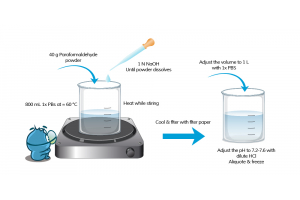
Paraformaldehyde (or polyoxymethylene) is polymerized formaldehyde powder. Dissolving paraformaldehyde in hot distilled water and adding 10% (v/v) methanol will produce the stabilized formaldehyde solution.
Precipitating fixatives, such as acetone and alcohol play the role of precipitating sugars and fat in addition to maintaining immunologic competence. Acetone is often chosen for unfixed, snap-frozen tissues and cytological smears due to its strong penetrability and dehydration property. Methanol and ethanol are the most common alcohols selected for cell and tissue fixation because of the similarities of their molecular structures with water, which enables them to substitute water molecules in tissues by competing for protein hydrogen bonds.
Precipitating fixatives are especially useful for snap-frozen tissues, where preserving enzyme activity is critical. They are also frequently applied in cytological smears to maintain cell morphology while allowing for immediate staining and analysis.
Non-aldehyde fixatives are valuable when aldehyde or precipitating fixatives are not suitable for the sample type or specific antigen. These fixatives often preserve cytological details while offering more intense staining. In cases where aldehyde or precipitating fixatives are not optimal choices for the sample type or antigen, non-aldehyde fixatives have been used as alternatives.
In some protocols, non-aldehyde fixatives are mixed with other fixatives to balance morphology preservation and antigen accessibility. This combination approach can optimize tissue integrity and staining outcomes for challenging samples.
Choosing the right fixative is crucial for the success of your IHC/ICC experiments. Contact us at support@bosterbio.com for expert advice and personalized recommendations for your specific samples and applications.