This website uses cookies to ensure you get the best experience on our website.


- Table of Contents
and ELISA kits, proteins related to Liver Cancer.
Liver cancer, a major health challenge globally, represents one of the most serious forms of cancer. Originating either directly in the liver (primary liver cancer) or spreading to the liver from other regions (secondary liver cancer), its common types include hepatocellular carcinoma (HCC), which is the most prevalent. Risk factors contributing to liver cancer include chronic infection with hepatitis B or C viruses, cirrhosis, alcohol consumption, and exposure to aflatoxins. Despite these challenges, advancements in medical research, particularly in the realm of targeted therapies and immunotherapies, provide hope. Antibodies have emerged as a groundbreaking tool in this fight, by specifically targeting cancer cells while sparing healthy tissue. This novel approach not only enhances the effectiveness of treatments but also minimizes side effects, marking a pivotal shift in liver cancer management. Our cutting-edge research continues to explore and develop antibodies that can potentially transform the landscape of liver cancer treatment, aiming to improve survival rates and quality of life for patients.

Anti-VEGF/VEGFA Antibody Picoband®, YJD affected the VEGF/VEGFR-2/FAK pathway in vivo. ( A – B ) Germ cell markers MVH and Oct4 were detected by IF. ( C ) The expression of VEGF, VEGFR-2, and...

Anti-MMP9 Antibody Picoband®, Conditioned medium derived from HCC cells grown on the high-stiffness substrate accelerates the formation of the lung pre-metastatic niche. a Schem...
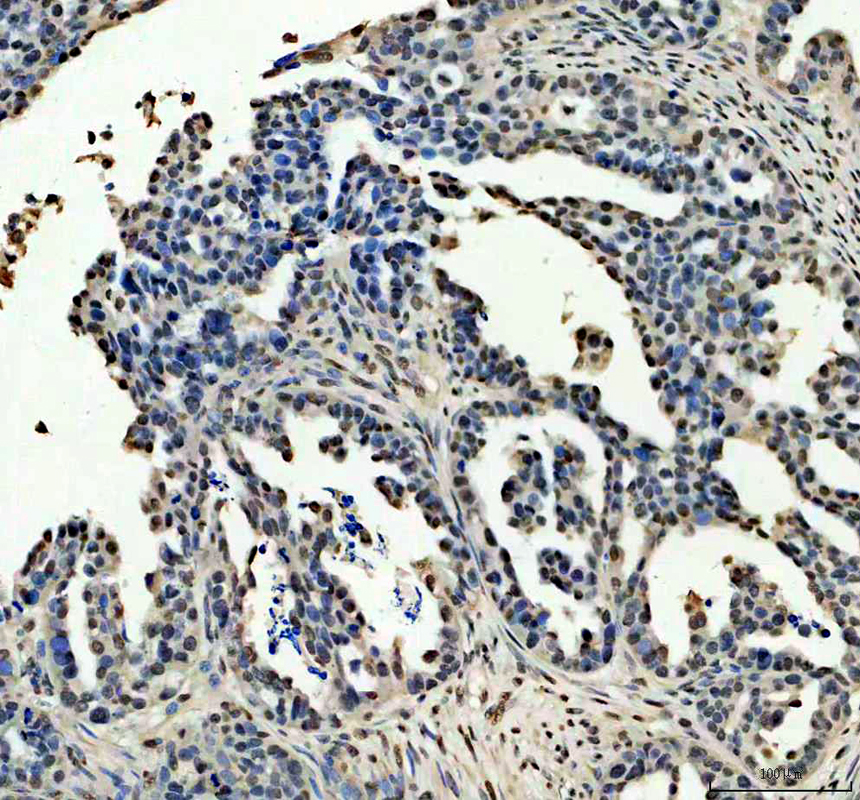
Anti-P53/TP53 Antibody Picoband®, IHC analysis of P53 using anti-P53 antibody (PB9008).
TP53 was detected in a paraffin-embedded section of humn ovarian cancer tissue. Heat mediated antigen retrieval was...
| Protein Name | Gene Name | Function |
|---|---|---|
| AFP | AFP | Prodces alpha-fetoprotein, a marker for hepatocellular carcinoma and yolk sac tumors |
| GPC3 | GPC3 | Plays a role in cell growth regulation, pathogenic in hepatocellular carcinoma |
| GLUL | GLUL | Involved in nitrogen metabolism, often overexpressed in liver cancer |
| ALB | ALB | Albumin levels can indicate liver function and are used in diagnostics of liver conditions |
| CDKN2A | CDKN2A | Regulates cell cycle and its deletion or mutation is linked to various cancers including liver cancer |
| TP53 | TP53 | Tumor suppressor protein, commonly mutated in cancers including liver |
| CTNNB1 | CTNNB1 | Plays a role in Wnt signaling pathway; mutations often found in hepatocellular carcinoma |
| MET | MET | Receptor tyrosine kinase implicated in the growth and development of hepatocellular carcinoma |
| AXIN1 | AXIN1 | Regulator of beta-catenin degredation, mutated in various liver cancers |
| TERT | TERT | Telomerase reverse transcriptase, reactivation is common in liver cancers for immortalization of cells |
| ARID1A | ARID1A | Chromatin remodeler, frequently mutated in several types of cancer including liver cancer |
| PKM | PKM | Pyruvate kinase M2 isoform, involved in glycolysis, often upregulated in cancer cells |
| FUT8 | FUT8 | Fucosyltransferase 8, involved in cell adhesion and migration, associated with tumor progression in liver cancer |
| RPS6KA3 | RPS6KA3 | Ribosomal protein S6 kinase, involved in cell growth and proliferation, implicated in liver cancer |
| MMP9 | MMP9 | Matrix metallopeptidase 9, involved in the breakdown of extracellular matrix, associated with cancer invasion and metastasis |
| IGF2 | IGF2 | Insulin-like growth factor 2, plays crucial roles in liver development and is implicated in liver tumorigenesis |
| EGFR | EGFR | Epidermal growth factor receptor, important for cell growth and survival, targeted by therapies in various cancers |
| VEGFA | VEGFA | Vascular endothelial growth factor A, key molecule in angiogenesis, which is critical for tumor growth and metastasis |
| PD1 | PDCD1 | Programmed cell death protein 1, negative regulator of the immune response, targeted by immunotherapies |
| PIK3CA | PIK3CA | Phosphatidylinositol-4,5-bisphosphate 3-kinase catalytic subunit alpha, mutation implicated in various cancers including liver cancer |
Hepatocellular carcinoma (HCC) is the most common type of primary liver cancer, accounting for a significant number of cases worldwide. This subtype primarily arises from hepatocytes, the predominant cells of the liver, which can become cancerous due to chronic liver diseases such as hepatitis B or C, and cirrhosis often caused by alcohol consumption. Research in HCC mechanisms primarily focuses on the molecular and cellular pathways that lead to tumor development and progression. This includes the study of gene mutations, dysregulation of cell growth signals, and the impact of metabolic syndromes. Scientists are particularly interested in how alterations in signaling pathways, like the Wnt/β-catenin pathway, contribute to the unchecked cellular proliferation characteristic of cancer. Further understanding these molecular mechanisms is crucial for developing targeted therapies that could inhibit the growth of HCC cells specifically without harming normal liver cells.
Liver Cancer Stem Cells (CSCs) represent a pivotal area in liver cancer research, offering insights into the origins of tumor regeneration and resistance to conventional therapies. These cells are a subpopulation within the tumor that possess the ability to self-renew and differentiate, much like normal stem cells. However, in the case of cancer, these abilities contribute to tumor heterogeneity and the continuous growth of the cancerous mass. Research on liver CSCs focuses on understanding the specific markers that identify these cells, such as EpCAM and CD133, and their role in tumor dynamics. The ultimate goal is to develop therapies that can selectively target and eliminate CSCs, thereby hindering the tumor's ability to rebound and spread after treatment. This approach holds promising potential not only for improving the effectiveness of treatments but also for reducing the likelihood of recurrence and metastasis.