

Click image to see more details
-

-
-
-
-
+1
Product Info Summary
| SKU: | M30480 |
|---|---|
| Size: | 100 µl |
| Reactive Species: | Human, Mouse, Rat |
| Host: | Mouse |
| Application: | WB |
Customers Who Bought This Also Bought

Product info
Product Name
Anti-DUSP4 Mouse Monoclonal Antibody [Clone ID: OTI7C11]
SKU/Catalog Number
M30480
Size
100 µl
Description
Boster Bio DUSP4 mouse monoclonal antibody,clone OTI7C11. Catalog# M30480. Tested in WB. This antibody reacts with Human, Mouse, Rat.
Storage & Handling
Store at -20°C as received.
Cite This Product
Anti-DUSP4 Mouse Monoclonal Antibody [Clone ID: OTI7C11] (Boster Biological Technology, Pleasanton CA, USA, Catalog # M30480)
Host
Mouse
Contents
PBS (pH 7.3) containing 1% stabilizing protein, 50% glycerol and 0.02% sodium azide.
This antibody is supplied in a stabilized formulation.
Compatibility with conjugation reactions depends on the chemistry of the conjugation method used.
For conjugation methods that are not compatible with the stabilizing components present in this formulation, a carrier-free antibody format is required.
Clonality
Monoclonal
Clone Number
OTI7C11
Isotype
IgG1
Immunogen
Human recombinant protein fragment corresponding to amino acids 1-257 of human DUSP4 (NP_476499) produced in E.coli.
Reactive Species
M30480 is reactive to DUSP4 in Human, Mouse, Rat
Calculated molecular weight
43.0 kDa
Antibody Validation
Boster validates all antibodies on WB, IHC, ICC, Immunofluorescence, and ELISA with known positive control and negative samples to ensure specificity and high affinity, including thorough antibody incubations.
Application & Images
Applications
M30480 is guaranteed for WB Boster Guarantee
Assay Dilutions Recommendation
The recommendations below provide a starting point for assay optimization. The actual working concentration varies and should be decided by the user.
WB: 1:2000
Validation Images & Assay Conditions
Click image to see more details
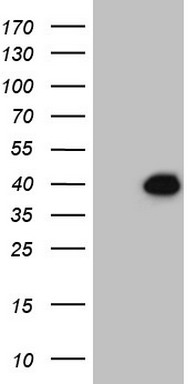
HEK293T cells were transfected with the pCMV6-ENTRY control (Left lane) or pCMV6-ENTRY DUSP4 (Right lane) cDNA for 48 hrs and lysed. Equivalent amounts of cell lysates (5 ug per lane) were separated by SDS-PAGE and immunoblotted with anti-DUSP4 (1:2000).
Click image to see more details
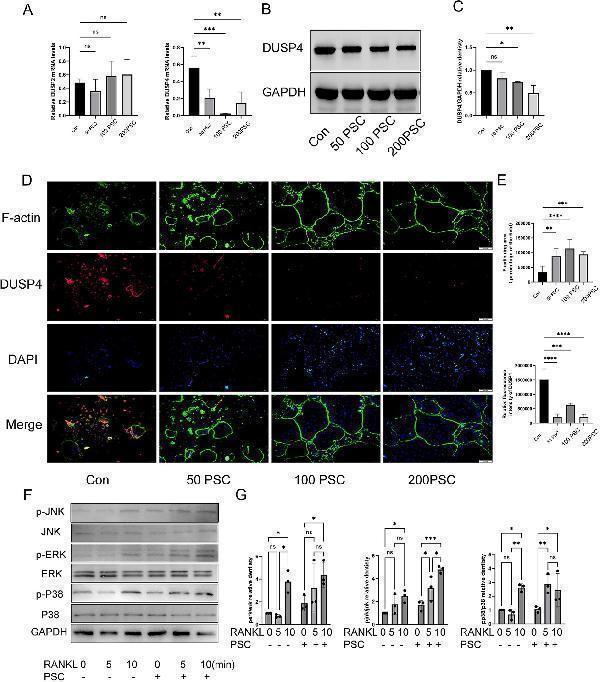
PSC intervention downregulates DUSP4 and upregulates the MAPK signaling pathway. (A) mRNA expression levels of DUSP2 and DUSP4 following different doses of PSC intervention. (B) Protein expression levels of DUSP4 after different doses of PSC intervention. (C) Quantification of DUSP4 protein levels shown in (B) . (D) Visualization of F-actin ring formation and DUSP4 expression in osteoclasts after different doses of PSC intervention. Green: F-actin; red: DUSP4; blue: DAPI. Magnification ×40. (E) Quantification of the F-actin ring area and the absolute and relative fluorescence intensity of DUSP4 shown in (D) . Data represent three independent experiments. ns, not significant; * p < 0.05, ** p < 0.01, *** p < 0.001, and **** p < 0.0001.
Index in PubMed under a CC BY license. PMID: 40177487
Click image to see more details
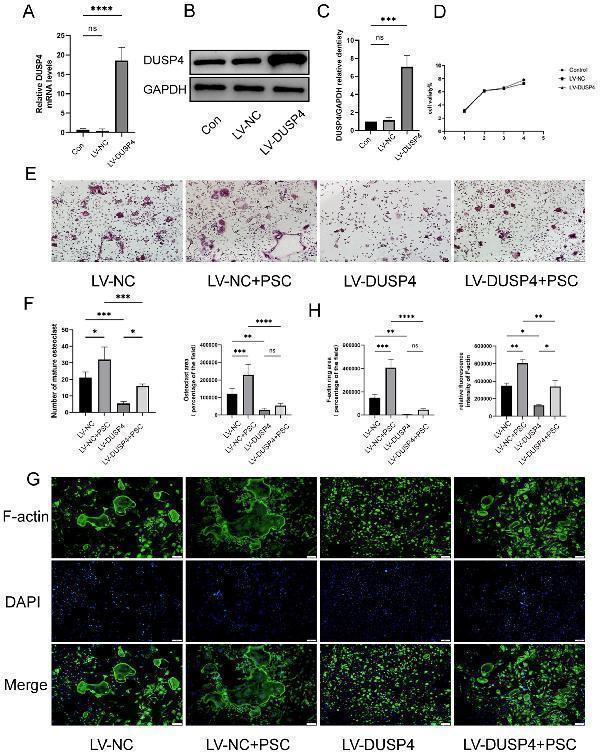
Overexpression of DUSP4 affects osteoclast formation. (A) mRNA expression levels of DUSP4 in control, lentiviral-transfected null, and DUSP4-overexpression groups. (B) Protein levels of DUSP4 in the same groups. (C) Quantification of (B) . (D) Cell viability assay in the same groups. (E) TRAP staining of osteoclasts in control and DUSP4-overexpression groups after PSC intervention. Magnification ×40. (F) Quantification of the area occupied by TRAP-positive cells and the number of TRAP-positive cells shown in (E) . (G) F-actin ring staining in control and DUSP4-overexpression groups after PSC intervention green: F-actin; blue: DAPI. Magnification ×40. (H) Quantification of the F-actin ring area and fluorescence intensity shown in (G) . Data represent three independent experiments, and significance was determined using one-way ANOVA. ns, no significance; * p < 0.05, ** p < 0.01, and *** p < 0.001.
Index in PubMed under a CC BY license. PMID: 40177487
Click image to see more details
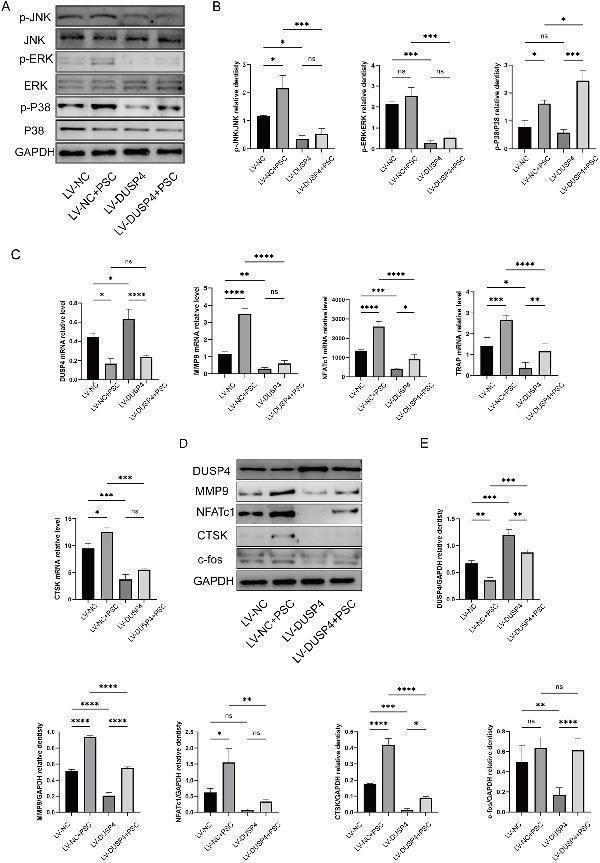
Effects of DUSP4 on the MAPK pathway and osteoclast-related genes. (A) Western blot analysis showing changes in MAPK signaling pathway components (p-JNK, p-ERK, and p-p38) in osteoclasts after PSC intervention in control and DUSP4-overexpression groups. (B) Quantification of MAPK pathway phosphorylation levels in osteoclasts from control and DUSP4-overexpression groups, as shown in (A) . (C) mRNA expression levels of osteoclast-related proteins (DUSP4, MMP9, NFATc1, TRAP, and CTSK) after PSC intervention in control and DUSP4-overexpression groups. (D) Western blot analysis of osteoclast-related proteins (DUSP4, MMP9, NFATc1, CTSK, and c-fos) after PSC intervention in control and overexpression groups. (E) Quantification of osteoclast-related proteins expression levels in (D) . Data represent three independent experiments, and significance was determined using one-way ANOVA. ns, no significance; * p < 0.05, ** p < 0.01, and *** p < 0.001.
Index in PubMed under a CC BY license. PMID: 40177487
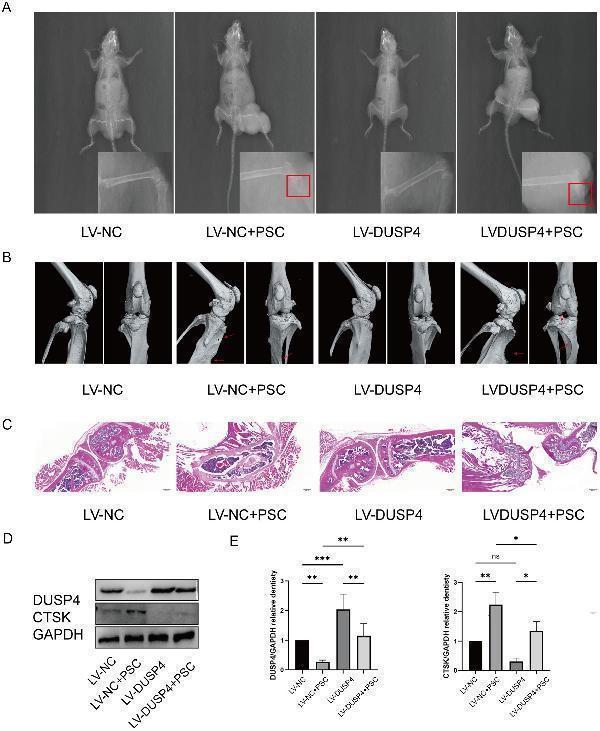
Click image to see more details
DUSP4 inhibits osteoclasts and attenuates bone destruction in osseous echinococcosis. (A) X-ray examination of long bones from mice treated with empty vector, lentiviral DUSP4, or left untreated in the affection of PSC after 6 months, with red rectangle indicating cyst. (B) Micro-CT images of long bones from each treatment group, with red arrows indicating bone defects. (C) HE staining of bone tissue sections from each treatment group. Magnification ×20. (D) Western blot analysis of osteoclast-related proteins (DUSP4 and CTSK) after PSC intervention in control and DUSP4-overexpression groups. (E) Quantification of osteoclast-related protein expression levels in osteoclasts from control and DUSP4-overexpression groups, as shown in (D) . Data are presented as mean ± SD from five mice per group. * p < 0.05, ** p < 0.01, and *** p < 0.001.
Index in PubMed under a CC BY license. PMID: 40177487
Specific Publications For Anti-DUSP4 Mouse Monoclonal Antibody [Clone ID: OTI7C11] (M30480)
Loading publications
Recommended Resources
Here are featured tools and databases that you might find useful.
- Boster's Pathways Library
- Protein Databases
- Bioscience Research Protocol Resources
- Data Processing & Analysis Software
- Photo Editing Software
- Scientific Literature Resources
- Research Paper Management Tools
- Molecular Biology Software
- Primer Design Tools
- Bioinformatics Tools
- Phylogenetic Tree Analysis
Customer Reviews
Have you used Anti-DUSP4 Mouse Monoclonal Antibody [Clone ID: OTI7C11]?
Share your experimental results or join a short interview to earn up to $1,000 in product credits or other rewards.
0 Reviews For Anti-DUSP4 Mouse Monoclonal Antibody [Clone ID: OTI7C11]
Customer Q&As
Have a question?
Find answers in Q&As, reviews.
Can't find your answer?
Submit your question

