



Click image to see more details
-
-

-
-
-
+1
Product Info Summary
| SKU: | RP1017 |
|---|---|
| Size: | 100 μg/vial |
| Reactive Species: | Mouse |
| Host: | Rabbit |
| Application: | ELISA, IHC, WB |
Customers Who Bought This Also Bought

Product info
Product Name
Anti-Interleukin-18 IL18 Antibody Picoband®
SKU/Catalog Number
RP1017
BA14935 is an alternative SKU for this antibody, used in previous lots.
Size
100 μg/vial
Form
Lyophilized
Description
Boster Bio Anti-Interleukin-18 IL18 Antibody catalog # RP1017. Tested in ELISA, IHC, WB applications. This antibody reacts with Mouse. The brand Picoband indicates this is a premium antibody that guarantees superior quality, high affinity, and strong signals with minimal background in Western blot applications. Only our best-performing antibodies are designated as Picoband, ensuring unmatched performance.
Storage & Handling
Store at -20˚C for one year from date of receipt. After reconstitution, at 4˚C for one month. It can also be aliquotted and stored frozen at -20˚C for six months. Avoid repeated freeze-thaw cycles.
Cite This Product
Anti-Interleukin-18 IL18 Antibody Picoband® (Boster Biological Technology, Pleasanton CA, USA, Catalog # RP1017)
Host
Rabbit
Contents
Each vial contains 4mg Trehalose, 0.9mg NaCl and 0.2mg Na2HPO4.
Clonality
Polyclonal
Isotype
Rabbit IgG
Immunogen
E. coli-derived mouse IL-18 recombinant protein (Position: N36-S192).
Cross-reactivity
No cross-reactivity with other proteins
Reactive Species
RP1017 is reactive to Il18 in Mouse
Observed Molecular Weight
22 kDa
Calculated molecular weight
22.1 kDa
Background of Il18
Interleukin-18 also known as IL18 is a protein which in humans is encoded by the IL18 gene. The protein encoded by this gene is a proinflammatory cytokine.IL-18 is a cytokine produced by macrophages and other cells that belongs to the IL-1 superfamily. IL-18 works by binding to the interleukin-18 receptor, and together with IL-12 it induces cell-mediated immunity following infection with microbial products like lipopolysaccharide (LPS). After stimulation with IL-18, natural killer (NK) cells and certain T cells release another important cytokine called interferon-gamma (IFN-gamma) or type II interferon that plays an important role in activating the macrophages or other cells.The combination of this cytokine and IL12 has been shown to inhibit IL4 dependent IgE and IgG1 production, and enhance IgG2a production in B cells. IL-18 binding protein (IL18BP) can specifically interact with this cytokine, and thus negatively regulate its biological activity. The human interleukin 18 gene IL18 maps to 11q22.2-q22.3, closely linked to the DRD2 gene locus and distinct from mapped IDDM loci.
Antibody Validation
Boster validates all antibodies on WB, IHC, ICC, Immunofluorescence, and ELISA with known positive control and negative samples to ensure specificity and high affinity, including thorough antibody incubations.
Application & Images
Applications
RP1017 is guaranteed for ELISA, IHC, WB Boster Guarantee
Recommend Dilution
| Application | Dilution | Species |
|---|---|---|
| Western blot | 0.1-0.5μg/ml | Mouse |
| Immunohistochemistry (Paraffin-embedded Section) | 2-5μg/ml | Mouse |
| ELISA | 0.1-0.5μg/ml | - |
Tested application
Suggested blocking solution with 5% non-fat milk or BSA; (*)Recommended protein loading: 20-40 µg per lane
Use TE buffer pH 9.0 for antigen retrieval; (*) citrate buffer pH 6.0 is an alternative.
Validation Images & Assay Conditions
Click image to see more details
Western blot analysis of IL18 using anti-IL18 antibody (RP1017).
Electrophoresis was performed on a 5-20% SDS-PAGE gel at 70V (Stacking gel) / 90V (Resolving gel) for 2-3 hours. The sample well of each lane was loaded with 30 ug of sample under reducing conditions.
Lane 1: mouse IL18 recombinant protein,
Lane 2: mouse J774A.1 whole cell lysates.
After electrophoresis, proteins were transferred to a nitrocellulose membrane at 150 mA for 50-90 minutes. Blocked the membrane with 5% non-fat milk/TBS for 1.5 hour at RT. The membrane was incubated with rabbit anti-IL18 antigen affinity purified polyclonal antibody (Catalog # RP1017) at 0.5 μg/mL overnight at 4°C, then washed with TBS-0.1%Tween 3 times with 5 minutes each and probed with a goat anti-rabbit IgG-HRP secondary antibody at a dilution of 1:5000 for 1.5 hour at RT. The signal is developed using an Enhanced Chemiluminescent detection (ECL) kit (Catalog # EK1002) with Tanon 5200 system. A specific band was detected for IL18 at approximately 22 kDa.
Click image to see more details
IHC analysis of IL18 using anti-IL18 antibody (RP1017).
IL18 was detected in a paraffin-embedded section of mouse spleen tissue. Heat mediated antigen retrieval was performed in EDTA buffer (pH 8.0, epitope retrieval solution). The tissue section was blocked with 10% goat serum. The tissue section was then incubated with 2 μg/ml rabbit anti-IL18 Antibody (RP1017) overnight at 4°C. Peroxidase Conjugated Goat Anti-rabbit IgG was used as secondary antibody and incubated for 30 minutes at 37°C. The tissue section was developed using HRP Conjugated Rabbit IgG Super Vision Assay Kit (Catalog # SV0002) with DAB as the chromogen.
Click image to see more details
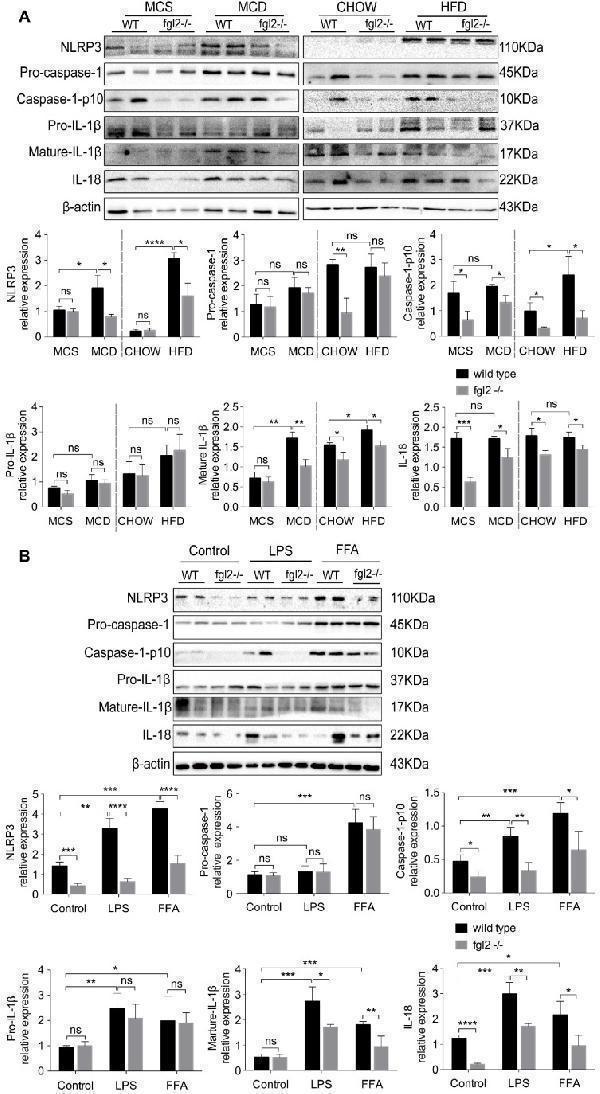
Fgl2 disruption inhibited activation of the NLRP3 inflammasome in NASH. Total protein was obtained from liver tissues of MCD-fed or HFD-fed WT and fgl2-/- mice. MCS-fed and chow-fed mice were used as controls. NLRP3, pro-caspase-1, cleaved caspase-1 (caspase-1 p10), pro-IL-1β, mature IL-1β and IL-18 were analyzed by western blotting (A). BMDMs from WT and fgl2-/- mice were stimulated with LPS or FFA and tested for inflammasomes by western blotting (B). Image density was quantified using ImageLab software. For bar graphs, n=6 in each group. The data represent the mean ± SD from at least three independent experiments. Statistical differences were determined by two-way ANOVA. *P<0.05, **P<0.01, ***P<0.001, ****P<0.0001; ns, not significant.
Index in PubMed under a CC BY license. PMID: 32863955
Click image to see more details
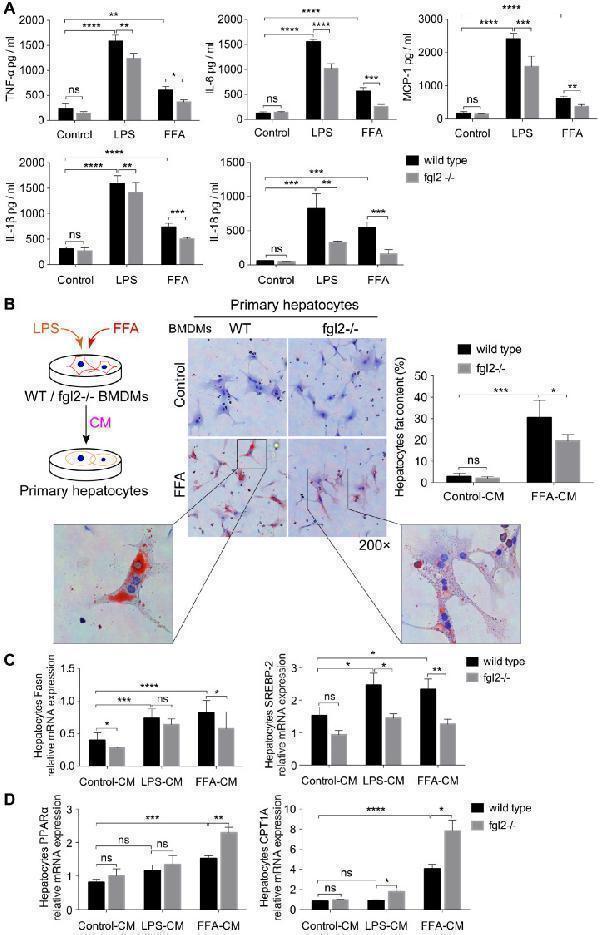
Fgl2 deficiency reduced lipid accumulation in hepatocytes by inhibiting the secretion of proinflammatory cytokines in macrophages. BMDMs from WT and fgl2-/- mice were stimulated with LPS (100 ng/ml) or FFA (800 μmol/L). The levels of proinflammatory cytokines, including TNF-α, MCP-1, IL-6, IL-1β and IL-18, in the supernatant of cell cultures were tested by ELISAs (A). Primary hepatocytes were isolated from C57BL/6J livers and incubated with LPS- or FFA-BMDM-CM for 24 hours. The brief experimental procedure is shown in a diagram. Oil red O staining was used to detect fat deposition in primary hepatocytes after treatment with BMDM-CM (B). Then, the mRNA levels of genes involved in lipogenesis (Fasn, SREBP-2) (C) or lipolysis (PPARα, CPT1A) (D) in primary hepatocytes were tested by real-time PCR. For bar graphs, n=6 in each group. The data represent the mean ± SD from at least three independent experiments. Statistical differences were determined by two-way ANOVA. *P<0.05, **P<0.01, ***P<0.001, ****P<0.0001; ns, not significant.
Index in PubMed under a CC BY license. PMID: 32863955
Click image to see more details
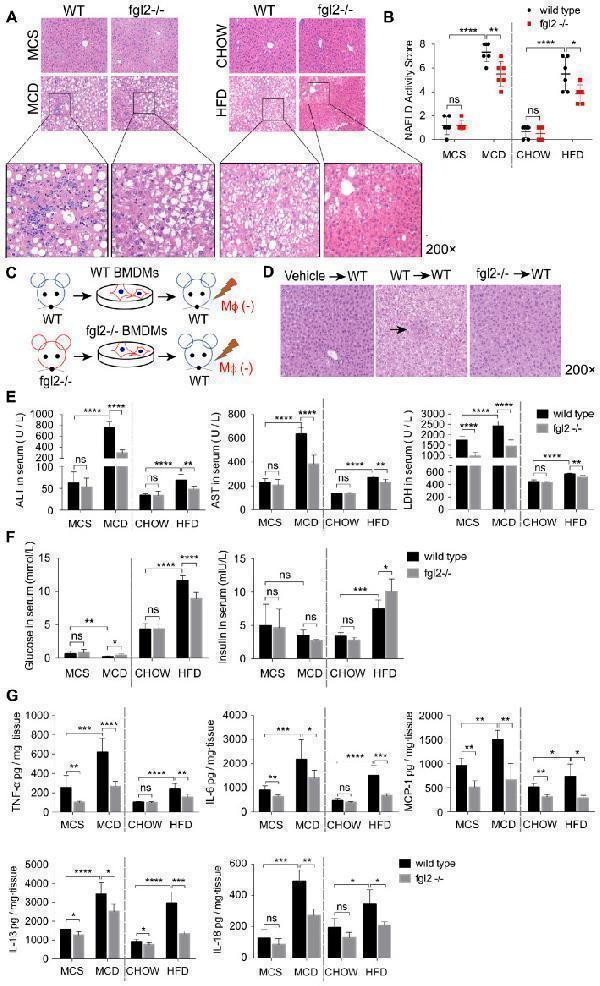
Fgl2 deficiency attenuated liver inflammatory injury in NASH mice. In MCD-fed or HFD-fed WT and fgl2-/- mice, HE staining was performed to detect histological changes in the liver (A). The NAFLD activity score was evaluated (B). BMDMs were isolated from WT or fgl2-/- mice and injected into macrophage-depleted WT NASH mice (C). Histological changes were detected by HE staining (D, arrows indicate inflammatory infiltration). Serum ALT, AST, LDH (E) and fasting glucose (F) were tested by an automatic biochemical analyzer (n=10 in each group). The levels of serum insulin were tested by an ELISA kit (F). The levels of the proinflammatory cytokines TNF-α, MCP-1, IL-6, IL-1β and IL-18 in the liver were tested by ELISAs (G). For bar graphs, n=6-10 in each group. The data represent the mean ± SD from at least three independent experiments. Statistical differences were determined by two-way ANOVA. *P<0.05, **P<0.01, ***P<0.001, ****P<0.0001; ns, not significant.
Index in PubMed under a CC BY license. PMID: 32863955
Specific Publications For Anti-Interleukin-18 IL18 Antibody Picoband® (RP1017)
Loading publications
Recommended Resources
Here are featured tools and databases that you might find useful.
- Boster's Pathways Library
- Protein Databases
- Bioscience Research Protocol Resources
- Data Processing & Analysis Software
- Photo Editing Software
- Scientific Literature Resources
- Research Paper Management Tools
- Molecular Biology Software
- Primer Design Tools
- Bioinformatics Tools
- Phylogenetic Tree Analysis
Customer Reviews
Have you used Anti-Interleukin-18 IL18 Antibody Picoband®?
Share your experimental results or join a short interview to earn up to $1,000 in product credits or other rewards.
0 Reviews For Anti-Interleukin-18 IL18 Antibody Picoband®
Customer Q&As
Have a question?
Find answers in Q&As, reviews.
Can't find your answer?
Submit your question
5 Customer Q&As for Anti-Interleukin-18 IL18 Antibody Picoband®
Question
Can RP1017 detect pro-IL18 ( precursor) or mature IL-18 (active form)?
Verified customer
Asked: 2020-12-07
Answer
The Anti-Interleukin-18 IL18 Antibody (RP1017) anti-mouse IL18 antibody reacts with precursor IL-18.
Boster Scientific Support
Answered: 2020-12-09
Question
We are currently using anti-IL18 antibody RP1017 for mouse tissue, and we are happy with the IHC results. The species of reactivity given in the datasheet says mouse. Is it possible that the antibody can work on goat tissues as well?
Verified Customer
Verified customer
Asked: 2020-02-14
Answer
The anti-IL18 antibody (RP1017) has not been tested for cross reactivity specifically with goat tissues, though there is a good chance of cross reactivity. We have an innovator award program that if you test this antibody and show it works in goat you can get your next antibody for free. Please contact me if I can help you with anything.
Boster Scientific Support
Answered: 2020-02-14
Question
We have seen staining in mouse peripheral blood. What should we do? Is anti-IL18 antibody supposed to stain peripheral blood positively?
Verified Customer
Verified customer
Asked: 2019-11-06
Answer
According to literature peripheral blood does express IL18. According to Uniprot.org, IL18 is expressed in lower esophagus mucosa, liver, urinary bladder, peripheral blood, among other tissues. Regarding which tissues have IL18 expression, here are a few articles citing expression in various tissues:
Liver, Pubmed ID: 8666798, 15326478
Peripheral blood, Pubmed ID: 10653850
Urinary bladder, Pubmed ID: 15489334
Boster Scientific Support
Answered: 2019-11-06
Question
We ordered your anti-IL18 antibody for IHC on lower esophagus mucosa in the past. I am using mouse, and We are going to use the antibody for ELISA next. you antibody examining lower esophagus mucosa as well as peripheral blood in our next experiment. Could you please give me some suggestion on which antibody would work the best for ELISA?
Verified Customer
Verified customer
Asked: 2017-07-12
Answer
I took a look at the website and datasheets of our anti-IL18 antibody and I see that RP1017 has been validated on mouse in both IHC and ELISA. Thus RP1017 should work for your application. Our Boster satisfaction guarantee will cover this product for ELISA in mouse even if the specific tissue type has not been validated. We do have a comprehensive range of products for ELISA detection and you can check out our website bosterbio.com to find out more information about them.
Boster Scientific Support
Answered: 2017-07-12
Question
Our team were satisfied with the WB result of your anti-IL18 antibody. However we have seen positive staining in peripheral blood secreted. using this antibody. Is that expected? Could you tell me where is IL18 supposed to be expressed?
M. Singh
Verified customer
Asked: 2013-03-22
Answer
Based on literature, peripheral blood does express IL18. Generally IL18 expresses in secreted. Regarding which tissues have IL18 expression, here are a few articles citing expression in various tissues:
Liver, Pubmed ID: 8666798, 15326478
Peripheral blood, Pubmed ID: 10653850
Urinary bladder, Pubmed ID: 15489334
Boster Scientific Support
Answered: 2013-03-22

