This website uses cookies to ensure you get the best experience on our website.


- Table of Contents

Antibodies, also known as immunoglobulins, are specialized proteins produced by the immune system to identify and neutralize foreign invaders such as bacteria, viruses, and toxins. Their ability to recognize and bind to specific antigens make them play a critical role in the immune response and serve as key tools in biomedical research, including advanced applications like Multiplex Assay Services where multiple targets can be simultaneously analyzed.
As antibody discovery moves from basic immunology into reagent and therapeutic development, researchers may generate antigen-specific candidates through methods such as single B cell antibody discovery, which preserves native heavy and light chain pairing from individual B cells, or phage display library screening, which enables controlled in vitro selection and enrichment of binders from large antibody libraries.
The intricate structure of antibodies allows them to perform with high specificity and efficiency. Central to this structure are the heavy and light chains, which together form the antibody's functional units.
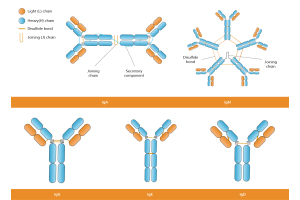
Antibodies are Y-shaped molecules composed of four polypeptide chains: two identical heavy chains and two identical light chains. These chains are held together by disulfide bonds, forming a stable and flexible structure. The heavy chains are larger, consisting of approximately 440–550 amino acids, while the light chains are smaller, with about 210–220 amino acids. Each heavy chain pairs with a light chain to form a half of the Y shape, and the two halves are connected at the base, creating a symmetrical structure.
The heavy and light chains can be divided into two main regions: the constant (C) region and the variable (V) region. The constant region is relatively uniform among antibodies of the same isotype and is responsible for mediating effector functions, such as binding to cell surface receptors and activating the complement system. The variable region, on the other hand, is highly diverse and is responsible for antigen recognition. It contains specific sequences known as complementarity-determining regions (CDRs), which directly interact with antigens. The diversity of these CDRs enables the immune system to recognize a vast array of antigens.
There are five main classes of immunoglobulins, each with a distinct heavy chain: IgA, IgD, IgE, IgG, and IgM. These classes differ in their constant regions, which impart unique functional properties to each isotype.
| Class | Heavy Chain Type | Primary Functions |
|---|---|---|
| IgA | Alpha (α) | Found in mucosal areas; protects body surfaces exposed to foreign substances. |
| IgD | Delta (δ) | Functions are less well understood; involved in the initiation of immune response. |
| IgE | Epsilon (ε) | Involved in allergic reactions and defense against parasitic infections. |
| IgG | Gamma (γ) | Most abundant in serum; neutralizes pathogens and toxins. |
| IgM | Mu (μ) | First antibody produced during an immune response; effective at forming antigen-antibody complexes. |
To learn more about the five immunoglobulin classes, head over to our blog on antibody isotypes.
The light chains of antibodies come in two types, kappa (κ) and lambda (λ), which are determined by their constant regions. Each antibody molecule contains either two kappa or two lambda light chains, but not a mixture of both. The ratio of kappa to lambda light chains can vary among species, and abnormalities in this ratio can indicate certain diseases, such as multiple myeloma.
Antibody fragments are specific portions or segments of an antibody molecule that retain certain functional properties while being smaller and more manageable than the full antibody structure. These fragments are produced by enzymatic cleavage of antibodies and can be used in various biomedical applications due to their unique characteristics and functions.
The main fragments produced from an antibody include:
When full-length antibodies are not necessary, many of these smaller formats are particularly compatible with microbial expression systems for antibody fragment production, where Fab, scFv, and related constructs can often be generated more quickly and efficiently in hosts such as E. coli or yeast.
The structure of antibodies is not static; it undergoes changes during the immune response to enhance antigen binding and effector functions. One such change is somatic hypermutation, a process that introduces point mutations into the variable regions of the antibody genes. This increases the diversity of the antibody repertoire and allows for the selection of antibodies with higher affinity for the antigen. Another process, class switch recombination, changes the constant region of the heavy chain, enabling the production of different isotypes with the same antigen specificity.
Understanding antibody structure is essential for producing antibodies for research, diagnostic, and therapeutic purposes. By comprehending the intricate arrangement of heavy and light chains, researchers can design antibodies with specific properties, such as high affinity for target antigens and minimal cross-reactivity. This structural insight is also pivotal when considering antibody pairing, particularly in diagnostic assays where the simultaneous use of two antibodies requires them to bind to separate, non-overlapping epitopes with high efficiency. Effective antibody pairing ensures that both antibodies in a sandwich ELISA or similar format can function without steric hindrance or binding interference, which is essential for assay sensitivity and specificity. For custom-designed antibodies with optimized structure and specificity, explore our Recombinant Antibody Production Service.
For full-length recombinant antibodies intended for advanced research or therapeutic development, CHO cell antibody production is widely used because it supports proper folding, biologically relevant glycosylation, and scalable manufacturing, while transgenic animals for antibody production remain especially important when researchers aim to generate fully human or humanized antibody candidates from in vivo immune repertoires.
Boster Bio specializes in producing high-quality primary antibodies for research purposes, including custom polyclonal antibody production services for projects requiring antigen-specific serum. Our primary antibodies are rigorously validated to ensure high specificity, affinity, and reproducibility. Browse our catalog of 20,000+ primary antibodies to find antibodies needed to study biological pathways, investigate disease mechanisms, and more.
The structure of antibodies, characterized by their heavy and light chains, along with the F(ab) and Fc regions, is fundamental to their role in the immune response. The intricate interplay between these components enables antibodies to recognize and neutralize a wide range of antigens. Advances in understanding antibody structure continue to drive innovation in research and therapeutic development. These insights also intersect with adjacent areas of molecular biology, including viral vector systems, where tools like AAV Packaging production are used to study gene function and cellular pathways in controlled experimental settings. These developments also enhance the precision and efficiency of antibody production services, which play a critical role in supplying high-performance antibodies for a range of life sciences applications.
Across the broader antibody workflow, researchers may move from single B cell discovery or phage display screening at the candidate-finding stage, to microbial fragment expression for smaller engineered binders, and ultimately to CHO-based recombinant production or transgenic animal platforms when full-length, human-compatible, or clinically oriented antibodies are required.