This website uses cookies to ensure you get the best experience on our website.


- Table of Contents
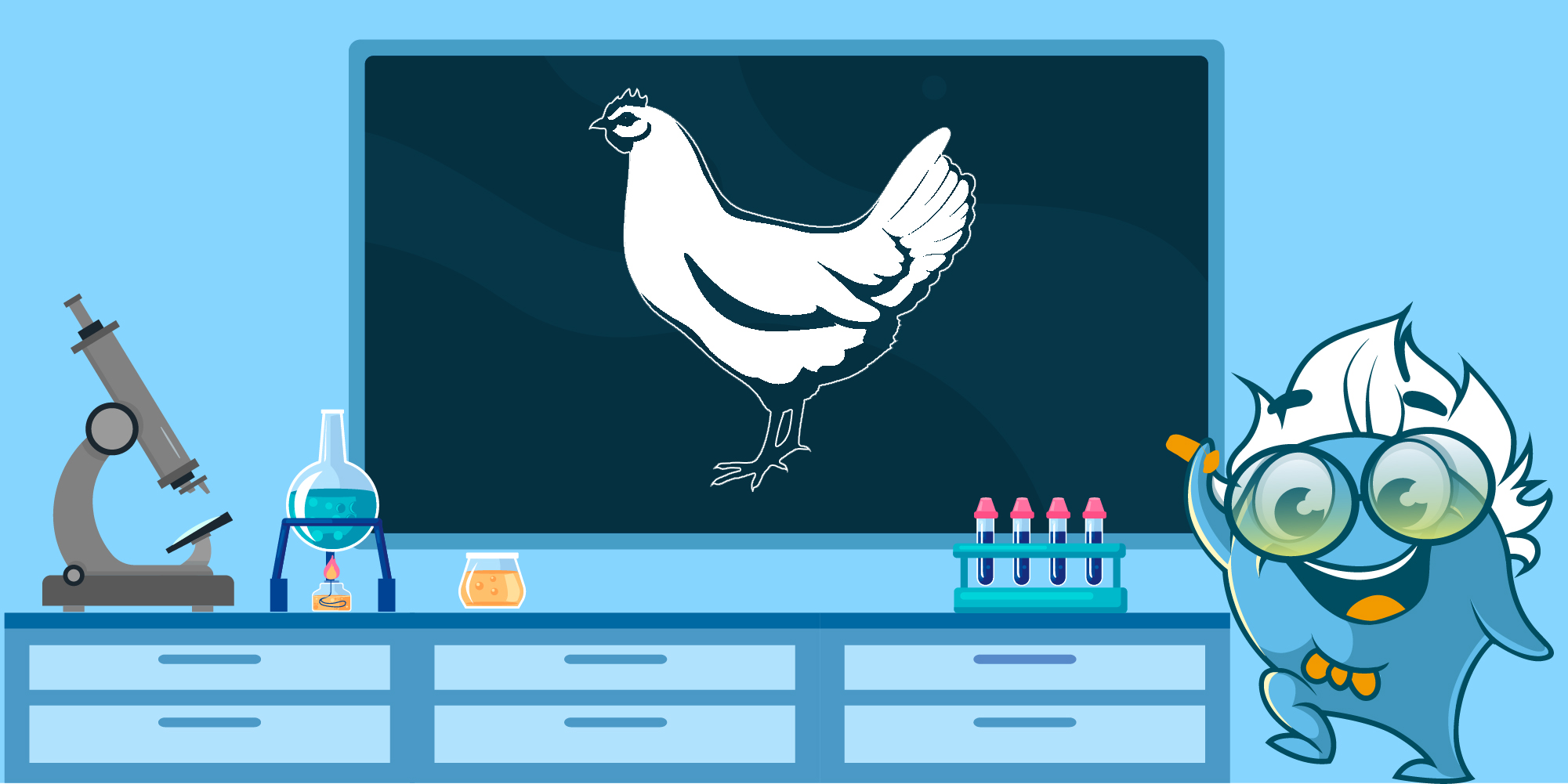
The domestic chicken (Gallus gallus domesticus) has been a model organism for scientific research due to its accessibility, ease of breeding, and large-sized eggs, which are particularly useful for embryological studies.
In this blog, we describe a brief history and some key breakthroughs of chicken as a model organism. We discuss the research advantages and limitations of chickens, and describe some research areas where scientists have explored using chickens. For researchers interested in working with chickens, we have provided a list of resources and guiding questions. If you’re considering choosing chickens for your research studies or simply want to learn more about chickens, this blog is for you!
Feel free to jump to a specific section about chicken:
Gallus gallus domesticus, commonly known as the domestic chicken, is a bird species widely used in developmental biology and genetic research. As a subspecies of the red junglefowl, which is native to southern Asia, the domestic chicken is versatile and economically significant. Adult chickens typically measure between 40 to 60 centimeters in length from beak to tail and weigh around 2 to 4 kilograms. They are characterized by their feathered bodies, beaks, and a range of plumage colors and patterns.
Gallus gallus domesticus are chosen as research models due to its well-understood developmental processes and genetic makeup. Chickens have a relatively long incubation period of about 21 days from egg fertilization to hatching, during which the embryos can be observed and manipulated. This extended embryonic development allows for detailed studies of developmental biology, including organ formation and genetic regulation. Furthermore, the chicken genome was sequenced in 2004, presenting a comprehensive resource for genetic studies. This genome facilitates research into gene function, evolution, and disease mechanisms.
The chicken is examined in immunology and vaccine development due to its production of large amounts of antibodies. Additionally, its large eggs make it a favored model for studying early embryonic development and the effects of genetic and environmental factors on growth and differentiation. Overall, Gallus gallus domesticus offers valuable insights into vertebrate biology and developmental processes, bridging the gap between simpler model organisms and more complex mammalian systems.
Gallus gallus domesticus, the domestic chicken, has been instrumental in several key scientific breakthroughs, especially in embryology, virology, genetics, and developmental biology. We discuss some of the most notable milestones below.
In 1910, Peyton Rous discovered the Rous sarcoma virus (RSV) in chickens, marking one of the first demonstrations that viruses could cause cancer. This discovery crucially linked viruses and cancer, fundamentally changing our comprehension of carcinogenesis. The identification of RSV in chickens eventually led to the discovery of oncogenes, which are genes that can cause normal cells to become cancerous.1 Rous's work was so influential that he was awarded the Nobel Prize in Physiology or Medicine in 1966.2
The chicken embryo became a key model in embryology starting in the early 20th century. In the 1920s and 1930s, Viktor Hamburger’s work with chicken embryos was foundational in determining the stages of vertebrate development. His research, in collaboration with Howard L. Hamilton, led to the establishment of the Hamburger-Hamilton stages in 1951, a detailed series of 46 stages that describe the chronological development of chick embryos from the laying of the egg to hatching. This work became a standardized system for describing embryonic development in chickens and presented a vital framework for studying developmental processes across vertebrates.3,4
Chickens have played a critical role in immunology, notably in the development of vaccines. For instance, the use of chicken eggs in the production of vaccines for diseases such as influenza has been a significant breakthrough.5 The ability to produce large quantities of virus in chicken eggs has been crucial for the rapid development and distribution of vaccines, especially during pandemics.
In the 20th century, chickens gained prominence in genetics research. The establishment of inbred chicken strains empowered scientists to investigate genetic variation and inheritance patterns.6 Studies on chickens uncovered quantitative genetics related to traits such as disease resistance and growth.7,8
The sequencing of the chicken genome in 2004 was a major milestone in genetic research. The chicken was the first bird and the first agricultural animal to have its genome fully sequenced.9 This sequencing clarified the evolution of vertebrates, revealing how birds, including chickens, evolved from dinosaur ancestors. The chicken genome has also been used to examine gene function and genetic diseases, providing a comparative framework for understanding human genetics.
Chickens have been employed in genetic engineering and transgenics. The development of transgenic chickens, which carry foreign genes inserted into their genome, has allowed researchers to unravel gene function and regulation in a vertebrate model.10 This technology has implications for both basic research and the development of biopharmaceuticals.
The domestic chicken has been a valuable model organism, contributing to major scientific breakthroughs in various fields. From developmental biology to cancer research and vaccine production, the use of Gallus gallus domesticus has deepened our comprehension of fundamental biological processes and their applications in medicine and agriculture.
Gallus gallus domesticus, the domestic chicken, is a model organism for various fields of biological research. It serves as a powerful model for studying vertebrate development, genetics, immunology, and virology due to its unique characteristics.
Gallus gallus domesticus offers advantages as a model organism, especially for vertebrate development, genetics, and immunology. Its accessible embryos, sequenced genome, and relevance to human health are valuable for scientific research, leading to numerous advancements in biology and medicine.
Despite the advantages of Gallus gallus domesticus (the domestic chicken) as a model organism, there are limitations and challenges associated with its use in research.
Researchers can address the limitations and challenges of Gallus gallus domesticus as a model organism through the following approaches:
While the chicken is a valuable model organism for many research areas, addressing its limitations through technological advancements, ethical practices, collaboration, and improved care can increase its effectiveness and broaden its applications in scientific discovery.
Gallus gallus domesticus, commonly known as the domestic chicken, has been a model organism for several research areas due to its developmental and physiological characteristics. We discuss some of the research areas below.
Gallus gallus domesticus continues to be a versatile model organism across a wide range of research fields, with ongoing and future studies promising to expand our understanding of both avian and human biology.
In this section, we describe some organizations, resources, conferences, and funding opportunities available for researchers working with the chicken as a model organism.
World's Poultry Science Association (WPSA): An international organization that promotes the advancement of knowledge and research in poultry science. Website: wpsa.com
Poultry Science Association (PSA): Focuses on advancing the discovery, dissemination, and application of knowledge in poultry science. Website: poultryscience.org
Boster Bio: Offers a deeply discounted $600 custom antibody service particularly for researchers working with non-traditional model organisms like chicken.
NCBI Genome Resource Consortium - Chicken: Provides information on the ongoing efforts to improve and maintain the chicken genome assembly, including updates on genome issues and data resources. Website: www.ncbi.nlm.nih.gov/grc/chicken
Chicken2K: A multi-functional database that integrates genomic data and bioinformatic tools to facilitate the study and conservation of global chicken genetic diversity. Website: chicken.ynau.edu.cn/index/home/index
Chicken QTLdb: A comprehensive database that collects and curates publicly available quantitative trait loci (QTL) data for chickens, facilitating genetic research and trait mapping. Website: www.animalgenome.org/cgi-bin/QTLdb/GG/index
Avibase: An extensive online database that organizes global bird taxonomic and distribution data, containing over 52 million records for around 10,000 species and 22,000 subspecies. Website: avibase.bsc-eoc.org/avibase.jsp
Bird 10,000 Genomes (B10K) Database: Provides access to genomic data from the Bird 10,000 Genomes Project, aiming to sequence and analyze the genomes of all extant bird species to understand avian diversity and evolution. Website: https://b10k.genomics.cn
American Poultry Historical Society (APHS): Provides historical information and resources related to poultry science and research. Website: poultryhistory.org
International Poultry Scientific Forum (IPSF): An annual conference focusing on the latest scientific research and developments in the poultry industry, including studies on chicken models. Website: www.ippexpo.org/education-programs/IPSF
European Poultry Conference (EPC): A major event bringing together researchers and industry professionals to discuss the latest advancements in poultry research. Website: epc2024.com
International Symposium on Avian Endocrinology (ISAE): A quadrennial event that gathers scientists worldwide to discuss the latest research and advancements in avian endocrinology, including studies on Gallus gallus domesticus. Website: website varies
Poultry Science Annual Meeting: Hosted by the Poultry Science Association, this conference covers a wide range of topics in poultry research, including genetic studies, nutrition, and disease management. Website: poultryscience.org/news-and-events/conferences/annual-meeting
Avian Model Systems Meeting: A periodic conference that brings together scientists to discuss advancements in avian research, covering topics like developmental biology, genetics, and comparative genomics. Website: hg3.co.uk/ams
USDA National Institute of Food and Agriculture (NIFA): Offers grants and funding for research related to agriculture, including studies involving Gallus gallus domesticus. Website: www.nifa.usda.gov
BBSRC (Biotechnology and Biological Sciences Research Council): Provides funding for research in biosciences, including projects involving poultry models. Website: www.ukri.org/councils/bbsrc
NSF (National Science Foundation): Offers various funding programs for basic research in biology, including the use of chickens as model organisms. Website: www.nsf.gov
These organizations, conferences, resources, and funding opportunities support scientists working with Gallus gallus domesticus as a model organism, facilitating research progress in varying scientific fields.
When considering Gallus gallus domesticus (the domestic chicken) as a model organism, researchers should reflect on the following questions:
Answering these questions can help determine whether Gallus gallus domesticus is the most suitable model organism for your research.
Want to learn more about the chicken and other model organisms? Download our free eBook “How to Choose a Model Organism” today!