This website uses cookies to ensure you get the best experience on our website.


- Table of Contents
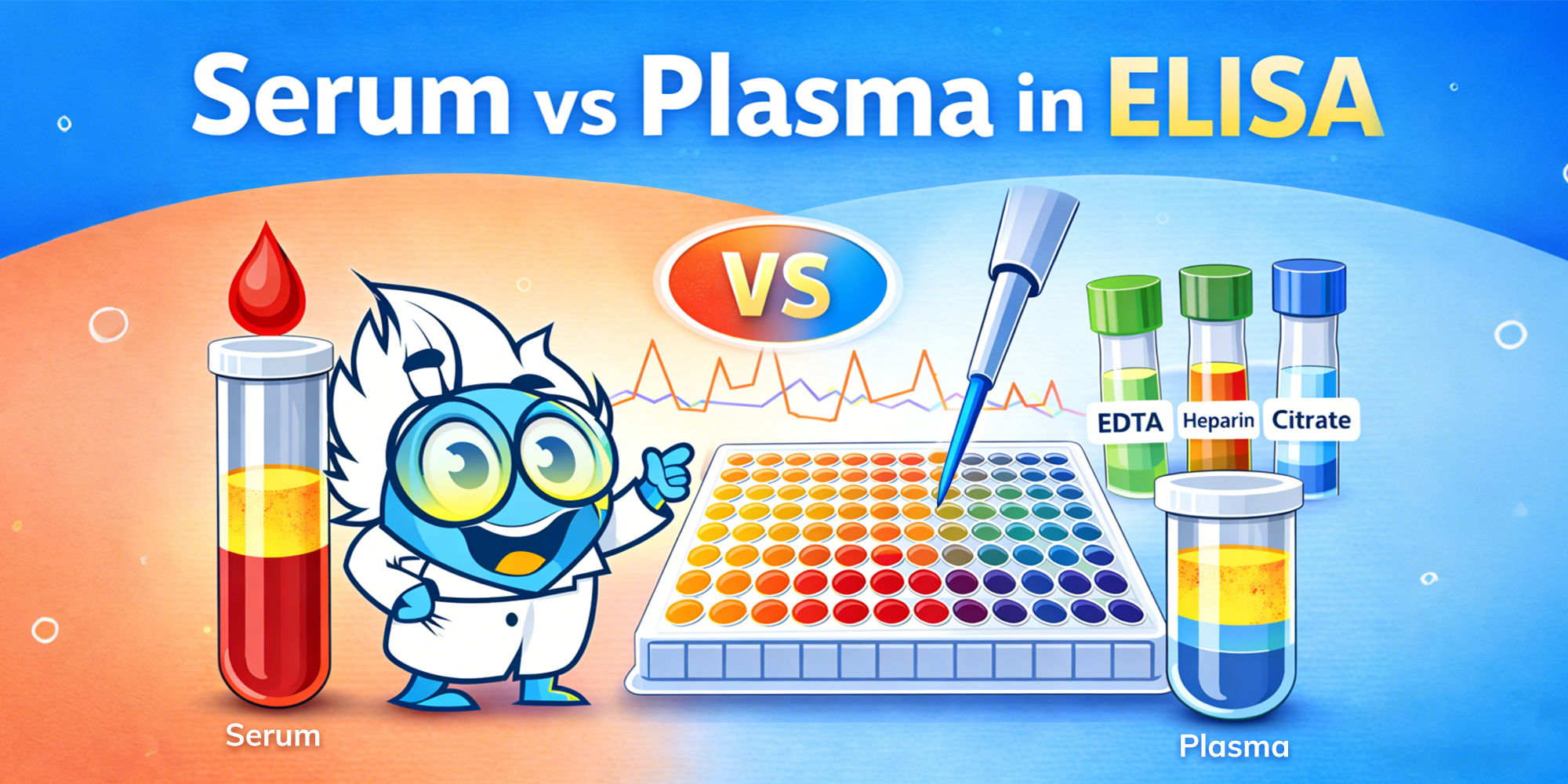
Blood-derived samples are among the most common materials used in ELISA. They are easy to collect, widely available, and relevant to a broad range of cytokines, hormones, biomarkers, and disease-related proteins. But in practice, “blood sample” is not a single matrix. Whole blood, serum, and plasma are not the same thing, and for ELISA, that difference matters.
Many assay-related questions begin with a simple assumption: if two sample types both come from blood, they should give comparable ELISA results. In reality, that is not always true. A standard curve may look clean, duplicates may be tight, and the assay may appear to be working well, yet the reported concentration can still change when the sample type changes from serum to plasma, or when plasma collected with one anticoagulant is replaced by another.
This does not automatically mean the kit failed, nor does it mean one matrix is always better than the other. Differences between serum and plasma can reflect the biology of the sample, the collection method, storage and handling conditions, and the extent to which the assay design and kit formulation can tolerate complex blood-derived matrices.
That is why the real question is not simply whether serum or plasma is “better.” The more useful questions are: what is the difference between them in ELISA, when should each one be used, and what should users check when the results do not behave as expected?
The difference starts with how the sample is obtained.
Whole blood contains blood cells suspended in plasma. Plasma is the liquid fraction obtained after anticoagulated blood is centrifuged, so clotting factors remain present. Serum is the liquid fraction obtained after blood is allowed to clot and is then centrifuged, so fibrinogen and some clot-related components are no longer present.
A simple way to think about it is:
For most ELISA applications, serum and plasma are preferred over whole blood because they are better suited to soluble analyte detection. But they should not be treated as interchangeable by default. The difference between clot formation and anticoagulation changes the sample environment seen by the assay, and that can influence background, recovery, dilution behavior, and apparent concentration.
In other words, serum and plasma are not just two labels for “blood supernatant.” In ELISA, they are two different matrices.
When users see different values between serum and plasma, the first suspicion is often that the kit failed. Sometimes the more important variable is the sample type itself.
One reason is that serum and plasma do not have the same composition. Serum is generated after clotting, while plasma retains clotting factors. That alone can affect assay background and analyte behavior.
Another major reason is the anticoagulant used for plasma. Plasma is not one universal sample type. EDTA plasma, heparin plasma, and citrate plasma are not methodologically identical. The anticoagulant can influence binding conditions, alter the chemistry of the sample, or affect certain analytes more than others. In many cases, what looks like “serum vs plasma” is really “serum vs a specific plasma type.”
A third reason is sample handling. Delayed processing, hemolysis, lipemia, microbial contamination, platelet carryover, visible precipitates after freezing, and repeated freeze-thaw cycles can all change assay performance. These are not minor pre-analytical details. They are part of sample quality.
Finally, differences between serum and plasma are also influenced by the assay itself. A well-designed kit may handle complex matrices more robustly, while a less optimized assay may show larger differences between sample types. That is one reason why the same serum/plasma comparison does not always look identical across kits.
That is why serum-plasma differences in ELISA should be interpreted in context, rather than reduced to a simple rule that one matrix is always preferable.
Whether serum or plasma is used, proper sample preparation is the first step toward reliable ELISA data.
For plasma, blood should be collected into a sterile tube containing anticoagulant and mixed gently. After centrifugation, the supernatant is removed carefully and can be tested immediately or aliquoted and stored at -20°C or -80°C. If plasma is used, the anticoagulant should be treated as part of the sample definition, not as an afterthought.
For serum, blood is collected without anticoagulant and allowed to clot before centrifugation. The supernatant is then collected for immediate testing or frozen in aliquots for later use. If frozen serum or plasma develops visible precipitate after thawing, it should be centrifuged again before loading onto the plate.
Across both sample types, several handling rules matter consistently:
These points are easy to overlook, but they are often the difference between a sample that behaves predictably and one that creates unexplained variability.
There is no universal answer that serum is always better, or that plasma is always better. The better choice depends on the assay, the analyte, the workflow, the historical dataset, and the study design.
If a project already has historical serum data, archived serum samples, or a serum-based workflow, serum is often the most practical choice because it preserves continuity. It also avoids introducing anticoagulant-related variables. On the other hand, if the collection workflow routinely uses plasma, or if rapid post-draw processing is important, plasma may be the better operational choice. Plasma can also provide practical advantages in studies where avoiding clot-related changes matters.
But whichever matrix is selected, the key principle is the same: choose one matrix for one study and keep it consistent.
That consistency matters more than many users realize. A study performed entirely in serum can often be interpreted more confidently than a study that mixes serum and plasma without validation. The same applies to plasma collected with different anticoagulants. If the plasma type changes, the matrix has changed.
In practical terms, serum and plasma each have their own advantages. Serum contains fewer clotting-related components and avoids anticoagulant interference. Plasma can usually be processed sooner after collection, often gives a higher recoverable sample volume, and may better preserve some analytes by avoiding clot formation. The more suitable option depends on which of these factors matters most for the study.
In most cases, not by default.
Even though both are blood-derived samples, serum and plasma can produce different concentrations for the same target because the matrices are different. Those differences may reflect clot-related changes, anticoagulant effects, analyte stability, assay tolerance, background interference, or pre-analytical handling.
For that reason, serum and plasma values should not be treated as directly interchangeable unless the assay has been shown to perform acceptably in both. If one cohort is measured in serum and another in plasma, or if a study changes matrix halfway through, interpretation becomes much weaker unless equivalence has already been demonstrated.
At minimum, users should check spike-and-recovery and dilution linearity or parallelism in the matrix they plan to use. If direct comparison between serum and plasma is important, paired testing is even better. Without that kind of evidence, serum and plasma should be interpreted as results from two different analytical contexts, not as numbers that can automatically be compared side by side.
For most ELISA users, the best approach is straightforward.
First, define the reporting matrix before routine testing begins. That means deciding whether the study will use serum, EDTA plasma, heparin plasma, or citrate plasma. If plasma is used, the anticoagulant should always be specified.
Second, standardize sample collection and handling as much as possible. Consistent clotting conditions, centrifugation, storage, thawing, and aliquoting reduce pre-analytical variability.
Third, evaluate whether the chosen matrix performs acceptably in the assay. Two checks are especially useful: spike-and-recovery, which asks whether a known amount of analyte can be recovered reasonably in that matrix, and dilution linearity or parallelism, which asks whether back-calculated concentration remains stable across serial dilutions. If these checks fail, the issue may not be the sample type alone. Collection, handling, or assay design may also need to be reviewed.
A simple decision rule is often enough:
In ELISA, serum and plasma should be treated as different matrices, not as interchangeable sample labels. Neither one is universally better. The better choice is the one that fits the workflow, remains consistent across the study, and performs acceptably in the assay.
If serum is used, validate in serum. If plasma is used, define the anticoagulant and validate in that plasma type. If the two need to be compared, do not assume equivalence—show it.