This website uses cookies to ensure you get the best experience on our website.


- Table of Contents
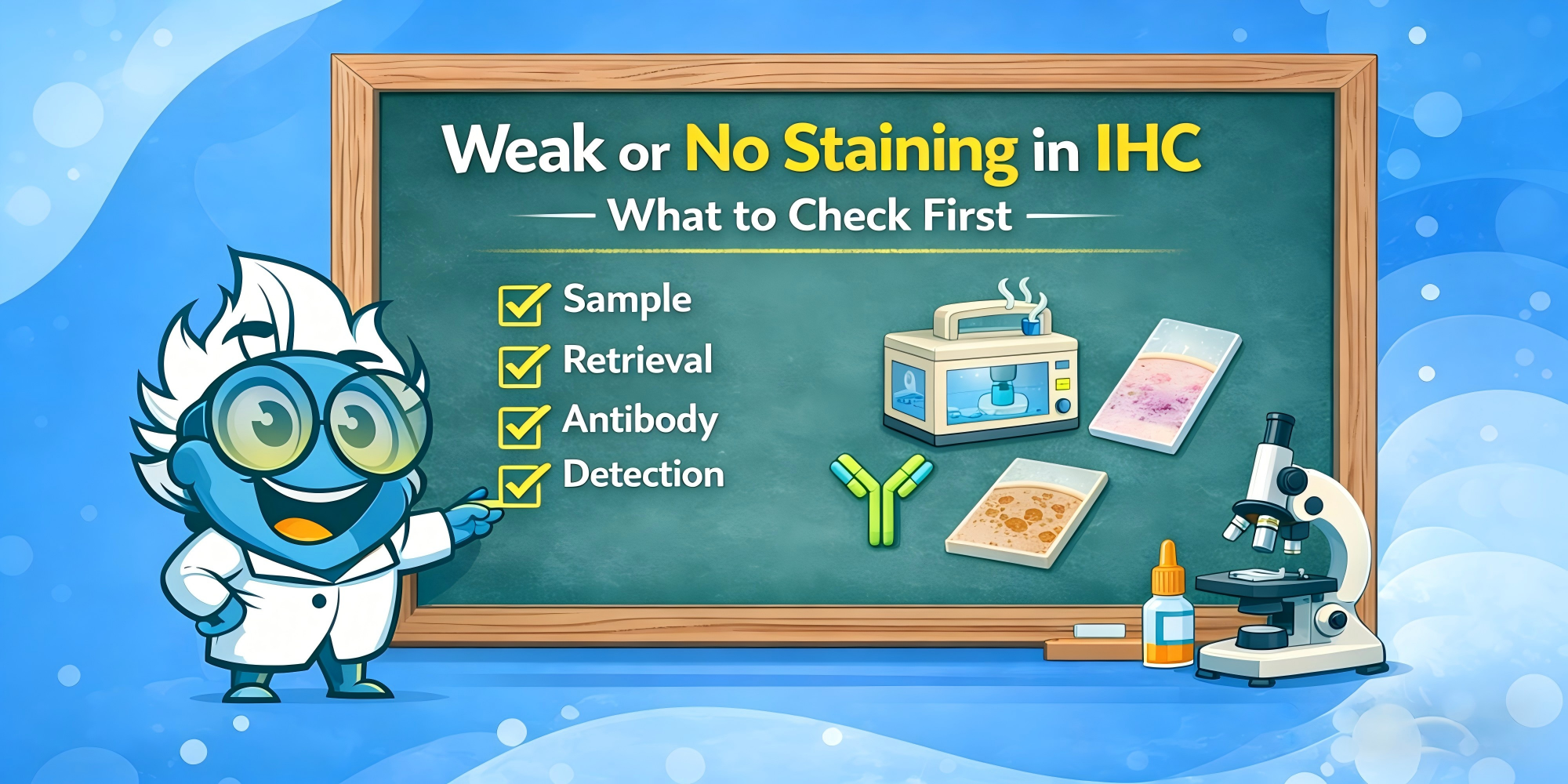
When an IHC slide looks weak or unexpectedly blank, start with the stain—not the antibody.
Weak or no staining in IHC usually points to one of four places: the sample, antigen retrieval, primary antibody conditions, or the detection layer. The antibody may still be the issue, but it should not be the first assumption.
That is the practical value of troubleshooting in order. If the tissue is a poor positive context, no amount of optimization will rescue the result. If the epitope is still masked, the antibody may never get a fair chance to bind. If the primary conditions are too mild, the stain may stay faint even when binding is specific. And if the detection layer is not converting binding into visible signal, a real interaction can still look negative.
This article focuses on one symptom: a slide that looks weak, unexpectedly clean, or blank. It is not a full IHC protocol. It is a shorter troubleshooting path for readers who need to decide what to check first before changing too many variables. For a broader refresher on staining logic, see Immunohistochemistry IHC Principle.
Start with the tissue, not the reagent.
A weak stain does not always mean the assay failed. Sometimes the tissue is simply a poor positive context for the target. Expression may be low, focal, region-specific, treatment-dependent, or limited to a small cell population. In those cases, a faint result may reflect biology more than technique.
This is also where morphology can be misleading. A section can look structurally fine and still stain poorly. Good architecture does not guarantee good antigen detectability. Delayed fixation, over-fixation, uneven processing, and inconsistent storage history can all reduce usable signal without making the slide look obviously damaged. If sample handling may be part of the problem, review your cell or tissue fixation approach first.
A more useful question is this: should this sample clearly be positive enough to test the assay? If the answer is uncertain, then weak staining may not tell you very much yet. Positive context matters for the same reason. If a known positive tissue, or at least an internal positive region, shows no convincing signal, the problem is more likely technical than biological. If you need a quick refresher on this logic, review How to Design Positive and Negative Controls for IHC.
Yes. In FFPE workflows, it is one of the first places to look.
If the sample should be positive but the slide stays faint or blank, retrieval may be the bottleneck. Formalin fixation can preserve morphology while still masking the epitope enough to suppress visible staining. That is why a technically neat slide can still give a biologically empty-looking result.
The mistake here is to think only in extremes. Retrieval is not just present or absent. It can also be present but mismatched. A condition that works for one marker may be too mild for another. A setup that performs well in one tissue type may not work equally well in another. A clean slide with little signal does not rule retrieval out. If retrieval looks suspicious, revisit your antigen retrieval strategy and compare it with HIER vs PIER.
Because validation does not override assay conditions.
A validated antibody can still produce weak staining if the working dilution is too conservative, the incubation is too short, or the temperature does not support strong enough binding for that target in that workflow. This is one of the easiest places to over-trust the product label and under-check the actual assay setup.
One especially useful clue is this: a weak but clean stain usually points to optimization before replacement. If the slide is faint but not obviously messy, the primary antibody may still be binding specifically. The problem may be that the current conditions are simply too mild to convert that binding into a convincing result. If the stain is weak but the workflow is otherwise stable, go back to the broader IHC protocol before replacing the reagent.
Absolutely.
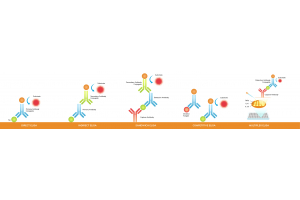
Not every weak stain is a primary binding problem. Sometimes the primary antibody binds, but the downstream system never turns that binding into a strong enough visible readout. A workflow that performed well before may weaken after a reagent substitution. A secondary antibody may not match the primary setup correctly. A low-abundance target may need more downstream sensitivity than the current detection chemistry can provide. A chromogen may simply be underdeveloped enough to make a real signal look absent.
If the sample should be positive, retrieval looks plausible, and the primary conditions are not obviously too mild, the detection layer deserves real suspicion. For broader assay-level failure patterns, see the full IHC Troubleshooting guide.
When a slide is weak or blank, the instinct is often to rewrite the whole workflow. That usually creates more confusion than clarity.
A better approach is to make the troubleshooting order explicit.
One practical rule matters throughout: change one variable at a time. If everything changes together, the slide may improve, but the reason for improvement will remain unclear.
Only after the earlier checkpoints have had a fair review.
The antibody becomes the stronger suspect when a tissue that should stain remains negative across repeated runs, retrieval adjustments do not help, primary conditions have already been revisited, and the rest of the workflow appears stable. At that point, comparing another clone, reviewing validation in the same application, or testing an alternative reagent becomes much more justified.
The real value of troubleshooting weak or no staining in IHC is not listing every possible cause. It is knowing what to check first.
If the tissue should be positive, ask these questions in order:
That sequence keeps readers from blaming the wrong part of the workflow, changing too many variables at once, or losing time on the wrong fix.
If weak staining points to assay setup rather than biology, explore Immunohistochemistry IHC Reagents for workflow components and IHC / Histology Services if the project needs outside technical support.