"; position: absolute; top: 2px; right: -15px; } /* pagi css end */ /* banner area css start */ .menu-area { position: sticky; top: -1px; z-index: 99; } .banner-area { background-size: cover; background-position: center; padding: 40px 0; } .banner-content h1 { color: #fff; text-transform: uppercase; font-weight: 700 !important; font-size: 36px; font-family: 'Open Sans', sans-serif; } .banner-content p { font-size: 18px; line-height: 25px; text-transform: capitalize; color: #fff; font-style: italic; } /* banner area css end */ /* main-menu-ara css start */ .main-menu-area { background: #4AB0D9; /*padding: 20px 0;*/ } .main-menu-area.fixed { position: fixed; width: 100%; top: 0; left: 0; } .main-menu li { display: inline-block; margin: 0; /*margin-left: 30px; margin-right: 30px;*/ } .main-menu li a { color: #fff; font-size: 17px; display: block; padding: 16px 42px; } .main-menu li a:hover { background: #ea8d28; color: #fff !important; text-decoration: none !important; } .main-menu { text-align: center; margin: 0; padding: 0; list-style: none; } /* main-menu-ara css end */ /* rabbit-area css start */ .rabbit-g-wrap { display: grid; grid-template-columns: auto 300px; margin-bottom: 60px; } .rabbit-content h3 { color: #EA8D28; font-size: 18px; font-weight: bold; } .read-more { color: #4AB0D9 !important; text-decoration: underline; } .rabbit-content { background: #f8f9fa; min-height: 281px; } .rabbit-img img { width: 100%; max-width: 100%; min-height: 281px; } .choose-g-wrap { border-top: 3px solid rgba(0, 0, 0, 0.3); border-bottom: 3px solid rgba(0, 0, 0, 0.3); padding: 30px 0; margin-bottom: 50px; } .choose-lf-content h1 { color: #EA8D28; text-transform: capitalize; font-size: 24px; font-weight: bold; font-family: 'Open Sans', sans-serif; } .single-blg { position: relative; background: #F5F5F5; box-shadow: 0px 4px 4px rgba(0, 0, 0, 0.25); border-radius: 10px; margin-bottom: 30px; overflow: hidden; } .blg-img img { max-width: 100%; width: 100%; } .single-blg h4 { font-family: Open Sans; font-style: normal; font-weight: 800; font-size: 16px; line-height: 22px; text-transform: capitalize; color: #000000; min-height: 80px; padding: 15px; margin: 0; } .trans-content { position: absolute; top: 100px; width: 100%; height: 100%; left: 0; right: 0; background: #F5F5F5; border-radius: 10px; padding: 15px; opacity: 0; visibility: hidden; transition: .3s; } .single-blg:hover .trans-content { opacity: 1; visibility: visible; top: 0; } .trans-content h3 { font-family: Open Sans; font-style: normal; font-weight: 800; font-size: 16px; line-height: 22px; text-transform: capitalize; color: #000000; } .line { background: #000; height: 2px; width: 50px; display: block; margin-top: 15px; margin-bottom: 15px; } .blog-g-wrap { margin-bottom: 30px; } .draw-g-wrap { display: grid; grid-template-columns: auto auto auto auto auto auto auto; grid-gap: 20px; position: relative; } .draw-g-wrap::after { position: absolute; width: 85%; height: 10px; background: #E8E8E8; content: ""; top: 52%; transform: translateY(-50%); z-index: -1; left: 110px; } .draw-item { align-self: center; text-align: center; } .draw-img { position: relative; } .draw-img p { position: absolute; left: 0; text-align: center; right: 0; bottom: -105px; margin: 0; font-family: Open Sans; font-style: normal; font-weight: normal; font-size: 14px; line-height: 18px; text-align: center; color: #000; } .draw-img img { max-width: 100%; } .draw-item.k-1 p { position: absolute; left: 0; text-align: center; right: 0; bottom: -105px; margin: 0; font-family: Open Sans; font-style: normal; font-weight: normal; font-size: 14px; line-height: 18px; text-align: center; color: #000; } .draw-img::after { width: 1px; height: 70px; content: ""; position: absolute; background: #000; top: 112%; left: 50%; transform: translateX(-50%); } .draw-item.k-2 p { width: auto; white-space: nowrap; bottom: -85px; } .draw-item.k-4 p { width: auto; white-space: nowrap; bottom: -85px; } .draw-item.k-2 .draw-img::after { height: 50px; top: 107%; } .draw-item.k-4 .draw-img::after { height: 50px; top: 107%; } .draw-item.k-6 p { bottom: -65px; white-space: nowrap; } .draw-item.k-6 .draw-img::after { height: 40px; right: 30%; left: auto; } .draw-item.k-7 p { bottom: -125px; white-space: nowrap; right: 0; left: auto; } .draw-item.k-3 { align-self: first baseline; } .draw-item.k-3 .draw-img::after { top: auto; bottom: 120%; height: 28px; } .draw-item.k-5 .draw-img::after { top: auto; bottom: 105%; height: 28px; } .draw-item.k-3 p { bottom: auto; top: -68px; white-space: nowrap; } .draw-item.k-5 p { bottom: auto; top: -68px; white-space: nowrap; } .draw-item.k-6 p.top-p { bottom: 0; top: -60px; } .draw-item.k-6 .draw-img::before { position: absolute; width: 1px; height: 30px; background: #000; content: ""; left: 30%; bottom: 105%; } /* rabbit-area css end */ /* overview-area css start */ .section-title h2 { font-family: Open Sans; font-style: normal; font-weight: bold; font-size: 24px; line-height: 18px; color: #F7931E; text-align: center; } .section-title { margin-bottom: 55px; } .single-protocol h3 { font-family: Open Sans; font-style: normal; font-weight: 600; font-size: 18px; line-height: 18px; color: #F7931E; margin-bottom: 20px; } .protocol-list { padding: 0; margin: 0; margin-bottom: 30px; } .protocol-list li { color: #000; font-size: 13px; } .outer-link { font-family: Open Sans; font-style: normal; font-weight: normal; font-size: 12px; line-height: 16px; text-decoration-line: underline; text-transform: capitalize; color: #4AB0D9; } .overview-area { width: 100%; background: #f8f9fa; } .overview-area h2 { text-align: center; } .overview-area ul.protocol-list { margin-bottom: 30px; } /* overview-area css end */ /* faq-area css start */ .faq-text { background: #4AB0D9; padding: 20px; } .faq-text h1 { font-family: Open Sans; font-style: normal; font-weight: bold; font-size: 30px; line-height: 18px; text-transform: capitalize; color: #FFFFFF; border-bottom: .5px solid #FFFFFF; padding-bottom: 18px; margin-bottom: 15px; } .faq-links { margin: 0; padding: 0; display: flow-root; } .faq-text ul { margin: 0 !important; } .faq-links li { list-style: none !important; } .faq-links li a { color: #fff; font-weight: normal; font-size: 14px; /*display: inline-block;*/ padding-left: 0; } .faq-links li a:hover { color: #fff !important; text-decoration: underline !important; } .nav-pills .nav-link.active, .nav-pills .show > .nav-link { border-radius: .25rem; background: #ea8d28; padding: 5px 10px; } .question { color: #3ca9d6 !important; display: inline; margin-bottom: 5px; font-weight: bold; } /* faq-area css end */ /* Normal desktop :992px. */ @media (min-width: 992px) and (max-width: 1199.98px) { .draw-item.k-3 p { left: -60px; } } /* Tablet desktop :768px. */ @media (min-width: 768px) and (max-width: 991.98px) { .choose-lf-content h1 { margin-bottom: 20px; } .rabbit-g-wrap { grid-template-columns: auto; } .main-menu li { margin-left: 20px; margin-right: 20px; } .faq-text { margin-bottom: 25px; } .overview-area { padding-bottom: 40px; padding-top: 10px; } .single-protocol { margin-bottom: 30px; } .draw-item.k-2 p { bottom: -121px; left: -20px; } .draw-item.k-2 .draw-img::after { height: 85px; top: 107%; } .draw-item.k-3 p { left: -90px; } .draw-g-wrap::after { width: 82%; } .rabbit-content { min-height: 170px; } .rabbit-img img { min-height: auto; } } /* small mobile :320px. */ @media (min-width: 320px) and (max-width: 767.98px) { .choose-lf-content h1 { margin-bottom: 20px; } .rabbit-g-wrap { grid-template-columns: auto; } .main-menu { display: grid; grid-template-columns: 1fr 1fr 1fr; grid-column-gap: 10px; text-align: left; } .main-menu li { margin-left: 0; margin-right: 0; } .banner-content h1 { font-size: 26px; } .faq-text { margin-bottom: 25px; } .overview-area { padding-bottom: 40px; padding-top: 10px; } .single-protocol { margin-bottom: 30px; } .draw-g-wrap { grid-template-columns: auto auto; grid-row-gap: 175px; padding-top: 30px; padding-bottom: 165px; } .draw-item.k-6 { grid-column: 1/3; } .draw-g-wrap::after { content: none; } .draw-item.k-4 p { right: 0; left: auto; } .draw-item.k-2 p { width: auto; white-space: nowrap; bottom: auto; top: -50px; right: 0; left: auto; } .draw-item.k-2 .draw-img::after { height: 23px; top: auto; bottom: 105%; } .draw-item.k-7 { grid-column: 1/3; } .rabbit-content { min-height: 170px; } .rabbit-img img { min-height: auto; } } .page-main { max-width: fit-content !important; padding: 0 !important; } .col-md h2 { font-family: 'Open Sans', 'Helvetica Neue', Helvetica, Arial, sans-serif; font-style: normal; font-size: 19px !important; color: #FFFFFF !important; padding-bottom: 0 !important; margin-bottom: 0 !important; font-weight: bold; } .col-md h3 { font-family: 'Open Sans', 'Helvetica Neue', Helvetica, Arial, sans-serif; font-style: normal; font-size: 20px !important; padding-bottom: 9px; color: #ea8d28; } .metrics-counter-bosterbio h2 { color: #FFF !important; } .choose-lf-content h2 { color: #ea8d28 !important; } html { scroll-behavior: smooth; } div#rab-mono-antibody-production { margin-top: 39px; } .rabbit-area .col-lg-8 { padding: 0; } { "*": { "Magento_Ui/js/core/app": { "components": { "messages": { "component": "Magento_Theme/js/view/messages" } } } } } Rabbit Monoclonal Antibodies Rabbit Monoclonal Antibody Advantages and Production Features Benefits Comparison Production Antibodies FAQs What are rabbit monoclonal antibodies? Monoclonal antibodies are used as primary antibodies in research because of their high specificity for a unique epitope of an antigen, which also leads to minimal lot-to-lot variation and low non-specific cross-reactivity... Hover to read more What are rabbit monoclonal antibodies? Monoclonal antibodies are used as primary antibodies in research because of their high specificity for a unique epitope of an antigen, which also leads to minimal lot-to-lot variation and low non-specific cross-reactivity. After the discovery of the hybridoma technique designed by Caesar Millstein and Georges Kohler to produce monoclonal antibodies in 1975, monoclonal antibodies have been conventionally developed in mice for various applications. Over the years, other new techniques have led to the emergence of monoclonal antibodies raised against rabbits, rats, and hamsters. Although mouse monoclonal antibodies have remained as the most commonly used type of monoclonal antibody, a 2015 CiteAb study observed accelerating growth in the number of researchers using rabbit monoclonal antibodies while mouse monoclonals have experienced a steady decrease in the percentage of citations. Many researchers have been choosing rabbit monoclonal antibodies over mouse monoclonal antibodies for their high specificity, affinity, and sensitivity. BosterBio offers over 500 high quality rabbit monoclonal antibodies that have been validated for flow cytometry, IP, IF, IHC, ICC, and WB. Why Choose Rabbit Monoclonal Antibodies? Rabbit monoclonal antibodies have been widely acknowledged for its high specificity and affinity. What enables rabbit monoclonal antibodies to be superior antibodies are the unique features of the rabbit immune system. The rabbit immune system can produce greater antibody diversity due to the factors below. Somatic Gene Conversion & Somatic Hypermutation Somatic Gene Conversion & Somatic Hypermutation Somatic gene conversion and hypermutation influence the variable regions of immunoglobulin (Ig) genes, which happen more often in rabbits than rodents. This ultimately contributes to enhancing the rabbit monoclonal antibody repertoire. IgG Vs IgM IgG Vs IgM Rabbits have more IgG as an isotype compared to mice which have a higher ratio of IgM. Because IgG has better specificity than IgM, rabbits have more potential to develop specific antibodies. CDRs (Complementarity-determining regions) CDRs (Complementarity-determining regions) Since rabbit CDR3 sequences are longer and more heterogeneous, more sequence variation can occur. Lower immunodominance Lower immunodominance Immunodominance refers to particular epitopes being more immunogenic than other epitopes of the same antigen, which causes the immune system to mainly generate antibodies against the dominantly immunogenic epitope. The rabbit’s immune system has lower immunodominance than mouse, which allows for more antibody diversity. Larger number of lymphocytes Larger number of lymphocytes Rabbits have larger spleens and other immune organs than mice, which indicates that more lymphocytes (B cells) are available for producing antibodies. Extended period of affinity maturation Extended period of affinity maturation After immunization, affinity maturation can persist for a longer period of time for rabbits than mice, resulting in higher affinity and specificity for rabbit monoclonal antibodies. Benefits of Rabbit Monoclonal Antibodies Due to the unique features of the rabbit immune system, rabbit monoclonal antibodies are capable of offering the following benefits: High specificity & affinity Rabbit monoclonal antibodies are effective in recognizing minor epitope variations and cleaved versions of a target protein. Furthermore, rabbit monoclonal antibodies can have extremely low equilibrium dissociation constants (KD) in the picomolar range (KD = 10-12M). Low background noise As rabbit monoclonal antibodies only detect a single epitope, they have a low chance of cross-reacting with other proteins. Since rabbit monoclonal antibodies also bind to the target antigen with greater affinity, they prove to have a higher signal-to-noise ratio than mouse monoclonal antibodies. Ideal for IHC For IHC, antibodies need to be able to identify epitopes in a background with more noise (i.e. FFPE tissues). In this case, rabbit monoclonal antibodies are an excellent choice because they can be highly sensitive while retaining specificity even in strict applications like IHC. Good for post-translational modification (PTM) detection The rabbit immune system can produce antibodies against small epitopes existing in small molecules, lipids, and polymers, which permit rabbit monoclonal antibodies to identify subtle changes from PTMs (e.g., phosphorylation, methylation, acetylation, sumoylation, etc.) or single amino acid substitutions. Novel epitope recognition for human, mouse, and rat targets In comparison to the mouse immune system, the rabbit immune system possesses reduced immunodominance and greater B-cell diversity, which enables wider epitope detection and a higher possibility of discovering unique epitopes when developing rabbit monoclonal antibodies. Validated for Flow, IHC, WB, ICC, IF, IP Our rabbit monoclonal antibodies have been validated for various applications including WB, IHC, ICC/IF, IP, and flow cytometry as well as common species like human, mouse, and rat. Rabbit Monoclonal vs. Mouse Monoclonal Comparison Rabbit Monoclonal Antibodies Mouse Monoclonal Antibodies Antigen Detection Better at identifying subtle differences (e.g., epitope variations, like modifications, mutations, conformational changes) Able to detect a wider range of antigens, like small molecules and peptides Identifies multiple epitopes per target antigen Often non-immunogenic for small molecules and peptides Immunodominance limits the number of epitopes recognized Affinity 10-100x higher affinity for target antigen than mouse monoclonal antibodies (Picomolar range: 10-12 KD M) Enhanced affinity, including antigens that are poorly immunogenic in mice and humans Lower affinity than rabbit monoclonal antibodies (Nanomolar range: ~10-9 KD M) Specificity High Medium or high Rabbit Monoclonal Antibody Production The general stages of rabbit monoclonal antibody production consist of rabbit immunization, plasma cell isolation, cloning and expression, and screening and selection. The rabbit monoclonal antibodies produced from a single clone are characterized for specific applications (e.g., ELISA, WB, IHC, etc.) and the best clone is chosen for scaling up production and performing purification. Because of the expensive and time-consuming process (usually 4-6 months) of monoclonal antibody production, they are typically more expensive than polyclonal antibodies. Immunize rabbits Isolate rabbit spleen cells Fuse with myeloma partner cells Recover hybridoma cells Screen for monospecific clones Produce best antibodies on small scales Characterize antibodies by application Scale up production and purification Custom Rabbit Monoclonal Antibodies Bosterbio provides custom antibody production and development services for rabbit and mouse monoclonal antibodies as well as rabbit polyclonal antibodies. For more details about how our service can help your research, visit our custom rabbit monoclonal antibody production service page to see service information, deliverables, and expected costs. If you have any questions about your custom rabbit monoclonal antibody project, please feel free to contact us to discuss and request a quote. Featured Rabbit Monoclonal Antibodies Anti-FOX3/NeuN Rabbit Monoclonal Antibody SKU: M11954-1 Reactivity: Human, Mouse, Rat Applications: IHC, WB View Details Anti-CD11b Rabbit Monoclonal Antibody SKU: M00144-1 Reactivity: Human, Mouse Applications: IF, IHC, ICC, WB View Details Anti-Cyclin B1 Rabbit Monoclonal Antibody SKU: M00745-2 Reactivity: Human, Mouse Applications: IF, IHC, WB View Details Anti-Lamin B1 Rabbit Monoclonal Antibody SKU: M02778 Reactivity: Human, Mouse, Rat Applications: IP, IF, IHC, WB View Details Anti-Ubiquitin Rabbit Monoclonal Antibody SKU: M02848-3 Reactivity: Human, Mouse, Rat Applications: IF, IHC, WB View Details Anti-Actin (Alpha-Actin) Rabbit Monoclonal Antibody SKU: M02014-4 Reactivity: Human, Mouse, Rat Applications: Flow Cytometry, IP, IF, IHC, ICC, WB View Details Previous Next Browse All Rabbit Monoclonals Can’t find your target? Check out our custom rabbit monoclonal antibody production service and contact us for a free consultation. Boster Rabbit Monoclonal Antibodies in Research Anti-Beta Actin Rabbit Monoclonal Antibody In a study published in Genes, scientists used Boster’s anti-beta actin rabbit monoclonal antibody as an internal control for western blotting to investigate retinol binding protein 4 (RBP4) expression in porcine granulosa cells. Zhao, Y., Li, C., & Zhou, X. (2019). Transcriptomic Analysis of Porcine Granulosa Cells Overexpressing Retinol Binding Protein 4. Genes, 10(8), 615. doi: 10.3390/genes10080615 Rabbit Monoclonals for Bcl2, Bax, pERK1/2, ERK1/2 Scientists investigated the role of indole-thiophene conjugate (ITC) as an inhibitor of cervical cancer cell proliferation. Using Boster’s rabbit monoclonal antibodies, the researchers studied the effects of ITC on the expression of Bcl2, Bax, pERK1/2, and ERK1/2 in HeLa cells through western blotting. Xu, X., Ma, H., Wang, F., & Yan, J. (2019). Indole-thiophene conjugate inhibits proliferation of human cervical cancer cell lines through DNA damage. Tropical Journal of Pharmaceutical Research, 18(8), 1705-1710. doi: 10.4314/tjpr.v18i8.20 Rabbit Monoclonals for TGF-β1, NF-κB65, Smad4, Smad3, Smad7, TNF-α, CTGF For a research studying the molecular responses of radiation‑induced liver damage (RILD), scientists used Boster rabbit monoclonals for IHC and WB to observe expression of TGF-β1, NF-κB65, Smad4, Smad3, Smad7, TNF-α, and CTGF for immunohistochemistry and western blot analyses in rat liver tissues. Cheng, W., Xiao, L., Ainiwaer, A., Wang, Y., Wu, G., Mao, R., … Bao, Y. (2014). Molecular responses of radiation-induced liver damage in rats. Molecular Medicine Reports, 11(4), 2592–2600. doi: 10.3892/mmr.2014.3051 Partners And Customers Previous Next Technical Resource Centers IHC, WB, ELISA & Flow Cytometry Troubleshooting Guides You are at the right place and at the right time for our latest series of troubleshooting handbooks. They are available at your finger tips... View Details IHC Protocol & Resource Center Every immunoassay protocol begins with sample preparation. Western blot, IHC, and ELISA all require different ways of preparing a sample, and nearly every sample... View Details Western Blotting Protocol & Resource Center Western blotting, ELISAs, and IHC are all immunoassays, and so all share in common the same basic principle of operation: primary antibodies... View Details "/> "; position: absolute; top: 2px; right: -15px; } /* pagi css end */ /* banner area css start */ .menu-area { position: sticky; top: -1px; z-index: 99; } .banner-area { background-size: cover; background-position: center; padding: 40px 0; } .banner-content h1 { color: #fff; text-transform: uppercase; font-weight: 700 !important; font-size: 36px; font-family: 'Open Sans', sans-serif; } .banner-content p { font-size: 18px; line-height: 25px; text-transform: capitalize; color: #fff; font-style: italic; } /* banner area css end */ /* main-menu-ara css start */ .main-menu-area { background: #4AB0D9; /*padding: 20px 0;*/ } .main-menu-area.fixed { position: fixed; width: 100%; top: 0; left: 0; } .main-menu li { display: inline-block; margin: 0; /*margin-left: 30px; margin-right: 30px;*/ } .main-menu li a { color: #fff; font-size: 17px; display: block; padding: 16px 42px; } .main-menu li a:hover { background: #ea8d28; color: #fff !important; text-decoration: none !important; } .main-menu { text-align: center; margin: 0; padding: 0; list-style: none; } /* main-menu-ara css end */ /* rabbit-area css start */ .rabbit-g-wrap { display: grid; grid-template-columns: auto 300px; margin-bottom: 60px; } .rabbit-content h3 { color: #EA8D28; font-size: 18px; font-weight: bold; } .read-more { color: #4AB0D9 !important; text-decoration: underline; } .rabbit-content { background: #f8f9fa; min-height: 281px; } .rabbit-img img { width: 100%; max-width: 100%; min-height: 281px; } .choose-g-wrap { border-top: 3px solid rgba(0, 0, 0, 0.3); border-bottom: 3px solid rgba(0, 0, 0, 0.3); padding: 30px 0; margin-bottom: 50px; } .choose-lf-content h1 { color: #EA8D28; text-transform: capitalize; font-size: 24px; font-weight: bold; font-family: 'Open Sans', sans-serif; } .single-blg { position: relative; background: #F5F5F5; box-shadow: 0px 4px 4px rgba(0, 0, 0, 0.25); border-radius: 10px; margin-bottom: 30px; overflow: hidden; } .blg-img img { max-width: 100%; width: 100%; } .single-blg h4 { font-family: Open Sans; font-style: normal; font-weight: 800; font-size: 16px; line-height: 22px; text-transform: capitalize; color: #000000; min-height: 80px; padding: 15px; margin: 0; } .trans-content { position: absolute; top: 100px; width: 100%; height: 100%; left: 0; right: 0; background: #F5F5F5; border-radius: 10px; padding: 15px; opacity: 0; visibility: hidden; transition: .3s; } .single-blg:hover .trans-content { opacity: 1; visibility: visible; top: 0; } .trans-content h3 { font-family: Open Sans; font-style: normal; font-weight: 800; font-size: 16px; line-height: 22px; text-transform: capitalize; color: #000000; } .line { background: #000; height: 2px; width: 50px; display: block; margin-top: 15px; margin-bottom: 15px; } .blog-g-wrap { margin-bottom: 30px; } .draw-g-wrap { display: grid; grid-template-columns: auto auto auto auto auto auto auto; grid-gap: 20px; position: relative; } .draw-g-wrap::after { position: absolute; width: 85%; height: 10px; background: #E8E8E8; content: ""; top: 52%; transform: translateY(-50%); z-index: -1; left: 110px; } .draw-item { align-self: center; text-align: center; } .draw-img { position: relative; } .draw-img p { position: absolute; left: 0; text-align: center; right: 0; bottom: -105px; margin: 0; font-family: Open Sans; font-style: normal; font-weight: normal; font-size: 14px; line-height: 18px; text-align: center; color: #000; } .draw-img img { max-width: 100%; } .draw-item.k-1 p { position: absolute; left: 0; text-align: center; right: 0; bottom: -105px; margin: 0; font-family: Open Sans; font-style: normal; font-weight: normal; font-size: 14px; line-height: 18px; text-align: center; color: #000; } .draw-img::after { width: 1px; height: 70px; content: ""; position: absolute; background: #000; top: 112%; left: 50%; transform: translateX(-50%); } .draw-item.k-2 p { width: auto; white-space: nowrap; bottom: -85px; } .draw-item.k-4 p { width: auto; white-space: nowrap; bottom: -85px; } .draw-item.k-2 .draw-img::after { height: 50px; top: 107%; } .draw-item.k-4 .draw-img::after { height: 50px; top: 107%; } .draw-item.k-6 p { bottom: -65px; white-space: nowrap; } .draw-item.k-6 .draw-img::after { height: 40px; right: 30%; left: auto; } .draw-item.k-7 p { bottom: -125px; white-space: nowrap; right: 0; left: auto; } .draw-item.k-3 { align-self: first baseline; } .draw-item.k-3 .draw-img::after { top: auto; bottom: 120%; height: 28px; } .draw-item.k-5 .draw-img::after { top: auto; bottom: 105%; height: 28px; } .draw-item.k-3 p { bottom: auto; top: -68px; white-space: nowrap; } .draw-item.k-5 p { bottom: auto; top: -68px; white-space: nowrap; } .draw-item.k-6 p.top-p { bottom: 0; top: -60px; } .draw-item.k-6 .draw-img::before { position: absolute; width: 1px; height: 30px; background: #000; content: ""; left: 30%; bottom: 105%; } /* rabbit-area css end */ /* overview-area css start */ .section-title h2 { font-family: Open Sans; font-style: normal; font-weight: bold; font-size: 24px; line-height: 18px; color: #F7931E; text-align: center; } .section-title { margin-bottom: 55px; } .single-protocol h3 { font-family: Open Sans; font-style: normal; font-weight: 600; font-size: 18px; line-height: 18px; color: #F7931E; margin-bottom: 20px; } .protocol-list { padding: 0; margin: 0; margin-bottom: 30px; } .protocol-list li { color: #000; font-size: 13px; } .outer-link { font-family: Open Sans; font-style: normal; font-weight: normal; font-size: 12px; line-height: 16px; text-decoration-line: underline; text-transform: capitalize; color: #4AB0D9; } .overview-area { width: 100%; background: #f8f9fa; } .overview-area h2 { text-align: center; } .overview-area ul.protocol-list { margin-bottom: 30px; } /* overview-area css end */ /* faq-area css start */ .faq-text { background: #4AB0D9; padding: 20px; } .faq-text h1 { font-family: Open Sans; font-style: normal; font-weight: bold; font-size: 30px; line-height: 18px; text-transform: capitalize; color: #FFFFFF; border-bottom: .5px solid #FFFFFF; padding-bottom: 18px; margin-bottom: 15px; } .faq-links { margin: 0; padding: 0; display: flow-root; } .faq-text ul { margin: 0 !important; } .faq-links li { list-style: none !important; } .faq-links li a { color: #fff; font-weight: normal; font-size: 14px; /*display: inline-block;*/ padding-left: 0; } .faq-links li a:hover { color: #fff !important; text-decoration: underline !important; } .nav-pills .nav-link.active, .nav-pills .show > .nav-link { border-radius: .25rem; background: #ea8d28; padding: 5px 10px; } .question { color: #3ca9d6 !important; display: inline; margin-bottom: 5px; font-weight: bold; } /* faq-area css end */ /* Normal desktop :992px. */ @media (min-width: 992px) and (max-width: 1199.98px) { .draw-item.k-3 p { left: -60px; } } /* Tablet desktop :768px. */ @media (min-width: 768px) and (max-width: 991.98px) { .choose-lf-content h1 { margin-bottom: 20px; } .rabbit-g-wrap { grid-template-columns: auto; } .main-menu li { margin-left: 20px; margin-right: 20px; } .faq-text { margin-bottom: 25px; } .overview-area { padding-bottom: 40px; padding-top: 10px; } .single-protocol { margin-bottom: 30px; } .draw-item.k-2 p { bottom: -121px; left: -20px; } .draw-item.k-2 .draw-img::after { height: 85px; top: 107%; } .draw-item.k-3 p { left: -90px; } .draw-g-wrap::after { width: 82%; } .rabbit-content { min-height: 170px; } .rabbit-img img { min-height: auto; } } /* small mobile :320px. */ @media (min-width: 320px) and (max-width: 767.98px) { .choose-lf-content h1 { margin-bottom: 20px; } .rabbit-g-wrap { grid-template-columns: auto; } .main-menu { display: grid; grid-template-columns: 1fr 1fr 1fr; grid-column-gap: 10px; text-align: left; } .main-menu li { margin-left: 0; margin-right: 0; } .banner-content h1 { font-size: 26px; } .faq-text { margin-bottom: 25px; } .overview-area { padding-bottom: 40px; padding-top: 10px; } .single-protocol { margin-bottom: 30px; } .draw-g-wrap { grid-template-columns: auto auto; grid-row-gap: 175px; padding-top: 30px; padding-bottom: 165px; } .draw-item.k-6 { grid-column: 1/3; } .draw-g-wrap::after { content: none; } .draw-item.k-4 p { right: 0; left: auto; } .draw-item.k-2 p { width: auto; white-space: nowrap; bottom: auto; top: -50px; right: 0; left: auto; } .draw-item.k-2 .draw-img::after { height: 23px; top: auto; bottom: 105%; } .draw-item.k-7 { grid-column: 1/3; } .rabbit-content { min-height: 170px; } .rabbit-img img { min-height: auto; } } .page-main { max-width: fit-content !important; padding: 0 !important; } .col-md h2 { font-family: 'Open Sans', 'Helvetica Neue', Helvetica, Arial, sans-serif; font-style: normal; font-size: 19px !important; color: #FFFFFF !important; padding-bottom: 0 !important; margin-bottom: 0 !important; font-weight: bold; } .col-md h3 { font-family: 'Open Sans', 'Helvetica Neue', Helvetica, Arial, sans-serif; font-style: normal; font-size: 20px !important; padding-bottom: 9px; color: #ea8d28; } .metrics-counter-bosterbio h2 { color: #FFF !important; } .choose-lf-content h2 { color: #ea8d28 !important; } html { scroll-behavior: smooth; } div#rab-mono-antibody-production { margin-top: 39px; } .rabbit-area .col-lg-8 { padding: 0; } { "*": { "Magento_Ui/js/core/app": { "components": { "messages": { "component": "Magento_Theme/js/view/messages" } } } } } Rabbit Monoclonal Antibodies Rabbit Monoclonal Antibody Advantages and Production Features Benefits Comparison Production Antibodies FAQs What are rabbit monoclonal antibodies? Monoclonal antibodies are used as primary antibodies in research because of their high specificity for a unique epitope of an antigen, which also leads to minimal lot-to-lot variation and low non-specific cross-reactivity... Hover to read more What are rabbit monoclonal antibodies? Monoclonal antibodies are used as primary antibodies in research because of their high specificity for a unique epitope of an antigen, which also leads to minimal lot-to-lot variation and low non-specific cross-reactivity. After the discovery of the hybridoma technique designed by Caesar Millstein and Georges Kohler to produce monoclonal antibodies in 1975, monoclonal antibodies have been conventionally developed in mice for various applications. Over the years, other new techniques have led to the emergence of monoclonal antibodies raised against rabbits, rats, and hamsters. Although mouse monoclonal antibodies have remained as the most commonly used type of monoclonal antibody, a 2015 CiteAb study observed accelerating growth in the number of researchers using rabbit monoclonal antibodies while mouse monoclonals have experienced a steady decrease in the percentage of citations. Many researchers have been choosing rabbit monoclonal antibodies over mouse monoclonal antibodies for their high specificity, affinity, and sensitivity. BosterBio offers over 500 high quality rabbit monoclonal antibodies that have been validated for flow cytometry, IP, IF, IHC, ICC, and WB. Why Choose Rabbit Monoclonal Antibodies? Rabbit monoclonal antibodies have been widely acknowledged for its high specificity and affinity. What enables rabbit monoclonal antibodies to be superior antibodies are the unique features of the rabbit immune system. The rabbit immune system can produce greater antibody diversity due to the factors below. Somatic Gene Conversion & Somatic Hypermutation Somatic Gene Conversion & Somatic Hypermutation Somatic gene conversion and hypermutation influence the variable regions of immunoglobulin (Ig) genes, which happen more often in rabbits than rodents. This ultimately contributes to enhancing the rabbit monoclonal antibody repertoire. IgG Vs IgM IgG Vs IgM Rabbits have more IgG as an isotype compared to mice which have a higher ratio of IgM. Because IgG has better specificity than IgM, rabbits have more potential to develop specific antibodies. CDRs (Complementarity-determining regions) CDRs (Complementarity-determining regions) Since rabbit CDR3 sequences are longer and more heterogeneous, more sequence variation can occur. Lower immunodominance Lower immunodominance Immunodominance refers to particular epitopes being more immunogenic than other epitopes of the same antigen, which causes the immune system to mainly generate antibodies against the dominantly immunogenic epitope. The rabbit’s immune system has lower immunodominance than mouse, which allows for more antibody diversity. Larger number of lymphocytes Larger number of lymphocytes Rabbits have larger spleens and other immune organs than mice, which indicates that more lymphocytes (B cells) are available for producing antibodies. Extended period of affinity maturation Extended period of affinity maturation After immunization, affinity maturation can persist for a longer period of time for rabbits than mice, resulting in higher affinity and specificity for rabbit monoclonal antibodies. Benefits of Rabbit Monoclonal Antibodies Due to the unique features of the rabbit immune system, rabbit monoclonal antibodies are capable of offering the following benefits: High specificity & affinity Rabbit monoclonal antibodies are effective in recognizing minor epitope variations and cleaved versions of a target protein. Furthermore, rabbit monoclonal antibodies can have extremely low equilibrium dissociation constants (KD) in the picomolar range (KD = 10-12M). Low background noise As rabbit monoclonal antibodies only detect a single epitope, they have a low chance of cross-reacting with other proteins. Since rabbit monoclonal antibodies also bind to the target antigen with greater affinity, they prove to have a higher signal-to-noise ratio than mouse monoclonal antibodies. Ideal for IHC For IHC, antibodies need to be able to identify epitopes in a background with more noise (i.e. FFPE tissues). In this case, rabbit monoclonal antibodies are an excellent choice because they can be highly sensitive while retaining specificity even in strict applications like IHC. Good for post-translational modification (PTM) detection The rabbit immune system can produce antibodies against small epitopes existing in small molecules, lipids, and polymers, which permit rabbit monoclonal antibodies to identify subtle changes from PTMs (e.g., phosphorylation, methylation, acetylation, sumoylation, etc.) or single amino acid substitutions. Novel epitope recognition for human, mouse, and rat targets In comparison to the mouse immune system, the rabbit immune system possesses reduced immunodominance and greater B-cell diversity, which enables wider epitope detection and a higher possibility of discovering unique epitopes when developing rabbit monoclonal antibodies. Validated for Flow, IHC, WB, ICC, IF, IP Our rabbit monoclonal antibodies have been validated for various applications including WB, IHC, ICC/IF, IP, and flow cytometry as well as common species like human, mouse, and rat. Rabbit Monoclonal vs. Mouse Monoclonal Comparison Rabbit Monoclonal Antibodies Mouse Monoclonal Antibodies Antigen Detection Better at identifying subtle differences (e.g., epitope variations, like modifications, mutations, conformational changes) Able to detect a wider range of antigens, like small molecules and peptides Identifies multiple epitopes per target antigen Often non-immunogenic for small molecules and peptides Immunodominance limits the number of epitopes recognized Affinity 10-100x higher affinity for target antigen than mouse monoclonal antibodies (Picomolar range: 10-12 KD M) Enhanced affinity, including antigens that are poorly immunogenic in mice and humans Lower affinity than rabbit monoclonal antibodies (Nanomolar range: ~10-9 KD M) Specificity High Medium or high Rabbit Monoclonal Antibody Production The general stages of rabbit monoclonal antibody production consist of rabbit immunization, plasma cell isolation, cloning and expression, and screening and selection. The rabbit monoclonal antibodies produced from a single clone are characterized for specific applications (e.g., ELISA, WB, IHC, etc.) and the best clone is chosen for scaling up production and performing purification. Because of the expensive and time-consuming process (usually 4-6 months) of monoclonal antibody production, they are typically more expensive than polyclonal antibodies. Immunize rabbits Isolate rabbit spleen cells Fuse with myeloma partner cells Recover hybridoma cells Screen for monospecific clones Produce best antibodies on small scales Characterize antibodies by application Scale up production and purification Custom Rabbit Monoclonal Antibodies Bosterbio provides custom antibody production and development services for rabbit and mouse monoclonal antibodies as well as rabbit polyclonal antibodies. For more details about how our service can help your research, visit our custom rabbit monoclonal antibody production service page to see service information, deliverables, and expected costs. If you have any questions about your custom rabbit monoclonal antibody project, please feel free to contact us to discuss and request a quote. Featured Rabbit Monoclonal Antibodies Anti-FOX3/NeuN Rabbit Monoclonal Antibody SKU: M11954-1 Reactivity: Human, Mouse, Rat Applications: IHC, WB View Details Anti-CD11b Rabbit Monoclonal Antibody SKU: M00144-1 Reactivity: Human, Mouse Applications: IF, IHC, ICC, WB View Details Anti-Cyclin B1 Rabbit Monoclonal Antibody SKU: M00745-2 Reactivity: Human, Mouse Applications: IF, IHC, WB View Details Anti-Lamin B1 Rabbit Monoclonal Antibody SKU: M02778 Reactivity: Human, Mouse, Rat Applications: IP, IF, IHC, WB View Details Anti-Ubiquitin Rabbit Monoclonal Antibody SKU: M02848-3 Reactivity: Human, Mouse, Rat Applications: IF, IHC, WB View Details Anti-Actin (Alpha-Actin) Rabbit Monoclonal Antibody SKU: M02014-4 Reactivity: Human, Mouse, Rat Applications: Flow Cytometry, IP, IF, IHC, ICC, WB View Details Previous Next Browse All Rabbit Monoclonals Can’t find your target? Check out our custom rabbit monoclonal antibody production service and contact us for a free consultation. Boster Rabbit Monoclonal Antibodies in Research Anti-Beta Actin Rabbit Monoclonal Antibody In a study published in Genes, scientists used Boster’s anti-beta actin rabbit monoclonal antibody as an internal control for western blotting to investigate retinol binding protein 4 (RBP4) expression in porcine granulosa cells. Zhao, Y., Li, C., & Zhou, X. (2019). Transcriptomic Analysis of Porcine Granulosa Cells Overexpressing Retinol Binding Protein 4. Genes, 10(8), 615. doi: 10.3390/genes10080615 Rabbit Monoclonals for Bcl2, Bax, pERK1/2, ERK1/2 Scientists investigated the role of indole-thiophene conjugate (ITC) as an inhibitor of cervical cancer cell proliferation. Using Boster’s rabbit monoclonal antibodies, the researchers studied the effects of ITC on the expression of Bcl2, Bax, pERK1/2, and ERK1/2 in HeLa cells through western blotting. Xu, X., Ma, H., Wang, F., & Yan, J. (2019). Indole-thiophene conjugate inhibits proliferation of human cervical cancer cell lines through DNA damage. Tropical Journal of Pharmaceutical Research, 18(8), 1705-1710. doi: 10.4314/tjpr.v18i8.20 Rabbit Monoclonals for TGF-β1, NF-κB65, Smad4, Smad3, Smad7, TNF-α, CTGF For a research studying the molecular responses of radiation‑induced liver damage (RILD), scientists used Boster rabbit monoclonals for IHC and WB to observe expression of TGF-β1, NF-κB65, Smad4, Smad3, Smad7, TNF-α, and CTGF for immunohistochemistry and western blot analyses in rat liver tissues. Cheng, W., Xiao, L., Ainiwaer, A., Wang, Y., Wu, G., Mao, R., … Bao, Y. (2014). Molecular responses of radiation-induced liver damage in rats. Molecular Medicine Reports, 11(4), 2592–2600. doi: 10.3892/mmr.2014.3051 Partners And Customers Previous Next Technical Resource Centers IHC, WB, ELISA & Flow Cytometry Troubleshooting Guides You are at the right place and at the right time for our latest series of troubleshooting handbooks. They are available at your finger tips... View Details IHC Protocol & Resource Center Every immunoassay protocol begins with sample preparation. Western blot, IHC, and ELISA all require different ways of preparing a sample, and nearly every sample... View Details Western Blotting Protocol & Resource Center Western blotting, ELISAs, and IHC are all immunoassays, and so all share in common the same basic principle of operation: primary antibodies... View Details "/>

What are rabbit monoclonal antibodies?

Monoclonal antibodies are used as primary antibodies in research because of their high specificity for a unique epitope of an antigen, which also leads to minimal lot-to-lot variation and low non-specific cross-reactivity...

Hover to read more

What are rabbit monoclonal antibodies?

Monoclonal antibodies are used as primary antibodies in research because of their high specificity for a unique epitope of an antigen, which also leads to minimal lot-to-lot variation and low non-specific cross-reactivity. After the discovery of the hybridoma technique designed by Caesar Millstein and Georges Kohler to produce monoclonal antibodies in 1975, monoclonal antibodies have been conventionally developed in mice for various applications. Over the years, other new techniques have led to the emergence of monoclonal antibodies raised against rabbits, rats, and hamsters. Although mouse monoclonal antibodies have remained as the most commonly used type of monoclonal antibody, a 2015 CiteAb study observed accelerating growth in the number of researchers using rabbit monoclonal antibodies while mouse monoclonals have experienced a steady decrease in the percentage of citations.

Many researchers have been choosing rabbit monoclonal antibodies over mouse monoclonal antibodies for their high specificity, affinity, and sensitivity. BosterBio offers over 500 high quality rabbit monoclonal antibodies that have been validated for flow cytometry, IP, IF, IHC, ICC, and WB.

Why Choose Rabbit Monoclonal Antibodies?

Rabbit monoclonal antibodies have been widely acknowledged for its high specificity and affinity. What enables rabbit monoclonal antibodies to be superior antibodies are the unique features of the rabbit immune system.

The rabbit immune system can produce greater antibody diversity due to the factors below.

Somatic Gene Conversion & Somatic Hypermutation

Somatic Gene Conversion & Somatic Hypermutation

Somatic gene conversion and hypermutation influence the variable regions of immunoglobulin (Ig) genes, which happen more often in rabbits than rodents. This ultimately contributes to enhancing the rabbit monoclonal antibody repertoire.

IgG Vs IgM

IgG Vs IgM

Rabbits have more IgG as an isotype compared to mice which have a higher ratio of IgM. Because IgG has better specificity than IgM, rabbits have more potential to develop specific antibodies.

CDRs (Complementarity-determining regions)

CDRs (Complementarity-determining regions)

Since rabbit CDR3 sequences are longer and more heterogeneous, more sequence variation can occur.

Lower immunodominance

Lower immunodominance

Immunodominance refers to particular epitopes being more immunogenic than other epitopes of the same antigen, which causes the immune system to mainly generate antibodies against the dominantly immunogenic epitope. The rabbit’s immune system has lower immunodominance than mouse, which allows for more antibody diversity.

Larger number of lymphocytes

Larger number of lymphocytes

Rabbits have larger spleens and other immune organs than mice, which indicates that more lymphocytes (B cells) are available for producing antibodies.

Extended period of affinity maturation

Extended period of affinity maturation

After immunization, affinity maturation can persist for a longer period of time for rabbits than mice, resulting in higher affinity and specificity for rabbit monoclonal antibodies.

Benefits of Rabbit Monoclonal Antibodies

Due to the unique features of the rabbit immune system, rabbit monoclonal antibodies are capable of offering the following benefits:

High specificity & affinity

Rabbit monoclonal antibodies are effective in recognizing minor epitope variations and cleaved versions of a target protein. Furthermore, rabbit monoclonal antibodies can have extremely low equilibrium dissociation constants (KD) in the picomolar range (KD = 10-12M).

Low background noise

As rabbit monoclonal antibodies only detect a single epitope, they have a low chance of cross-reacting with other proteins. Since rabbit monoclonal antibodies also bind to the target antigen with greater affinity, they prove to have a higher signal-to-noise ratio than mouse monoclonal antibodies.

Ideal for IHC

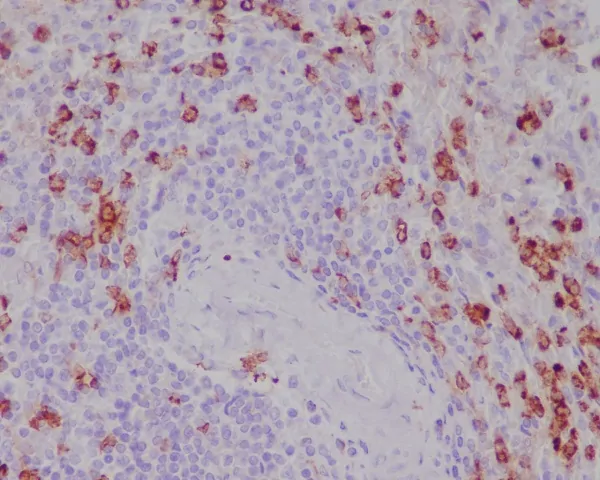
For IHC, antibodies need to be able to identify epitopes in a background with more noise (i.e. FFPE tissues). In this case, rabbit monoclonal antibodies are an excellent choice because they can be highly sensitive while retaining specificity even in strict applications like IHC.

Good for post-translational modification (PTM) detection

The rabbit immune system can produce antibodies against small epitopes existing in small molecules, lipids, and polymers, which permit rabbit monoclonal antibodies to identify subtle changes from PTMs (e.g., phosphorylation, methylation, acetylation, sumoylation, etc.) or single amino acid substitutions.

Novel epitope recognition for human, mouse, and rat targets

In comparison to the mouse immune system, the rabbit immune system possesses reduced immunodominance and greater B-cell diversity, which enables wider epitope detection and a higher possibility of discovering unique epitopes when developing rabbit monoclonal antibodies.

Validated for Flow, IHC, WB, ICC, IF, IP

Our rabbit monoclonal antibodies have been validated for various applications including WB, IHC, ICC/IF, IP, and flow cytometry as well as common species like human, mouse, and rat.

Rabbit Monoclonal vs. Mouse Monoclonal

Comparison Rabbit Monoclonal Antibodies Mouse Monoclonal Antibodies
Antigen Detection
  • Better at identifying subtle differences (e.g., epitope variations, like modifications, mutations, conformational changes)
  • Able to detect a wider range of antigens, like small molecules and peptides
  • Identifies multiple epitopes per target antigen
  • Often non-immunogenic for small molecules and peptides
  • Immunodominance limits the number of epitopes recognized
Affinity
  • 10-100x higher affinity for target antigen than mouse monoclonal antibodies (Picomolar range: 10-12 KD M)
  • Enhanced affinity, including antigens that are poorly immunogenic in mice and humans
  • Lower affinity than rabbit monoclonal antibodies (Nanomolar range: ~10-9 KD M)
Specificity High Medium or high

Rabbit Monoclonal Antibody Production

The general stages of rabbit monoclonal antibody production consist of rabbit immunization, plasma cell isolation, cloning and expression, and screening and selection. The rabbit monoclonal antibodies produced from a single clone are characterized for specific applications (e.g., ELISA, WB, IHC, etc.) and the best clone is chosen for scaling up production and performing purification. Because of the expensive and time-consuming process (usually 4-6 months) of monoclonal antibody production, they are typically more expensive than polyclonal antibodies.

Immunize rabbits

Isolate rabbit spleen cells

Fuse with myeloma partner cells

Recover hybridoma cells

Screen for monospecific clones

Produce best antibodies on small scales

Characterize antibodies by application

Scale up production and purification

Custom Rabbit Monoclonal Antibodies

Bosterbio provides custom antibody production and development services for rabbit and mouse monoclonal antibodies as well as rabbit polyclonal antibodies. For more details about how our service can help your research, visit our custom rabbit monoclonal antibody production service page to see service information, deliverables, and expected costs. If you have any questions about your custom rabbit monoclonal antibody project, please feel free to contact us to discuss and request a quote.

Boster Rabbit Monoclonal Antibodies in Research

Technical Resource Centers

IHC, WB, ELISA & Flow Cytometry Troubleshooting Guides

IHC, WB, ELISA & Flow Cytometry Troubleshooting Guides

You are at the right place and at the right time for our latest series of troubleshooting handbooks. They are available at your finger tips...

View Details

IHC Protocol & Resource Center

IHC Protocol & Resource Center

Every immunoassay protocol begins with sample preparation. Western blot, IHC, and ELISA all require different ways of preparing a sample, and nearly every sample...

View Details

Western Blotting Protocol & Resource Center

Western Blotting Protocol & Resource Center

Western blotting, ELISAs, and IHC are all immunoassays, and so all share in common the same basic principle of operation: primary antibodies...

View Details

Flow Cytometry Protocol & Resource Center