Product Info Summary
| SKU: | PA1766 |
|---|---|
| Size: | 100 μg/vial |
| Reactive Species: | Human, Mouse, Rat |
| Host: | Rabbit |
| Application: | WB |
Customers Who Bought This Also Bought
Product info
Product Name
Anti-Transcriptional activator GLI3 Gli3 Antibody Picoband®
SKU/Catalog Number
PA1766
BA2158 is an alternative SKU for this antibody, used in previous lots.
Size
100 μg/vial
Form
Lyophilized
Description
Boster Bio Anti-Transcriptional activator GLI3 Gli3 Antibody catalog # PA1766. Tested in WB applications. This antibody reacts with Human, Mouse, Rat. The brand Picoband indicates this is a premium antibody that guarantees superior quality, high affinity, and strong signals with minimal background in Western blot applications. Only our best-performing antibodies are designated as Picoband, ensuring unmatched performance.
Storage & Handling
Store at -20˚C for one year from date of receipt. After reconstitution, at 4˚C for one month. It can also be aliquotted and stored frozen at -20˚C for six months. Avoid repeated freeze-thaw cycles.
Cite This Product
Anti-Transcriptional activator GLI3 Gli3 Antibody Picoband® (Boster Biological Technology, Pleasanton CA, USA, Catalog # PA1766)
Host
Rabbit
Contents
Each vial contains antibody formulated with stabilizing components, 0.9mg NaCl, 0.2mg Na2HPO4, 0.05mg Thimerosal, 0.05mg NaN3.
*This antibody is supplied in a stabilized formulation.
Compatibility with conjugation reactions depends on the chemistry of the conjugation method used.
For conjugation methods that are not compatible with the stabilizing components present in this formulation, a carrier-free antibody format is required.
Clonality
Polyclonal
Isotype
Rabbit IgG
Immunogen
A synthetic peptide corresponding to a sequence at the N-terminus of human Gli3, different from the related rat sequence by two amino acids, and from the related mouse sequence by one amino acid.
Cross-reactivity
No cross-reactivity with other proteins
Reactive Species
PA1766 is reactive to GLI3 in Human, Mouse, Rat
Observed Molecular Weight
33 kDa
Calculated molecular weight
169.9 kDa
Background of GLI3
GLI3 (Gli-kruppel family member 3), also called ONCOGENE GLI3, encodes a member of the zinc finger gene family related to Kruppel, a gene that is known to regulate development in Drosophila. The GLI3 gene is expressed as an 8.5-kb mRNA in tissues such as testis, myometrium, placenta, and lung, and the protein product (relative molecular mass, 190,000) shows sequence-specific DNA binding. The GLI3 gene is mapped on 7p14.1. GLI3 is homologous to the Drosophila cubitus interruptus (ci) gene product (Ci), which regulates the Patched (pct), gooseberry (gsb), and decapentaplegic (dpp) genes. PKA-dependent processing of vertebrate GLI3 in developing limb generates a potent repressor in a manner antagonized by apparent long-range signaling from posteriorly localized Sonic hedgehog protein. The high relative abundance and potency of GLI3 repressor suggested specialization of GLI3 and its products for negative hedgehog pathway regulation.Coimmunoprecipitation and immunoblot studies showed that GLI3 protein is polyubiquitinated and that its processing depends on proteasome activity. The findings suggested that BTRC is required for GLI3 processing.
Antibody Validation
Boster validates all antibodies on WB, IHC, ICC, Immunofluorescence, and ELISA with known positive control and negative samples to ensure specificity and high affinity, including thorough antibody incubations.
Application & Images
Applications
PA1766 is guaranteed for WB Boster Guarantee
Assay Dilutions Recommendation
The recommendations below provide a starting point for assay optimization. The actual working concentration varies and should be decided by the user.
Western blot, 0.1-0.5μg/ml, Human, Rat, Mouse
Positive Control
WB: Rat Testis Tissue, A549 Cell, SW620 Cell,
Validation Images & Assay Conditions
Click image to see more details
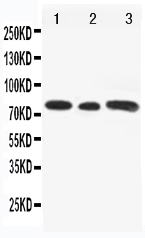
Anti-Gli3 antibody, PA1766, Western blotting
Lane 1: Rat Testis Tissue Lysate
Lane 2: A549 Cell Lysate
Lane 3: SW620 Cell Lysate
Specific Publications For Anti-Transcriptional activator GLI3 Gli3 Antibody Picoband® (PA1766)
Loading publications
Recommended Resources
Here are featured tools and databases that you might find useful.
- Boster's Pathways Library
- Protein Databases
- Bioscience Research Protocol Resources
- Data Processing & Analysis Software
- Photo Editing Software
- Scientific Literature Resources
- Research Paper Management Tools
- Molecular Biology Software
- Primer Design Tools
- Bioinformatics Tools
- Phylogenetic Tree Analysis
Customer Reviews
Have you used Anti-Transcriptional activator GLI3 Gli3 Antibody Picoband®?
Share your experimental results or join a short interview to earn up to $1,000 in product credits or other rewards.
0 Reviews For Anti-Transcriptional activator GLI3 Gli3 Antibody Picoband®
Customer Q&As
Have a question?
Find answers in Q&As, reviews.
Can't find your answer?
Submit your question
5 Customer Q&As for Anti-Transcriptional activator GLI3 Gli3 Antibody Picoband®
Question
I was wanting to use your anti-Gli3 antibody for WB for rat cervix carcinoma on frozen tissues, but I want to know if it has been tested for this particular application. Has this antibody been tested and is this antibody a good choice for rat cervix carcinoma identification?
Verified Customer
Verified customer
Asked: 2020-05-04
Answer
It shows on the product datasheet, PA1766 anti-Gli3 antibody has been tested for WB on human, mouse, rat tissues. We have an innovator award program that if you test this antibody and show it works in rat cervix carcinoma in IHC-frozen, you can get your next antibody for free.
Boster Scientific Support
Answered: 2020-05-04
Question
Will anti-Gli3 antibody PA1766 work on goat WB with cerebellum?
Verified Customer
Verified customer
Asked: 2018-09-21
Answer
Our lab technicians have not validated anti-Gli3 antibody PA1766 on goat. You can run a BLAST between goat and the immunogen sequence of anti-Gli3 antibody PA1766 to see if they may cross-react. If the sequence homology is close, then you can perform a pilot test. Keep in mind that since we have not validated goat samples, this use of the antibody is not covered by our guarantee. However we have an innovator award program that if you test this antibody and show it works in goat cerebellum in WB, you can get your next antibody for free.
Boster Scientific Support
Answered: 2018-09-21
Question
We are currently using anti-Gli3 antibody PA1766 for human tissue, and we are happy with the WB results. The species of reactivity given in the datasheet says human, mouse, rat. Is it likely that the antibody can work on canine tissues as well?
N. Thomas
Verified customer
Asked: 2014-10-29
Answer
The anti-Gli3 antibody (PA1766) has not been tested for cross reactivity specifically with canine tissues, but there is a good chance of cross reactivity. We have an innovator award program that if you test this antibody and show it works in canine you can get your next antibody for free. Please contact me if I can help you with anything.
Boster Scientific Support
Answered: 2014-10-29
Question
Is this PA1766 anti-Gli3 antibody reactive to the isotypes of GLI3?
J. Carter
Verified customer
Asked: 2014-05-06
Answer
The immunogen of PA1766 anti-Gli3 antibody is A synthetic peptide corresponding to a sequence at the N-terminus of human Gli3(40-57aa SNEDESPGQTYHRERRNA), different from the related rat sequence by two amino acids, and from the related mouse sequence by one amino acid. Could you tell me which isotype you are interested in so I can help see if the immunogen is part of this isotype?
Boster Scientific Support
Answered: 2014-05-06
Question
Is a blocking peptide available for product anti-Gli3 antibody (PA1766)?
E. Williams
Verified customer
Asked: 2013-04-08
Answer
We do provide the blocking peptide for product anti-Gli3 antibody (PA1766). If you would like to place an order for it please contact support@bosterbio.com and make a special request.
Boster Scientific Support
Answered: 2013-04-08