This website uses cookies to ensure you get the best experience on our website.


- Table of Contents

A flow cytometry panel can behave perfectly for weeks and then suddenly look different.
The fluorophore assignments are unchanged. The same markers are being stained. The instrument appears to be running normally. Yet a population that previously compensated cleanly now spreads further into a neighboring channel.
With tandem fluorophores such as PE-Cy7 or APC-Cy7, one possibility is that the reagent itself is no longer producing exactly the same emission pattern it did before.
That does not mean every run-to-run compensation change is caused by tandem dye degradation. A new reagent lot, mismatched compensation control, fixation or permeabilization, instrument settings, or changes in sample autofluorescence can produce similar symptoms.
But when donor-channel spillover increases over time, tandem behavior is worth checking early.
For a refresher on excitation, emission spectra, detector channels, and spillover, see Boster's Flow Cytometry Principle.
A tandem fluorophore combines a donor and an acceptor dye.
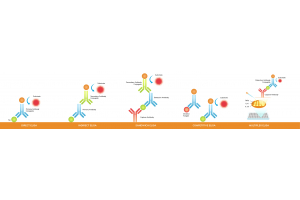
In an intact tandem, the donor absorbs excitation energy and transfers much of that energy to the acceptor through Forster resonance energy transfer, or FRET. The acceptor then emits at the longer wavelength used to identify the tandem.
For PE-Cy7, PE is the donor and Cy7 is the acceptor. For APC-Cy7, APC is the donor and Cy7 is the acceptor.
Intact tandem: donor excitation -> efficient energy transfer -> strong acceptor emission.
Altered tandem: donor excitation -> reduced energy transfer -> more donor emission and less efficient acceptor emission.
The important point for compensation is not whether the tandem has literally broken apart. What matters is that its effective spectral behavior can change.
When FRET becomes less efficient, a PE-Cy7 conjugate can produce more PE-channel fluorescence than it did previously. APC-Cy7 can show the same type of shift toward APC.
Tandem behavior is only one part of multicolor performance. Boster's Multicolor Panel Design for Flow Cytometry covers fluorophore selection, antigen-fluorophore pairing, and strategies for reducing problematic spectral overlap.
The easiest place to look is usually the donor channel.
If PE-Cy7 is behaving differently, inspect PE. If APC-Cy7 is behaving differently, inspect APC.
A healthy single-stain tandem control generally produces a reproducible relationship between its primary detector and the donor detector. When tandem performance changes, that relationship can shift.
You may see increased donor-channel fluorescence from tandem-positive events, reduced or altered tandem-channel brightness, more spreading toward the donor detector, a diagonal distribution rather than the tight pattern seen previously, or a different spillover value when a fresh single-color control is calculated.
For example, a PE-Cy7-positive population that previously sat cleanly in PE-Cy7 may begin to extend further into PE. That can look like undercompensation.
The distinction matters because undercompensation and a changing tandem spectrum are not the same problem.
Tandem conjugates can change during storage. Older tandem reagents may show increased donor leakage and weaker acceptor emission, making reagent age particularly relevant when a panel worked previously but begins to drift gradually.
Some tandem fluorophores are sensitive to handling conditions. Repeated room-temperature exposure, unnecessary time on the bench, or prolonged exposure to ambient light can alter fluorescence performance. The useful question is whether the handling history changed between the clean and problematic experiments.
Fixation and permeabilization can also affect tandem emission. This becomes important when compensation controls are prepared differently from the experimental sample. If the experiment is fixed and permeabilized but the compensation control is not, the control may no longer reproduce the fluorophore behavior present in the sample.
Because fixation and permeabilization can change staining behavior, these steps should be optimized together with the fluorophore panel. See Flow Cytometry Optimization for additional guidance.
A new bottle with the same antibody clone and the same fluorophore name is not necessarily spectrally identical to the previous bottle. This is particularly important for tandem reagents, which can show meaningful lot-to-lot variation in spillover.
Most troubleshooting focuses on reagent storage and handling, but some APC-based tandems can behave differently on cells than on compensation beads. This is one reason bead controls should not automatically be assumed to reproduce every biological sample perfectly.
Seeing more spillover does not by itself prove degradation. A few comparisons are much more informative than the appearance of a single compensated plot.
Use the same tandem antibody that is currently being used in the experiment. Do not substitute a different PE-Cy7 or APC-Cy7 reagent simply because the fluorophore name is the same.
If the fresh control produces a different spillover value than it did several weeks earlier, the fluorophore-control relationship has changed. That is more informative than manually moving the compensation slider.
Fresh, matched single-color controls are essential when the current tandem spectrum is in question. For a broader overview of single-color, FMO, and other controls, see Experimental Controls in Flow Cytometry.
If possible, run the old reagent and a fresh reagent side by side under identical staining and acquisition conditions.
If the old PE-Cy7 reagent shows increased PE-channel signal while a fresh PE-Cy7 reagent returns to the previous pattern, that strongly suggests the older reagent has changed. If both behave the same way, the explanation is more likely to lie elsewhere.
If the problem appeared immediately after opening a new lot, do not assume the old compensation matrix should still apply. Rebuild the single-stain control using the current reagent. A change in spillover coefficient after a lot change is not automatically a reagent defect; it may reflect normal spectral variability of tandem conjugates.
If the shift only appears after fixation or permeabilization, the processing step deserves attention. A fresh unfixed control that looks normal while the matched fixed control shows more donor leakage points toward sample treatment rather than long-term reagent degradation alone.
If several unrelated fluorophores change at the same time, tandem degradation becomes a less convincing explanation. Review instrument QC, detector settings, application settings, acquisition configuration, autofluorescence, sample preparation, and staining protocol. A tandem-specific problem should usually behave like a tandem-specific problem.
Compensation is calculated from measured spillover. It does not correct a fluorophore based simply on the name written on the antibody vial.
If the fluorescence spectrum changes, the spillover value can change with it. This is especially important for tandem dyes because FRET efficiency can vary between lots and with reagent or sample treatment.
A matrix generated several weeks earlier may therefore no longer represent the current reagent. That does not mean compensation values should fluctuate randomly from run to run. Under stable conditions, a panel should be reasonably reproducible.
But an old matrix should not be treated as permanent proof that today's tandem reagent behaves identically to yesterday's.
A compensation matrix corrects the spectrum you measured, not the fluorophore name printed on the vial.
If PE-Cy7 starts appearing in PE, the obvious reaction is to increase PE-Cy7-to-PE compensation.
Sometimes the problem really is an incorrect compensation value. But if the reagent's spectral behavior has changed, forcing the matrix higher can create a second problem.
Compensation is a mathematical correction based on the relationship measured in the single-color control. If that control no longer represents the experiment, manual adjustment may clean up one population while distorting another.
The better sequence is to prepare a fresh matched single-color control, recalculate compensation, compare the current spillover value with historical runs, and investigate the tandem reagent if the spectral relationship has genuinely changed.
Do not use manual compensation adjustment to hide an unexplained reagent shift.
| What you observe | What to check first |
|---|---|
| Same panel, more donor spillover several weeks later | Fresh tandem single-color control and reagent history |
| PE-Cy7-positive events spread further into PE | PE-Cy7 spectral behavior |
| APC-Cy7-positive events spread further into APC | APC-Cy7 spectral behavior |
| Problem starts with a new antibody lot | Lot-specific compensation control |
| Only fixed samples show the shift | Fixation/permeabilization effect |
| Old vial shows more donor leakage than a fresh vial | Reagent aging or degradation |
| Fresh compensation control corrects the pattern | Previous compensation matrix was outdated |
| Bead control looks normal but cells do not | Compare cell- and bead-based controls |
| Several non-tandem fluorophores also shift | Instrument, sample, or broader workflow problem |
| Manual compensation cannot cleanly correct the population | Recheck the control and tandem reagent before forcing the matrix |
The pattern should guide the next experiment, not serve as a diagnosis by itself.
If several fluorophores shift together or the pattern does not look tandem-specific, Boster's Flow Cytometry Troubleshooting Guide covers instrument settings, under-compensation, high background, weak signal, and other common causes.
Consider an eight-color panel containing a PE-Cy7-conjugated marker.
During the original validation run, the PE-Cy7 single-stain control produced a PE spillover value of approximately 4%.
The panel ran cleanly for several weeks.
Later, the PE-Cy7-positive population begins spreading visibly into PE. Nothing obvious has changed in the panel design.
A new single-color control prepared from the current PE-Cy7 vial now gives a PE spillover value closer to 9%. The old compensation matrix no longer corrects the population cleanly.
A fresh vial of the same conjugate is then tested under the same conditions and produces a value of about 4-5%, similar to the original validation.
That comparison makes a reagent-related spectral change much more plausible than instrument drift.
Now consider the opposite result. Both the old and fresh PE-Cy7 reagents give similar single-stain controls, while PE, FITC, and APC signals have all shifted compared with previous runs.
In that case, tandem degradation would not be the first explanation to pursue. Instrument configuration, sample preparation, or acquisition conditions deserve attention instead.
The important observation is not that a compensation percentage is high or low. It is that the relationship between the same fluorophore and its spillover detector changed over time.
Tandem fluorophores do not need to be avoided. They need to be controlled in a way that reflects how they actually behave.
Protect tandem reagents and stained samples from unnecessary light exposure and keep reagents within their recommended storage conditions.
Avoid long, unnecessary delays between staining, fixation, and acquisition.
When fixation or permeabilization is part of the experiment, verify that the compensation control remains representative after the same type of treatment.
For tandem fluorophores, use the exact conjugated reagent used in the experiment whenever practical for compensation. A different antibody carrying the same tandem name may not provide the same spillover relationship.
Rebuild or verify single-color controls after a new tandem lot is introduced rather than automatically carrying forward historical values.
It can also help to trend spillover values over time. A gradual shift is easier to recognize when historical values are available than when each experiment is evaluated in isolation.
Sample quality and handling can also change fluorescence distributions between runs. Boster's Flow Cytometry Sample Preparation guide covers preparation of cultured cells, blood, bone marrow, and other common sample types.
For the broader staining and acquisition workflow, refer to the Flow Cytometry Protocol.
Tandem degradation is only one explanation for a panel that suddenly looks different. Look elsewhere when several non-tandem fluorophores change at the same time, instrument QC is outside its usual range, detector or application settings have changed, the experimental sample has different autofluorescence, the staining protocol or sample type changed, the compensation control was prepared from a different material than before, or a fresh matched tandem control reproduces the expected spectrum.
Compensation itself can also be wrong because the single-color control was inappropriate. Before concluding that the tandem dye has degraded, confirm that the control was appropriate in the first place.
When a flow cytometry panel that previously compensated cleanly starts showing more donor-channel spillover, do not assume the biology changed and do not immediately increase the compensation value.
First ask whether the current single-color control still reproduces the fluorophore behavior present in the experiment.
With tandem dyes, the same fluorophore name does not guarantee the same spillover value across lots, storage histories, or sample-processing conditions.
A fresh matched control, an old-versus-new reagent comparison, and a quick review of fixation and instrument QC can usually narrow the problem much faster than repeatedly editing the compensation matrix.
Compensation only works when the control represents the fluorophore that is actually emitting in the experiment.
For additional guidance on sample preparation, controls, panel optimization, protocols, and troubleshooting, visit the Flow Cytometry Technical Resource Center.