This website uses cookies to ensure you get the best experience on our website.


- Table of Contents
Facts about Calmodulin-regulated spectrin-associated protein 2.
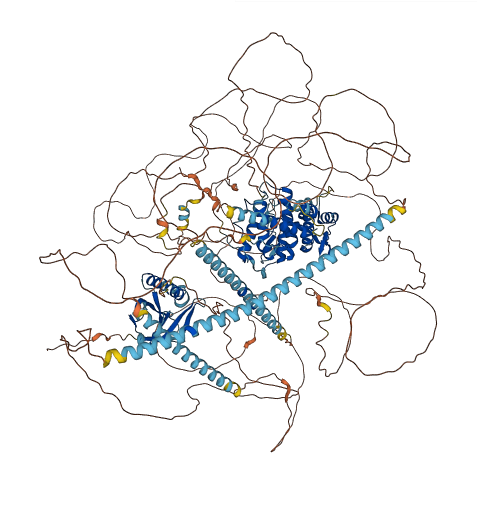
Acts on free microtubule minus-ends that aren't capped by microtubule-nucleating proteins or other factors and protects microtubule minus-ends from depolymerization (PubMed:24486153, PubMed:24706919). In addition, it also decreases the speed of microtubule polymerization (PubMed:24486153, PubMed:24706919).
| Human | |
|---|---|
| Gene Name: | CAMSAP2 |
| Uniprot: | Q08AD1 |
| Entrez: | 23271 |
| Belongs to: |
|---|
| CAMSAP1 family |

calmodulin regulated spectrin-associated protein 1-like 1; calmodulin-regulated spectrin-associated protein 2; CAMSAP2; KIAA1078Calmodulin-regulated spectrin-associated protein 1-like protein 1; MGC150680; MGC150681
Mass (kDA):
168.089 kDA

| Human | |
|---|---|
| Location: | 1q32.1 |
| Sequence: | 1; NC_000001.11 (200738905..200860707) |
Cytoplasm, cytoskeleton. Golgi apparatus. Associated with the minus-end of microtubules and also detected at the centrosomes (PubMed:23169647, PubMed:24486153, PubMed:24908486, PubMed:24706919, PubMed:27666745, PubMed:28814570). Decorates the minus-end of microtubules by decreasing the rate of tubulin incorporation and remaining bound (PubMed:24486153). The length of CAMSAP2-decorated stretches on the minus-end of microtubules depends on MAPRE1/EB1 and MAPRE3/EB3, which promote elongation of CAMSAP2-decorated microtubule stretches (PubMed:28814570). Recruited to the Golgi apparatus by AKAP9 an



PMID: 22116939 by Guo Y., et al. Two-stage genome-wide association study identifies variants in CAMSAP1L1 as susceptibility loci for epilepsy in Chinese.
PMID: 23169647 by Tanaka N., et al. Nezha/CAMSAP3 and CAMSAP2 cooperate in epithelial-specific organization of noncentrosomal microtubules.