AI-Designed Antibody Validation
Produce AI-designed antibody candidates and assess target recognition and specificity through antibody characterization, with ELISA, Western blot or IHC selected for the intended application.

WET-LAB VALIDATION SERVICES · LAB-IN-THE-LOOP
Wet-Lab Validation for AI Drug Discovery
Boster Bio is the wet-lab validation layer for AI-driven biotech and pharma — plugged directly into your discovery workflow, turning computational predictions into experimental evidence on a pipeline built for consistency.
Tell us about your candidates and the experimental question you want to answer.
Prefer email? custom@bosterbio.com
If your models generate more candidates than any lab can keep up with, you don't need another transactional CRO. You need a validation partner engineered to run inside your workflow — so experimental evidence keeps pace with computational discovery.
Drug-discovery AI, protein engineering, antibody design, genomics, biomarker and digital-pathology platforms all hit the same wall: the wet lab. Lab-in-the-Loop is built to dissolve it. Our wet-lab support for AI-driven discovery covers the teams that most often reach that wall:

Experimental validation services for the candidates your platform generates.
Produce AI-designed antibody candidates and assess target recognition and specificity through antibody characterization, with ELISA, Western blot or IHC selected for the intended application.
Express and purify designed proteins through recombinant protein services, with yield, identity and functional testing matched to the project.
Test computationally ranked hits in cell-based assays to measure activity in a biological system.
Assess candidate biomarkers using ELISA assay development, Western blotting and IHC, as appropriate for protein measurement and tissue localization.
A curated set of in-house capabilities aligned to the biological validation needs of computational discovery:
Monoclonal & polyclonal against your novel targets.
Express and purify AI-designed proteins or selected targets in suitable expression systems.
Quantitative PicoKine™ assays, custom sandwich ELISA.
Publication-grade expression & spatial validation.
Assess AI-designed antibody candidates using assays selected for their intended application.
Test computationally ranked compounds in cellular assays, with readouts matched to your study.
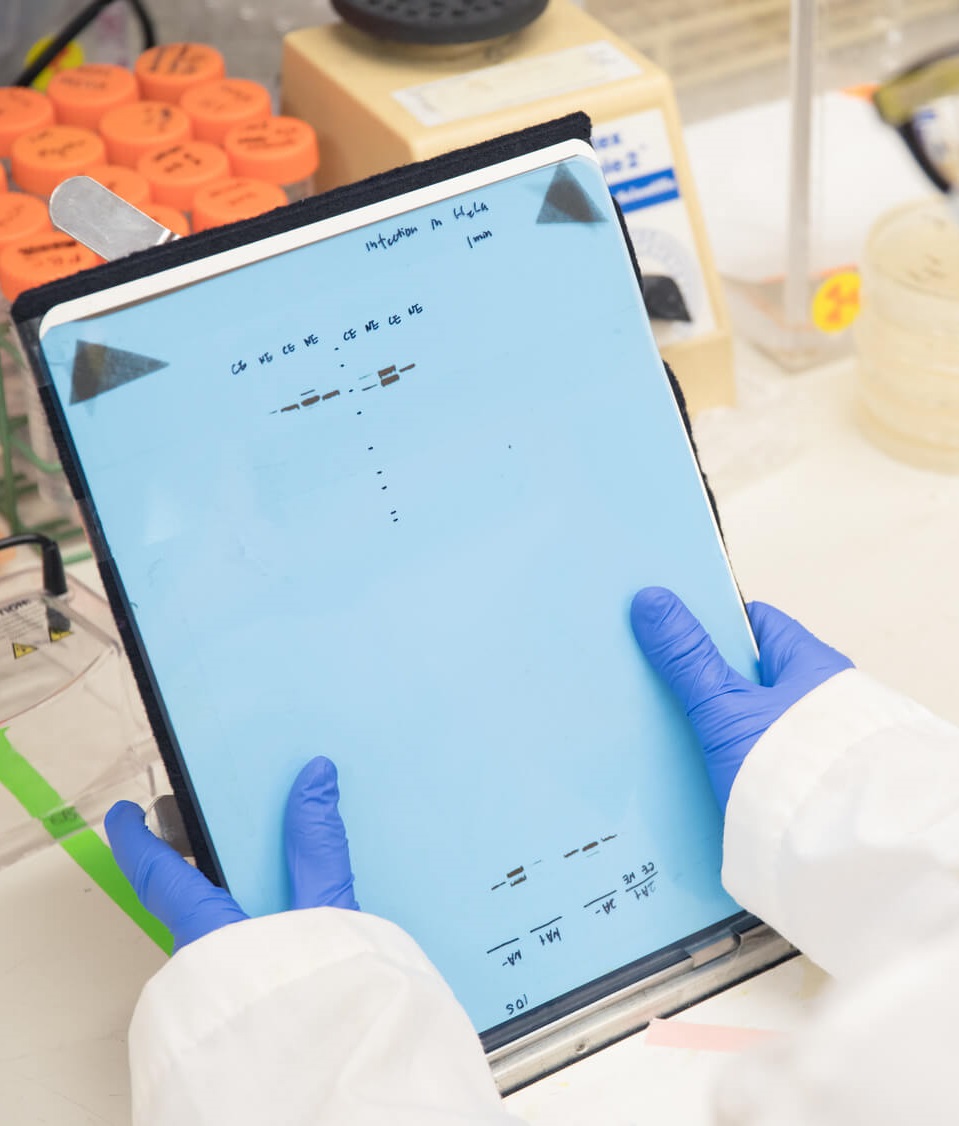
Together these cover protein expression, antibody characterization, cell-based assays and ELISA assay development. Browse the analytical services for details.
How a validation project moves from submission to results.
Send AI-generated candidates — protein targets, biomarker panels, compound hits — in your own structured format.
Scientists define the assay strategy, reagents, controls and any custom development needed.
We run it in-house — Western Blot, ELISA, IHC, cell-based assays, recombinant protein — whatever the biology demands.
Receive structured experimental results for your next iteration.
For example, an antibody-design platform could submit a ranked batch of sequences. Boster would express the candidates, assess target recognition using agreed assays and controls, and return results with assay conditions and QC flags. The client team could use the data, including non-binding candidates, to guide its next design round.
Deliverables are agreed before testing and may include:
Candidate-level results, assay context and QC information in an agreed structure.
| Candidate ID | Assay | Result | Unit | QC status |
|---|---|---|---|---|
| Candidate identifier | Agreed assay | Measured value | Assay-specific unit | Agreed QC assessment |
Candidate and sample identifiers linked to the reported readouts.
Assay conditions, controls, replicates and relevant experimental records.
Acceptance-criteria assessment and a concise findings summary.
Five deliberate choices that make Boster a native part of your discovery loop instead of a bottleneck bolted onto the end of it.
Structured candidate lists in, machine-readable results out. Following setup, submit candidates in batches and receive structured results in the agreed format for your next modeling cycle.
Your data has its own schema, so we build the adapter to match it at no charge. Send targets in your existing format; our intake adapters translate them into a validation-ready project.
Set up a single blanket purchase order once, and new validation projects within the agreed scope initiate automatically on submission — no per-order procurement cycle, no waiting on a fresh quote.
Standing agreements and structured intake collapse the back-and-forth. Fewer emails, fewer quote rounds, fewer status pings. Your team spends its time on discovery, not on coordinating a vendor.
We optimize for a smooth, repeatable validation pipeline — consistent design, in-house execution, predictable delivery — not one-off rush jobs or headline turnaround claims. Reliable experimental evidence, cycle after cycle.
Since 1993, Boster has manufactured 40,000+ antibodies and 2,000+ ELISA kits cited in 70,000+ publications — with the in-house manufacturing to build whatever your targets require.
Establish a blanket purchase order once and turn every future validation request into an instant go. Your platform submits a project; the work begins — no new quote, no new PO, no waiting on finance.
Automatic initiation applies to projects within the agreed scope and available PO balance.
The same wet-lab science — delivered in a model built for AI iteration cycles.
| Feature | Traditional CRO | Boster Lab-in-the-Loop |
|---|---|---|
| Project intake | Manual forms, email PDFs | Programmatic, schema-native adapter |
| Intake adapter | Not typically included | Custom-built, included free |
| Project initiation | Per-project quote & PO | Automatic on blanket PO |
| Results format | Primarily report-based | Machine-readable + metadata |
| Communication | Email threads per run | Structured, near-zero overhead |
| Optimized for | One-off studies | Repeatable validation at scale |
Reagent manufacturing and analytical services, now purpose-built for the AI era.
AI discovery uses machine-learning models to read large biological datasets and propose what to test next: which antibody variant, which protein design, which screening hit, which biomarker. Lab-in-the-Loop is the operating model that closes the cycle.
Models prioritize hypotheses, wet-lab experiments test them, and client teams use the structured results to inform candidate ranking or model refinement. A one-off validation study answers one question. A loop answers the next one too, which is why we describe our approach as iterative experimental validation rather than a series of disconnected projects.
Computational platforms rank candidates and generate hypotheses worth the cost of a bench experiment.
Wet-lab assays measure whether each prediction holds up in real expression systems, cells and tissue.
Client teams can use machine-readable results and metadata to refine training and candidate ranking.
In-silico predictions are hypotheses, not results. In complex biology, the distance between what a model predicts and what actually happens in a sample is where most candidates are lost.
A model confidence score does not establish experimental performance. It does not tell you whether a protein will express and fold, whether an antibody will recognize its native target, or whether a compound will act in a living cell. Those are empirical questions with empirical answers.
Results shift with expression system, post-translational modification, cell type, sample matrix, buffer and assay format. Models trained on heterogeneous public data often miss that context, and published datasets skew toward positive results, leaving few well-labeled negatives to learn from.
Wet-lab validation is the mechanism that converts a ranked list into decisions: advance, redesign or drop. Negative results count too — they are some of the most valuable training signal a model can receive.
Who handles each step between candidate selection and the next modeling cycle.
AI teams use single-cell, omics, imaging and perturbation datasets to identify candidate targets and biomarkers. Boster supports experimental follow-up through the agreed validation assays.
Transcript, protein and chromatin measurements show how cell states differ inside one sample and point to candidate targets and biomarkers.
Image-based readouts capture morphology and spatial context, the type of signal digital-pathology models learn from.
Knockouts, knockdowns and treatments can help test causal relationships when supported by suitable controls.
Large datasets reveal rare subpopulations and shared patterns across donors, lines and conditions.
Large cellular datasets carry technical noise, dropout, donor variability and batch effects. A model can learn a batch signature as easily as a biological one, so a strong pattern in the data is a lead to be tested, not a conclusion.
Validation should match the claim being tested. That means:
How agreed data formats, metadata and laboratory records support repeatable handoffs.
Consistent protocols and controls help support comparisons across cycles.
Data fields and transfer requirements are agreed with your platform team during setup.
Agreed metadata may include reagent lots, assay conditions, replicates and QC flags.
Agreed schemas help your team ingest experimental results without manual transcription.
Standardized workflows and appropriate automation support repeatable batch execution.
Your team manages model versions, training decisions and documented updates; Boster supplies agreed experimental records.
On our side of the interface, this shows up as structured candidate intake, in-house execution with consistent design, and machine-readable results delivered with metadata.
Common questions AI/ML teams ask before their first validation run.
It is the experimental testing of computationally predicted candidates — such as designed antibodies, proteins, screening hits or biomarkers — in a real laboratory. The goal is to find out which predictions hold up in biological systems and to return that evidence as structured data.
It is an ongoing collaboration rather than a single project. Your platform submits candidates, Boster performs the agreed experiments, and structured results return to your team for the next iteration.
No. The same wet-lab validation services support AI-designed antibodies, protein engineering, biomarker discovery, genomics and digital-pathology platforms whenever predictions need experimental confirmation.
We agree the submission format during setup, such as CSV or JSON. A custom intake adapter can map your existing format to the agreed workflow.
As structured, machine-readable results with agreed metadata, ready for your team to review and use in the next modeling cycle. Deliverables are agreed before testing begins.
You set up one blanket purchase order, and projects submitted by your platform start automatically without a new quote or PO each time. Automatic initiation applies to projects within the agreed scope and available PO balance.
Yes. Custom antibody development, recombinant protein production, and custom ELISA design are core capabilities — built in-house around your platform's specific output.
We optimize for a streamlined, predictable pipeline with consistent throughput rather than headline "overnight" claims. You get reliable timelines you can plan iteration cycles around. Timelines for your assays are confirmed when we scope the work.
Contact our team to discuss your candidates and validation goals. We’ll scope the initial project and discuss an intake adapter or blanket PO if these fit your workflow.
Tell us about your platform and your validation needs. We'll scope your validation project and discuss a blanket PO or intake adapter if these fit your workflow.