This website uses cookies to ensure you get the best experience on our website.


- Table of Contents
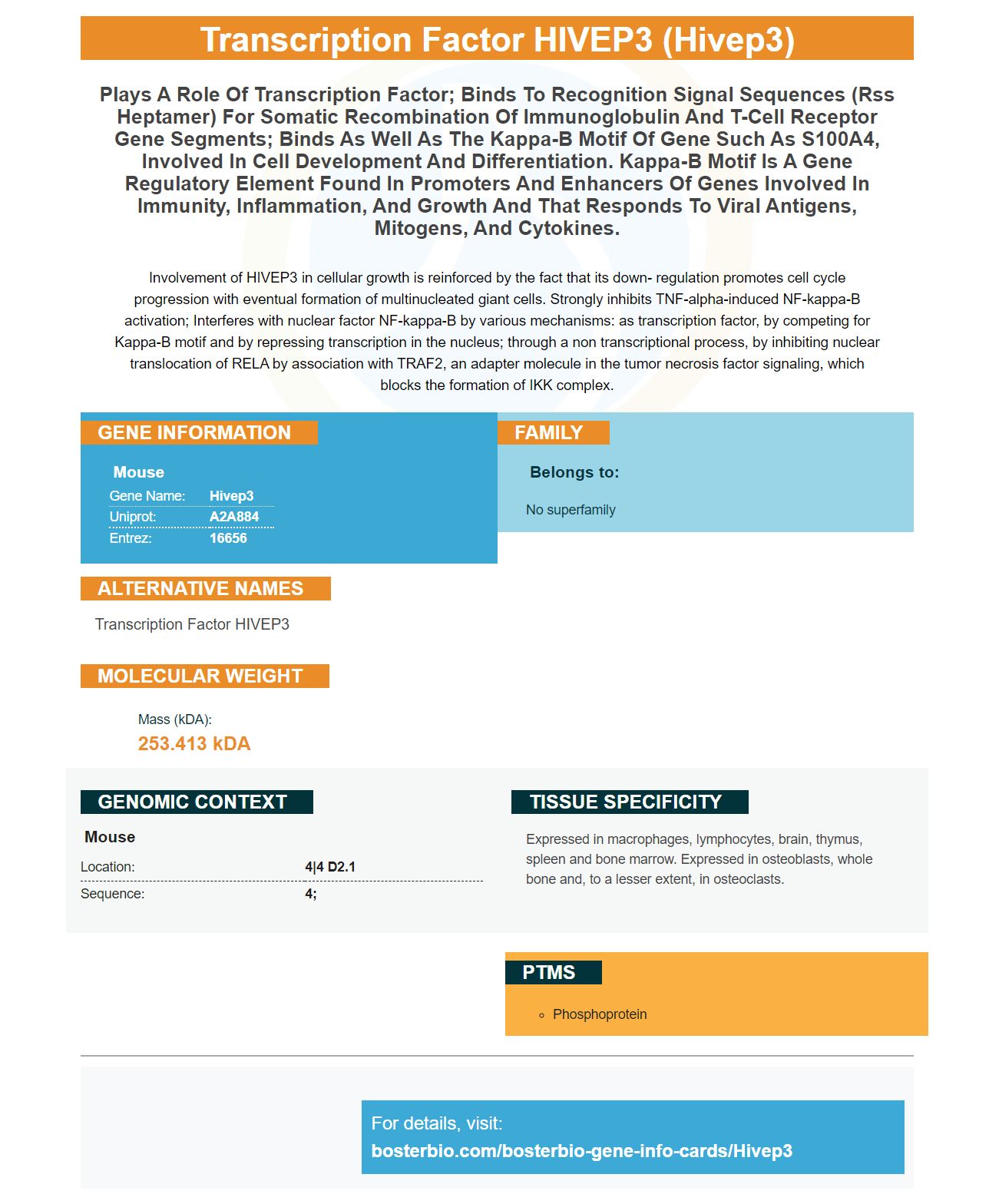
Facts about Transcription factor HIVEP3.
Involvement of HIVEP3 in cellular growth is reinforced by the fact that its down- regulation promotes cell cycle progression with eventual formation of multinucleated giant cells. Strongly inhibits TNF-alpha-induced NF-kappa-B activation; Interferes with nuclear factor NF-kappa-B by various mechanisms: as transcription factor, by competing for Kappa-B motif and by repressing transcription in the nucleus; through a non transcriptional process, by inhibiting nuclear translocation of RELA by association with TRAF2, an adapter molecule in the tumor necrosis factor signaling, which blocks the formation of IKK complex.
| Mouse | |
|---|---|
| Gene Name: | Hivep3 |
| Uniprot: | A2A884 |
| Entrez: | 16656 |
| Belongs to: |
|---|
| No superfamily |

Transcription factor HIVEP3
Mass (kDA):
253.413 kDA

| Mouse | |
|---|---|
| Location: | 4|4 D2.1 |
| Sequence: | 4; |
Expressed in macrophages, lymphocytes, brain, thymus, spleen and bone marrow. Expressed in osteoblasts, whole bone and, to a lesser extent, in osteoclasts.

PMID: 8812474 by Wu L.-C., et al. The mouse DNA binding protein Rc for the kappa B motif of transcription and for the V(D)J recombination signal sequences contains composite DNA-protein interaction domains and belongs to a new family of large transcriptional proteins.
PMID: 8255760 by Wu L.-C., et al. Molecular cloning of a zinc finger protein which binds to the heptamer of the signal sequence for V(D)J recombination.