This website uses cookies to ensure you get the best experience on our website.


- Table of Contents
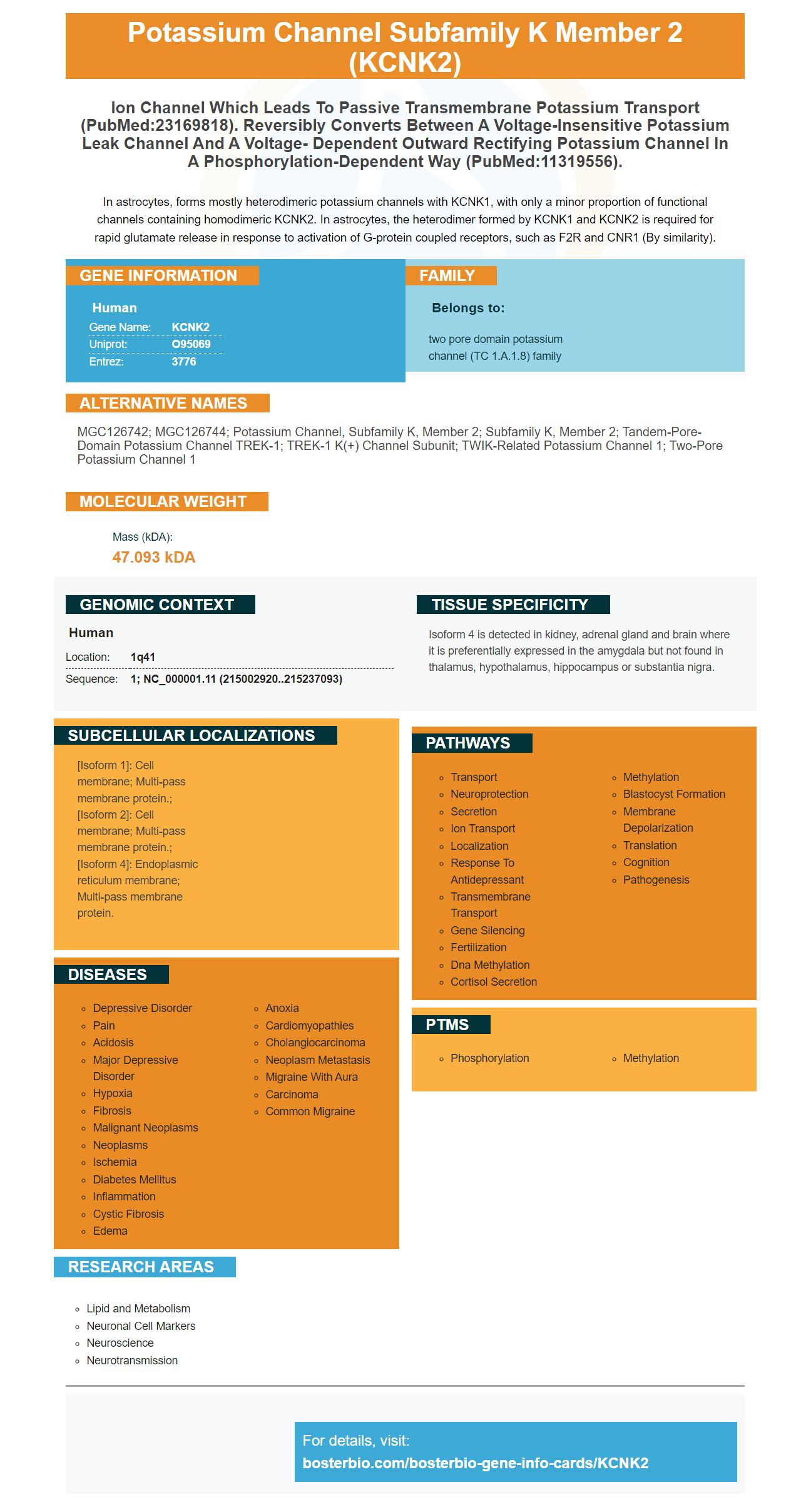
Facts about Potassium channel subfamily K member 2.
In astrocytes, forms mostly heterodimeric potassium channels with KCNK1, with only a minor proportion of functional channels containing homodimeric KCNK2. In astrocytes, the heterodimer formed by KCNK1 and KCNK2 is required for rapid glutamate release in response to activation of G-protein coupled receptors, such as F2R and CNR1 (By similarity).
| Human | |
|---|---|
| Gene Name: | KCNK2 |
| Uniprot: | O95069 |
| Entrez: | 3776 |
| Belongs to: |
|---|
| two pore domain potassium channel (TC 1.A.1.8) family |

MGC126742; MGC126744; potassium channel, subfamily K, member 2; subfamily K, member 2; tandem-pore-domain potassium channel TREK-1; TREK-1 K(+) channel subunit; TWIK-related potassium channel 1; two-pore potassium channel 1
Mass (kDA):
47.093 kDA

| Human | |
|---|---|
| Location: | 1q41 |
| Sequence: | 1; NC_000001.11 (215002920..215237093) |
Isoform 4 is detected in kidney, adrenal gland and brain where it is preferentially expressed in the amygdala but not found in thalamus, hypothalamus, hippocampus or substantia nigra.
[Isoform 1]: Cell membrane; Multi-pass membrane protein.; [Isoform 2]: Cell membrane; Multi-pass membrane protein.; [Isoform 4]: Endoplasmic reticulum membrane; Multi-pass membrane protein.



PMID: 10321245 by Patel A.J., et al. Inhalational anesthetics activate two-pore-domain background K+ channels.
PMID: 10784345 by Meadows H.J., et al. Cloning, localisation and functional expression of the human orthologue of the TREK-1 potassium channel.