This website uses cookies to ensure you get the best experience on our website.


- Table of Contents
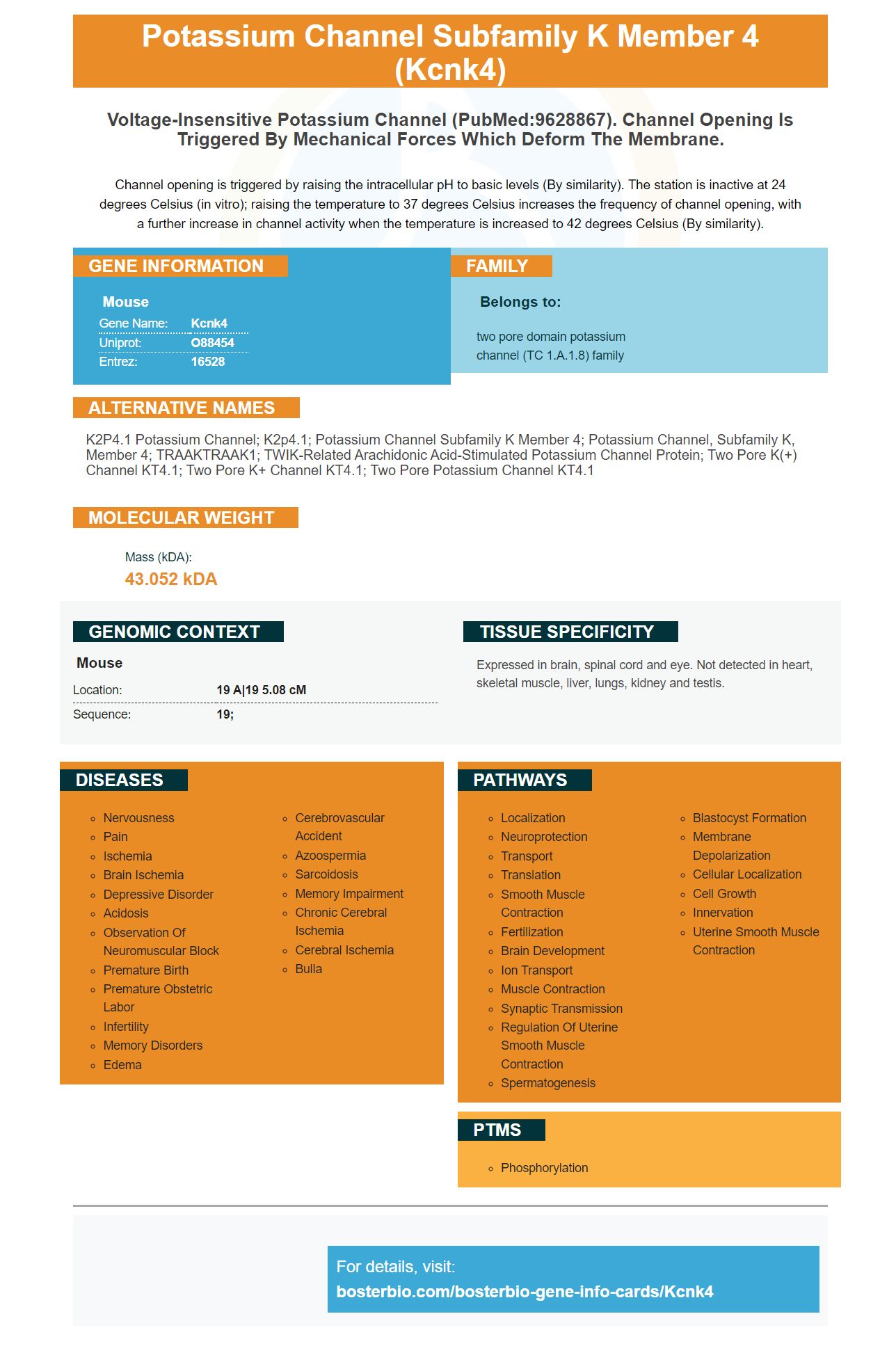
Facts about Potassium channel subfamily K member 4.
Channel opening is triggered by raising the intracellular pH to basic levels (By similarity). The station is inactive at 24 degrees Celsius (in vitro); raising the temperature to 37 degrees Celsius increases the frequency of channel opening, with a further increase in channel activity when the temperature is increased to 42 degrees Celsius (By similarity).
| Mouse | |
|---|---|
| Gene Name: | Kcnk4 |
| Uniprot: | O88454 |
| Entrez: | 16528 |
| Belongs to: |
|---|
| two pore domain potassium channel (TC 1.A.1.8) family |

K2P4.1 potassium channel; K2p4.1; potassium channel subfamily K member 4; potassium channel, subfamily K, member 4; TRAAKTRAAK1; TWIK-related arachidonic acid-stimulated potassium channel protein; Two pore K(+) channel KT4.1; two pore K+ channel KT4.1; Two pore potassium channel KT4.1
Mass (kDA):
43.052 kDA

| Mouse | |
|---|---|
| Location: | 19 A|19 5.08 cM |
| Sequence: | 19; |
Expressed in brain, spinal cord and eye. Not detected in heart, skeletal muscle, liver, lungs, kidney and testis.


PMID: 9628867 by Fink M., et al. A neuronal two P domain K+ channel stimulated by arachidonic acid and polyunsaturated fatty acids.
PMID: 10321245 by Patel A.J., et al. Inhalational anesthetics activate two-pore-domain background K+ channels.