This website uses cookies to ensure you get the best experience on our website.


- Table of Contents
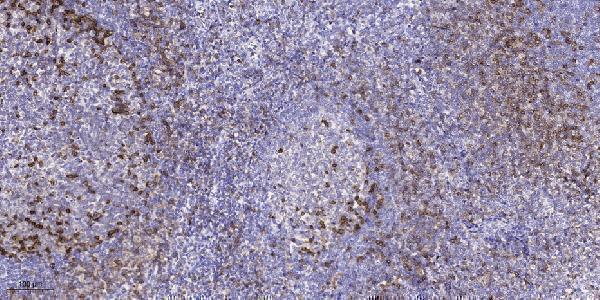
Designing an IHC experiment for LRBA? The guide has the expected staining pattern, antigen retrieval and fixation, antibodies backed by real IHC images, the tissue controls to run alongside, and protocols taken from published papers.
Open the LRBA IHC Guide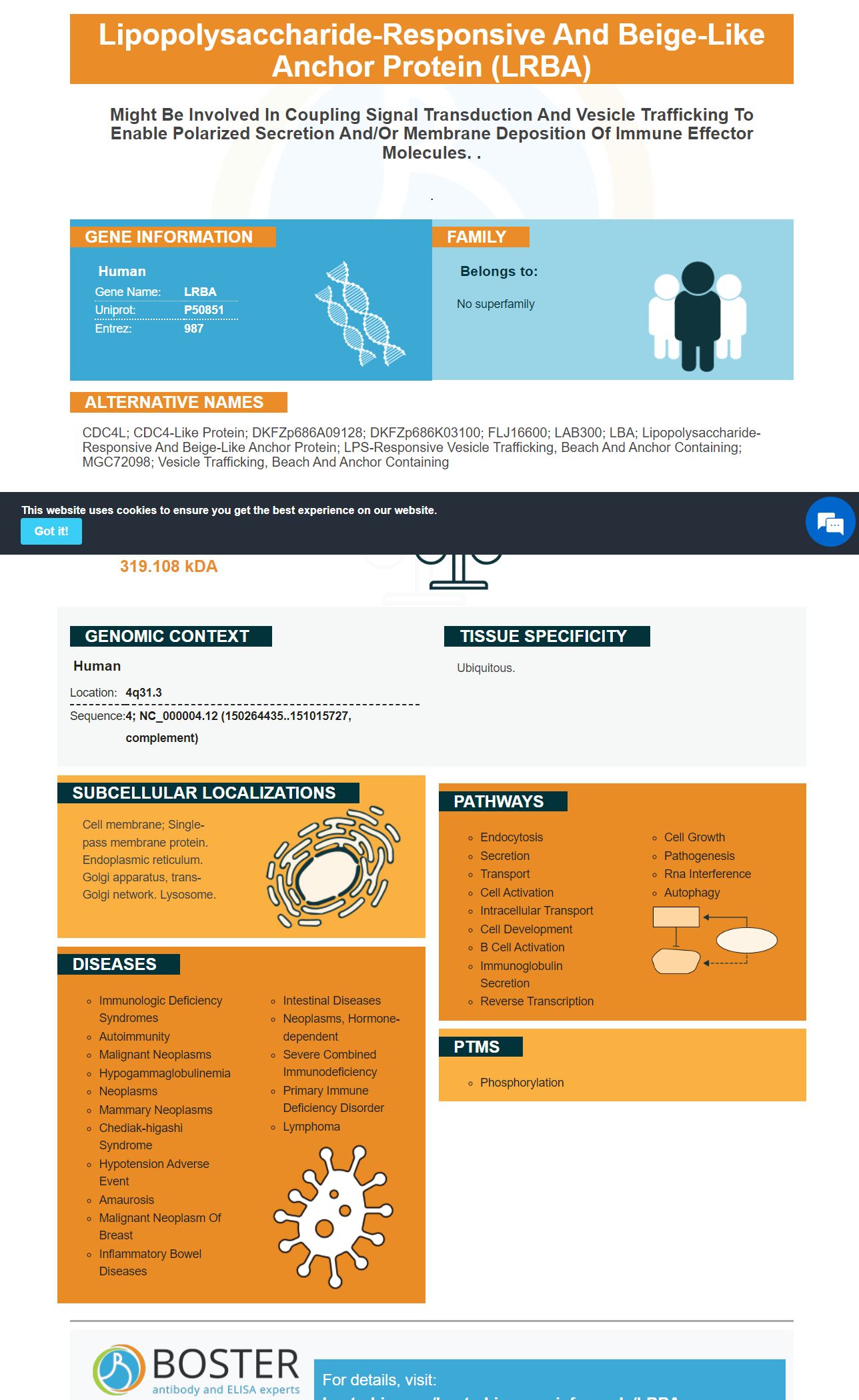
Facts about Lipopolysaccharide-responsive and beige-like anchor protein.
.
| Human | |
|---|---|
| Gene Name: | LRBA |
| Uniprot: | P50851 |
| Entrez: | 987 |

| Belongs to: |
|---|
| No superfamily |

CDC4L; CDC4-like protein; DKFZp686A09128; DKFZp686K03100; FLJ16600; LAB300; LBA; lipopolysaccharide-responsive and beige-like anchor protein; LPS-responsive vesicle trafficking, beach and anchor containing; MGC72098; vesicle trafficking, beach and anchor containing
Mass (kDA):
319.108 kDA

| Human | |
|---|---|
| Location: | 4q31.3 |
| Sequence: | 4; NC_000004.12 (150264435..151015727, complement) |
Ubiquitous.
Cell membrane; Single-pass membrane protein. Endoplasmic reticulum. Golgi apparatus, trans-Golgi network. Lysosome.




PMID: 11254716 by Wang J.-W., et al. Identification of a novel lipopolysaccharide-inducible gene with key features of both A kinase anchor proteins and chs1/beige proteins.
PMID: 12160729 by Dyomin V.G., et al. BCL8 is a novel, evolutionarily conserved human gene family encoding proteins with presumptive protein kinase A anchoring function.