This website uses cookies to ensure you get the best experience on our website.


- Table of Contents
Facts about Otogelin.
May be involved in the organization and/or stabilization of the fibrillar system that write the tectorial membrane in the cochlea. May play a role in mechanotransduction processes.
| Mouse | |
|---|---|
| Gene Name: | Otog |
| Uniprot: | O55225 |
| Entrez: | 18419 |
| Belongs to: |
|---|
| otogelin family |

Otogelin
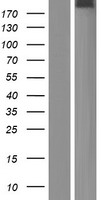
Mass (kDA):
313.62 kDA

| Mouse | |
|---|---|
| Location: | 7 B3|7 29.66 cM |
| Sequence: | 7; |
Expressed specifically in neuroepithelial supporting cells of the inner ear. Expressed in the cochlea between postnatal day P0 and P6 in pseudostratified cells of the greater epithelial ridge, in supporting cells of the neuroepithelium comprising Deiter's, Hensen's, pillar and Claudius cells, in epithelial cells of the Reissner's membrane, in a small set of cells comprising the spiral prominence. Expressed in the cochlea at P15 in interdental cells located underneath the limbal part of the tectorial membrane. Expressed in the vestibular apparatus at P0 in supporting cells of the saccular, utricular maculae and cristae ampullares, in the epithelial cells of the roof of the saccule but not in the roof of the utricle and cristae ampullares (at protein level). Expressed in the cochlea and vestibular organ of the inner ear.

PMID: 9405633 by Cohen-Salmon M., et al. Otogelin: a glycoprotein specific to the acellular membranes of the inner ear.
PMID: 10655058 by Simmler M.C., et al. Targeted disruption of otog results in deafness and severe imbalance.