This website uses cookies to ensure you get the best experience on our website.


- Table of Contents
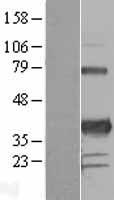
Designing a Western blot for Pituitary homeobox 3? The guide has the expected band size, antibodies backed by real blot images, the controls to run alongside, and protocols taken from published papers.
Open the PITX3 Western Blot Guide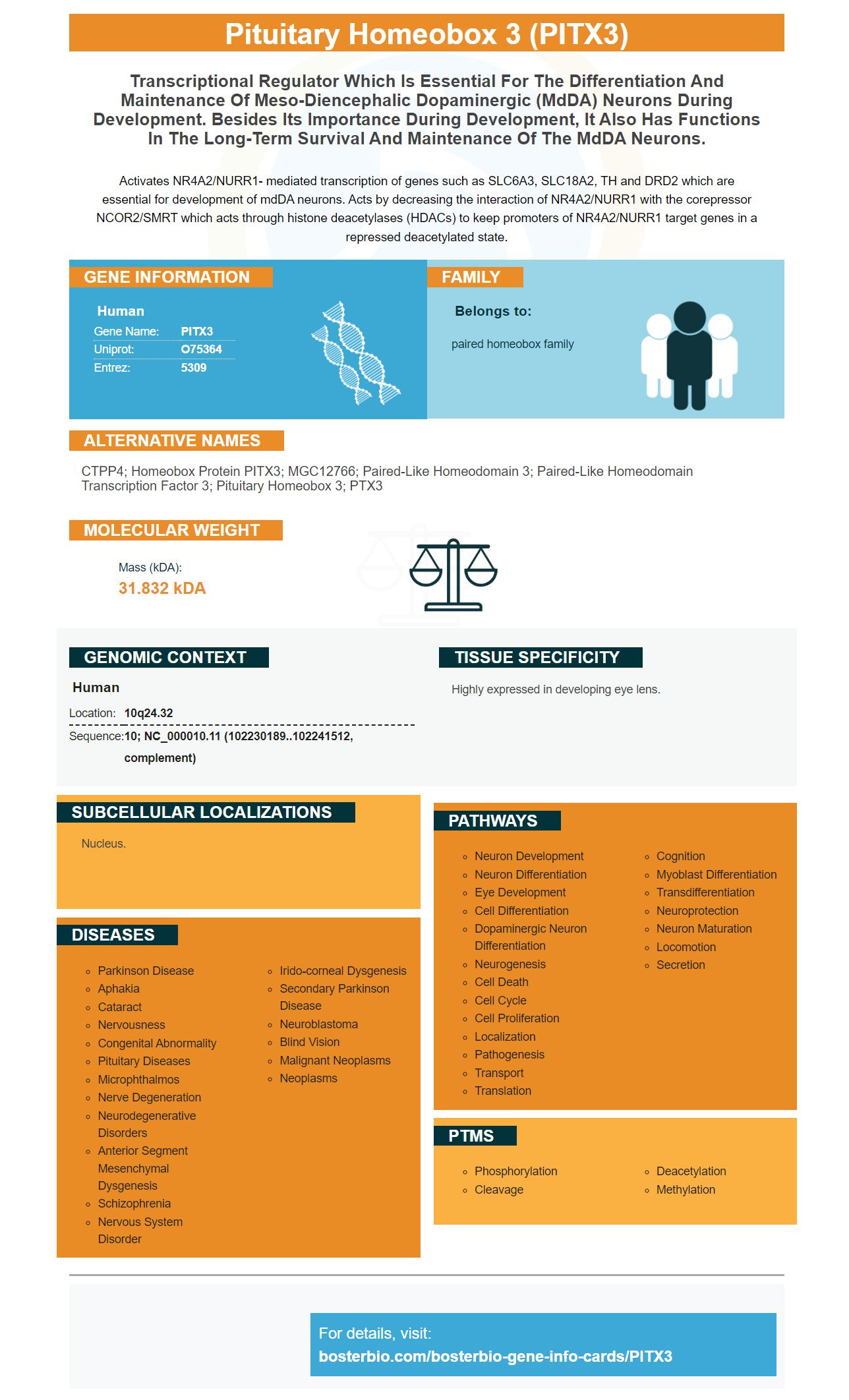

Facts about Pituitary homeobox 3.
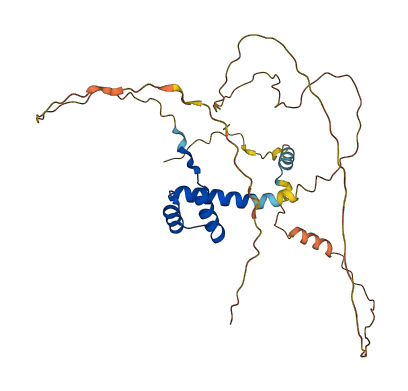
Activates NR4A2/NURR1- mediated transcription of genes such as SLC6A3, SLC18A2, TH and DRD2 which are essential for development of mdDA neurons. Acts by decreasing the interaction of NR4A2/NURR1 with the corepressor NCOR2/SMRT which acts through histone deacetylases (HDACs) to keep promoters of NR4A2/NURR1 target genes in a repressed deacetylated state.
| Human | |
|---|---|
| Gene Name: | PITX3 |
| Uniprot: | O75364 |
| Entrez: | 5309 |

| Belongs to: |
|---|
| paired homeobox family |

CTPP4; Homeobox protein PITX3; MGC12766; paired-like homeodomain 3; Paired-like homeodomain transcription factor 3; pituitary homeobox 3; PTX3
Mass (kDA):
31.832 kDA

| Human | |
|---|---|
| Location: | 10q24.32 |
| Sequence: | 10; NC_000010.11 (102230189..102241512, complement) |
Highly expressed in developing eye lens.
Nucleus.




PMID: 9620774 by Semina E.V., et al. A novel homeobox gene PITX3 is mutated in families with autosomal- dominant cataracts and ASMD.
PMID: 15286169 by Berry V., et al. Recurrent 17 bp duplication in PITX3 is primarily associated with posterior polar cataract (CPP4).
*More publications can be found for each product on its corresponding product page