This website uses cookies to ensure you get the best experience on our website.


- Table of Contents
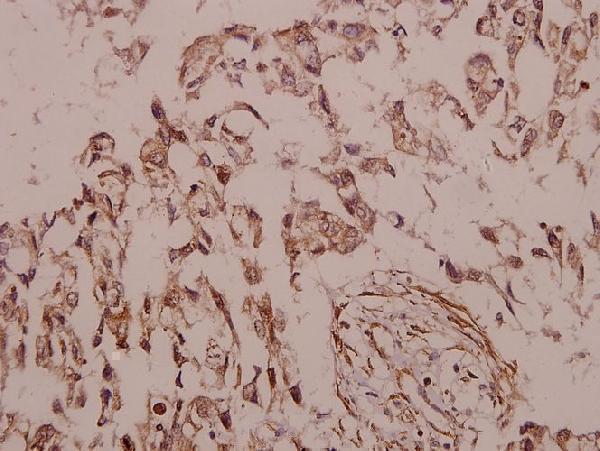
Designing an IHC experiment for SIAH2? The guide has the expected staining pattern, antigen retrieval and fixation, antibodies backed by real IHC images, the tissue controls to run alongside, and protocols taken from published papers.
Open the SIAH2 IHC Guide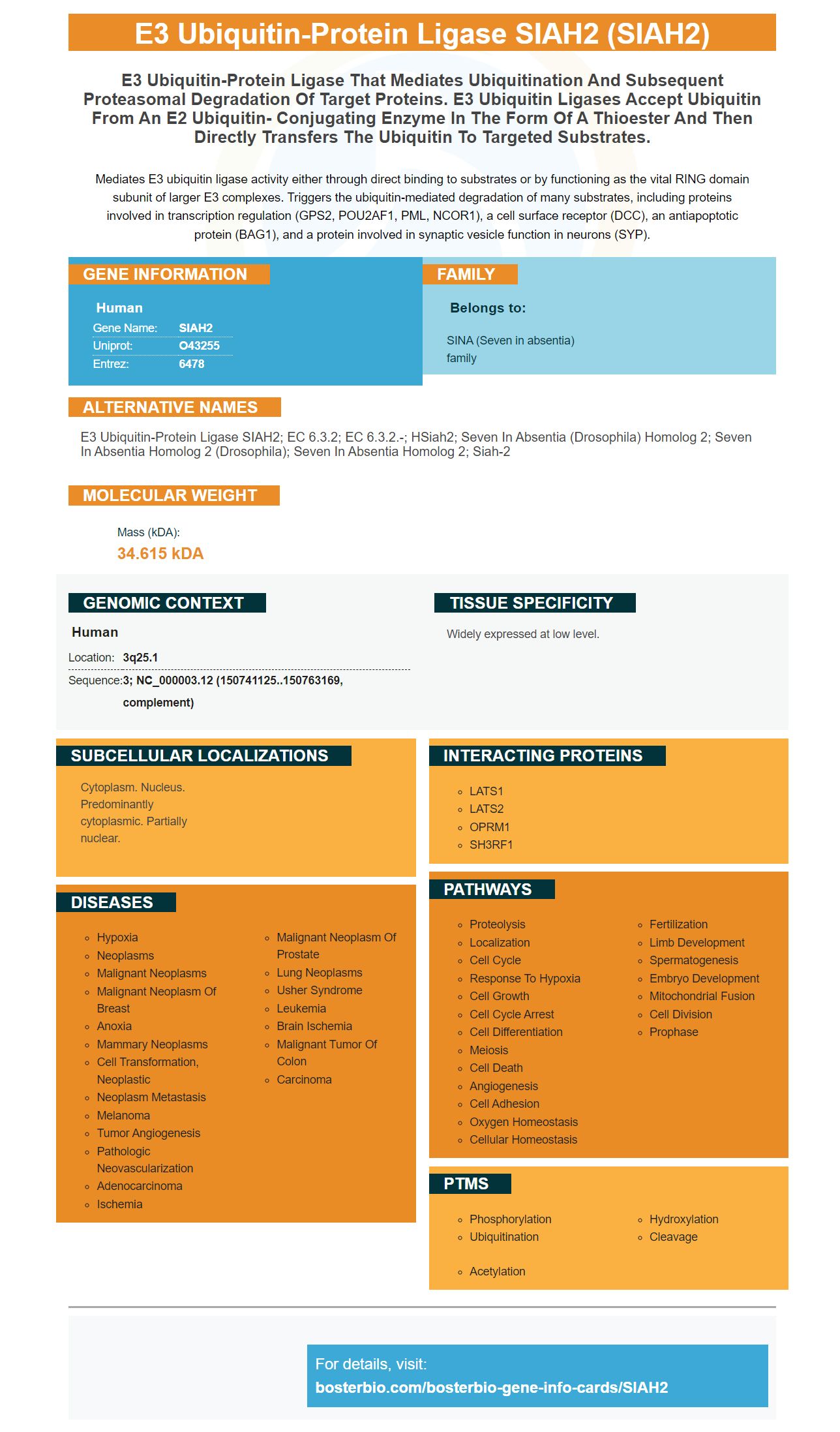
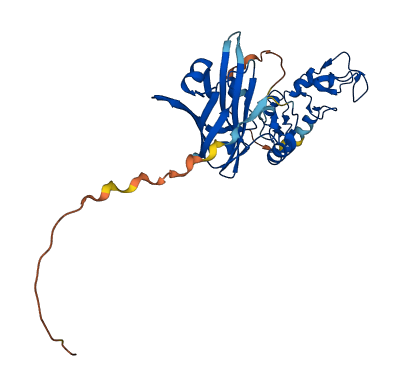
Facts about E3 ubiquitin-protein ligase SIAH2.
Mediates E3 ubiquitin ligase activity either through direct binding to substrates or by functioning as the vital RING domain subunit of larger E3 complexes. Triggers the ubiquitin-mediated degradation of many substrates, including proteins involved in transcription regulation (GPS2, POU2AF1, PML, NCOR1), a cell surface receptor (DCC), an antiapoptotic protein (BAG1), and a protein involved in synaptic vesicle function in neurons (SYP).
| Human | |
|---|---|
| Gene Name: | SIAH2 |
| Uniprot: | O43255 |
| Entrez: | 6478 |
| Belongs to: |
|---|
| SINA (Seven in absentia) family |

E3 ubiquitin-protein ligase SIAH2; EC 6.3.2; EC 6.3.2.-; hSiah2; seven in absentia (Drosophila) homolog 2; seven in absentia homolog 2 (Drosophila); Seven in absentia homolog 2; siah-2
Mass (kDA):
34.615 kDA

| Human | |
|---|---|
| Location: | 3q25.1 |
| Sequence: | 3; NC_000003.12 (150741125..150763169, complement) |
Widely expressed at low level.
Cytoplasm. Nucleus. Predominantly cytoplasmic. Partially nuclear.




PMID: 9403064 by Hu G., et al. Characterization of human homologs of the Drosophila seven in absentia (sina) gene.
PMID: 10207103 by Germani A., et al. hSiah2 is a new Vav binding protein which inhibits Vav-mediated signaling pathways.