This website uses cookies to ensure you get the best experience on our website.


- Table of Contents
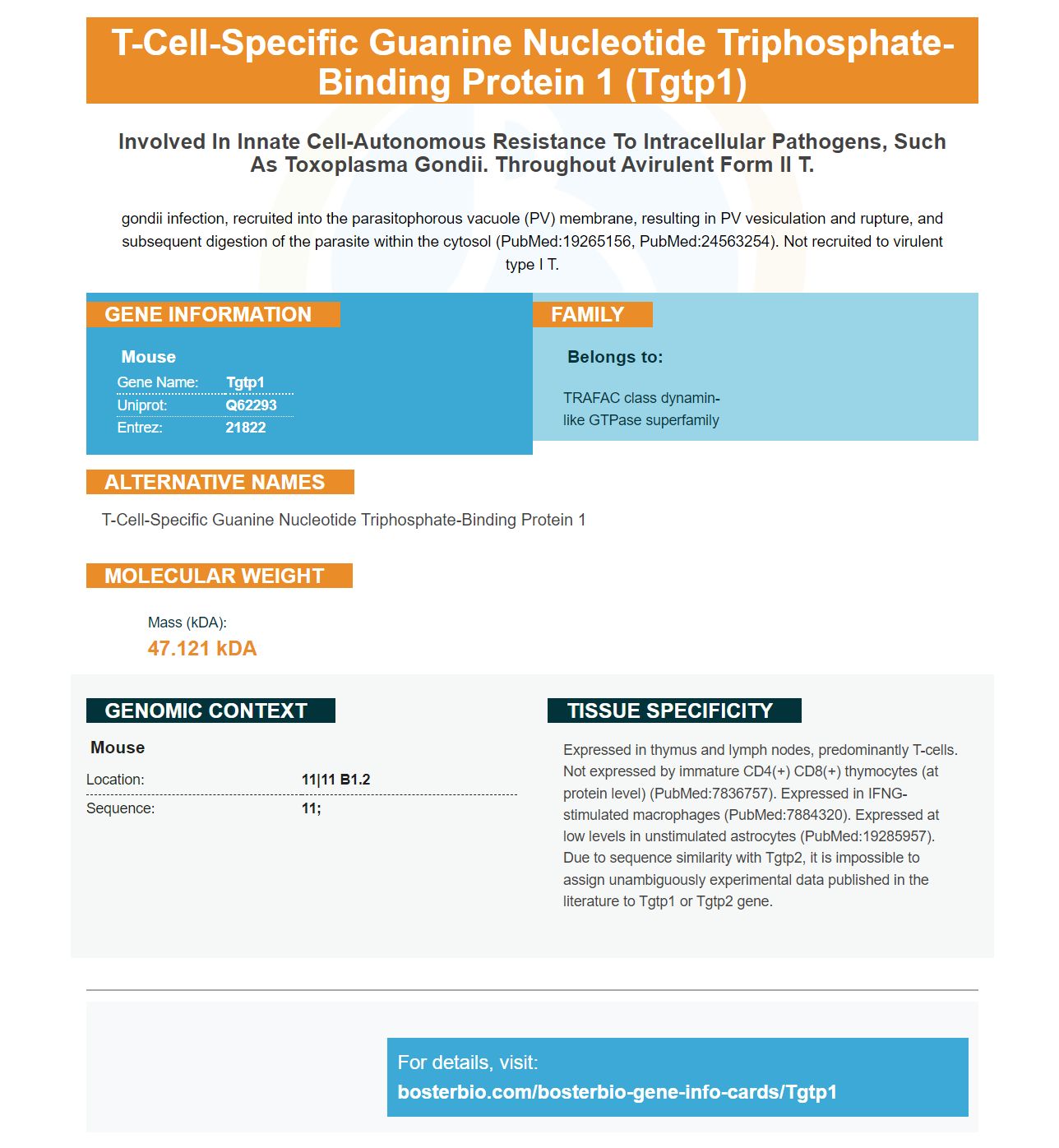
Facts about T-cell-specific guanine nucleotide triphosphate-binding protein 1.
gondii infection, recruited into the parasitophorous vacuole (PV) membrane, resulting in PV vesiculation and rupture, and subsequent digestion of the parasite within the cytosol (PubMed:19265156, PubMed:24563254). Not recruited to virulent type I T.
| Mouse | |
|---|---|
| Gene Name: | Tgtp1 |
| Uniprot: | Q62293 |
| Entrez: | 21822 |

| Belongs to: |
|---|
| TRAFAC class dynamin-like GTPase superfamily |

T-cell-specific guanine nucleotide triphosphate-binding protein 1
Mass (kDA):
47.121 kDA

| Mouse | |
|---|---|
| Location: | 11|11 B1.2 |
| Sequence: | 11; |
Expressed in thymus and lymph nodes, predominantly T-cells. Not expressed by immature CD4(+) CD8(+) thymocytes (at protein level) (PubMed:7836757). Expressed in IFNG- stimulated macrophages (PubMed:7884320). Expressed at low levels in unstimulated astrocytes (PubMed:19285957). Due to sequence similarity with Tgtp2, it is impossible to assign unambiguously experimental data published in the literature to Tgtp1 or Tgtp2 gene.

PMID: 7884320 by Lafuse W.P., et al. Cloning and characterization of a novel cDNA that is IFN-gamma- induced in mouse peritoneal macrophages and encodes a putative GTP- binding protein.
PMID: 7836757 by Carlow D.A., et al. Isolation of a gene encoding a developmentally regulated T cell- specific protein with a guanine nucleotide triphosphate-binding motif.