01

You choose
A panel and your tissue. Your targets are covered by one of our four panels.


Boster Bio Spatial Biology Services
Choose your panel and join a shared batch. Get Akoya high-plex staining and imaging results from Boster Bio, with the run cost split across labs.
Why Group Staining
You don't buy an instrument. You choose a panel and we run the experiment. The catch is that a solo project carries the whole run cost.
Group Staining combines slides from several labs into one coordinated batch, so the per-slide price follows the pooled volume.
A panel and your tissue. Your targets are covered by one of our four panels.

Staining, imaging and data delivery handled by Boster Bio.

Eligible partner products are fulfilled directly by the manufacturer while your purchase is managed through BosterBio.
A published reference point for a comparable high-plex protein assay, next to Boster Bio's prices for the same plex range.
 Academic core facility, CosMx (external rate)
+ Low published rate for a 64-plex protein assay
− Subsidized core rates may be limited to eligible users; different platform
 AKOYA, Human IO60, solo project (3 slides)
+ Run on your own schedule, no waiting for other labs
− Highest cost per slide: one project carries the whole run
 Boster Bio, Human IO60, group batch (13 → 20 slides)
+AKOYA-grade service at a much lower price per slide
−The run starts once enough compatible researchers have joined the batch

Reading the table fairly: a solo 3-slide IO60 project ($26,030 per slide) is above the published external CosMx 64-plex rate ($24,242). From 4 pooled slides the IO60 per-slide price drops below it, and at 13 slides it is 61% lower. That gap is what Group Staining is built to close.
Source: K-State CosMx price list (external rate; billed per run, one slide, adjusted by slides and ROIs). Academic core-facility rates are subsidized and may be limited to eligible users. Boster Bio prices are from the current Boster Bio price list and confirmed in a project-specific quote.


Click a bar to select.

Any panel should include at least one positive control slide.

Run a few slides first to review the results. If you run more of the same panel within 3 months, a credit applies on the second invoice so the total reflects volume pricing.
Open Group Batches DEMO DATA
Swipe through the panels, pick yours and reserve a spot. Every researcher who joins adds slides to the pool and lowers the per-slide price for the whole batch.
 346 researchers joined
 4 open batches
 819 slides reserved
Joining reserves a place in a batch and is not a purchase. A batch runs once enough compatible researchers have joined; scope and final pricing are confirmed in a project-specific quote. Per-slide figures use the Boster Bio price list at the pooled slide count.
Available Panels
Pick the panel that matches your tissue and targets. Panel availability and composition may change;
contact Boster Bio to confirm compatibility with your project.
Marker Explorer
Choose a panel or search across all four to see exactly which targets each one covers.
| TARGET / MARKER | SPECIES | CATEGORY | PANEL |
|---|
Panel composition and availability may change. Please contact Boster Bio to confirm current panel options and project compatibility.
Workflow
Boster Bio coordinates the staining workflow according to the selected panel and project requirements.

Review your samples, research goals, panel requirements and staining configuration.

Select one of the four panels and reserve a spot in an open group batch, or start a project of your own.

Samples are processed using the applicable spatial biology staining workflow, with at least one positive control slide.

Generate multiplex spatial protein profiling data for downstream analysis.
The Technology Behind the Service
Akoya Biosciences, now a Quanterix company, calls itself "The Spatial Biology Company." Its PhenoCycler-Fusion system (the PhenoCycler instrument,
formerly CODEX, integrated with Fusion imaging) is built to see 100+ proteins in the same tissue, cell by cell, without losing where they sit.

biomarkers imaged on a single tissue section

mapped in about 10 minutes

from sample to data, per Akoya

whole slides per week of imaging capacity
 Whole-slide, unbiased phenotyping at single-cell and sub-cellular resolution, not hand-picked regionsAutomated fluidics plus iterative imaging, driven by a single softwareWorks with FFPE and fresh frozen tissue, human and mouseBarcoded-antibody chemistry that supports validated multiplex panelsMultiomic direction: protein plus RNA workflows, including an announced Bio-Techne RNAscope automation partnership
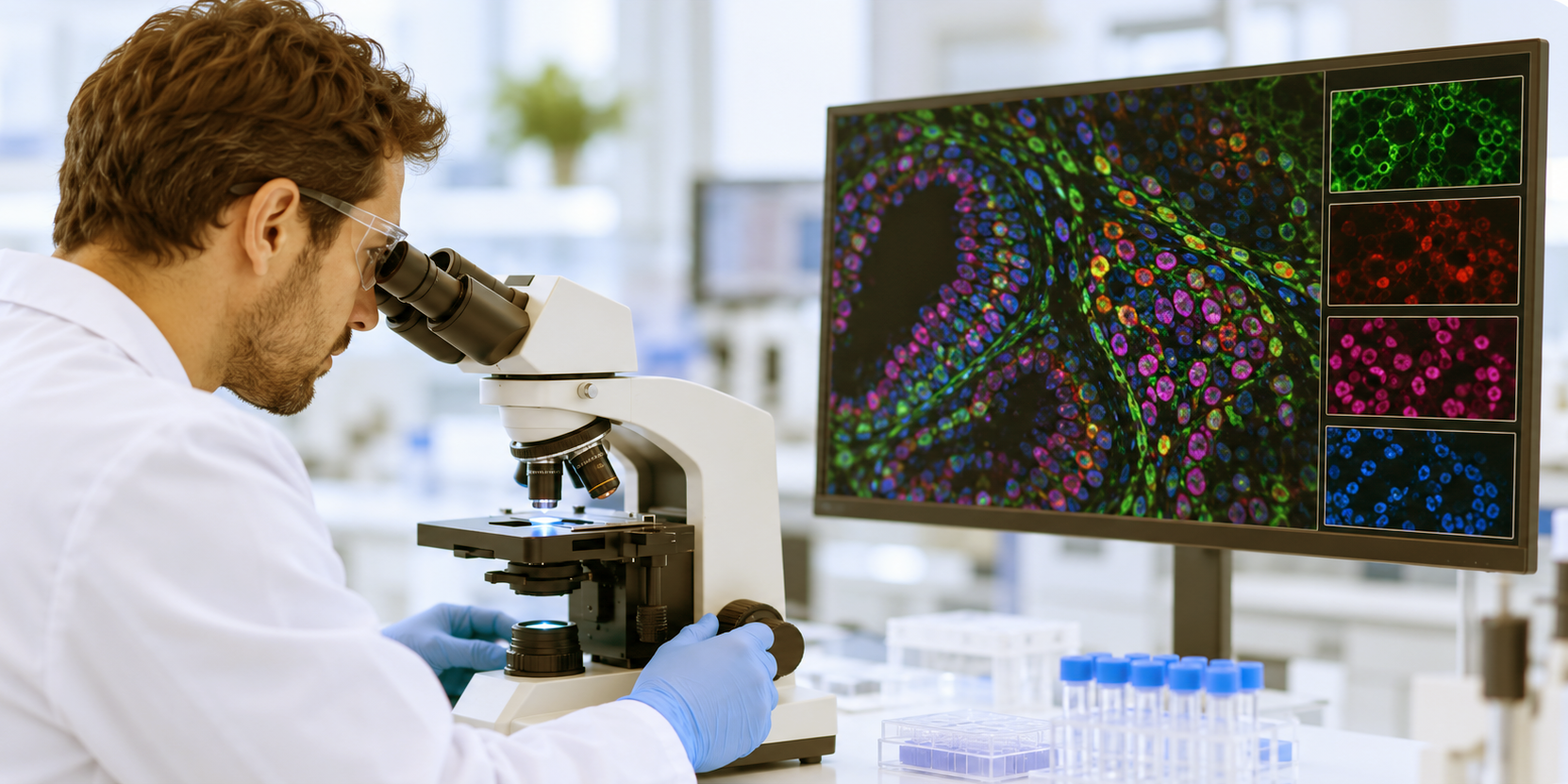
Figures from Akoya's product pages and launch announcement for PhenoCycler-Fusion; published methods tables list >100 plex and 0.25 µm resolution for PhenoCycler.
Performance depends on panel, tissue and configuration. Boster Bio is an independent service provider using applicable third-party products and workflows.
Learn more about the Group Staining Program, pricing and project requirements.
Tell us about your samples, target markers and project requirements. Our team can help determine the most suitable spatial biology approach.