

Click image to see more details
Product Info Summary
| SKU: | A07257 |
|---|---|
| Size: | 100ug |
| Reactive Species: | Human |
| Host: | Rabbit |
| Application: | ELISA, WB |
Customers Who Bought This Also Bought

Product info
Product Name
Anti-ASPP1 Ppp1r13b Antibody
SKU/Catalog Number
A07257
Size
100ug
Form
Liquid (sterile filtered)
Description
Boster Bio Anti-ASPP1 Ppp1r13b Antibody (Catalog # A07257). Tested in ELISA, WB applications. This antibody reacts with Human.
Storage & Handling
Store vial at -20°C prior to opening. Aliquot contents and freeze at -20°C or below for extended storage. Avoid cycles of freezing and thawing. Centrifuge product if not completely clear after standing at room temperature. This product is stable for several weeks at 4°C as an undiluted liquid. Dilute only prior to immediate use. Expiration date is one (1) year from date of opening. (Ship on dry ice.)
Cite This Product
Anti-ASPP1 Ppp1r13b Antibody (Boster Biological Technology, Pleasanton CA, USA, Catalog # A07257)
Host
Rabbit
Contents
0.02 M Potassium Phosphate, 0.15 M Sodium Chloride, pH 7.2, 0.01% (w/v) Sodium Azide
Clonality
Polyclonal
Isotype
IgG
Immunogen
This affinity purified antibody was prepared from whole rabbit serum produced by repeated immunizations with a synthetic peptide corresponding to an internal sequence of human ASPP1.
Cross-reactivity
No cross reactivity with other proteins.
Reactive Species
A07257 is reactive to PPP1R13B in Human
Observed Molecular Weight
42 kDa
Calculated molecular weight
119.6 kDa
Background of PPP1R13B
ASPP (ankyrin-repeat-, SH3-domain- proline-rich-region protein) proteins (ASPP1, ASPP2 and iASPP) represent a new family of p53 binding proteins. ASPP1 and ASPP2 bind and enhance p53-mediated apoptosis. In contrast, iASPP functionally inactivates p53. ASPPs may also regulate p63- and p73-mediated apoptosis. Both ASPP1 and 2 directly interact with p53 and specifically enhance the apoptotic function of p53 by stimulating its DNA binding and transactivation function on promoters of pro-apoptotic genes, such as Bax and PIG-3. Not all cell cycle arrest genes are affected, such as p21. Interestingly, expression of ASPP is frequently down-regulated in human breast carcinomas expressing wild-type p53 but not mutant p53. Therefore, ASPP might regulate the tumor suppression function of p53 in vivo.
Antibody Validation
Boster validates all antibodies on WB, IHC, ICC, Immunofluorescence, and ELISA with known positive control and negative samples to ensure specificity and high affinity, including thorough antibody incubations.
Application & Images
Applications
A07257 is guaranteed for ELISA, WB Boster Guarantee
Assay Dilutions Recommendation
The recommendations below provide a starting point for assay optimization. The actual working concentration varies and should be decided by the user.
ELISA: 1:2,500 - 1:10,000
WB: 1:500 - 1:3,000
This affinity purified antibody has been tested for use in ELISA and western blotting. Specific conditions for reactivity should be optimized by the end user. Expect a band approximately 120 kDa in size corresponding to ASPP1 by western blotting in the appropriate cell lysate or extract.
Validation Images & Assay Conditions
Click image to see more details
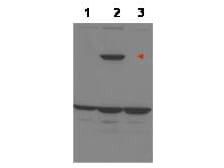
Western blot using Boster's affinity purified anti-ASPP1 to detect over-expressed ASPP1 in MCF-7 cells (lane 2, arrowhead). Lane 1 is a non-transfected control. Lane 3 is MCF-7 cells over-expressing ASPP2. Cell extracts were electrophoresed and transferred to nitrocellulose. The membrane was probed with the primary antibody at a 1:1,000 dilution. The identity of the lower MW band at approximately 50kDa is unknown. Primary experimental data indicate that the unknown band intensifies in extracts from p53 siRNA knockdown cells. Personal Communication, H. Yang, Univ. Oklahoma, Oklahoma City, OK.
Specific Publications For Anti-ASPP1 Ppp1r13b Antibody (A07257)
Loading publications
Recommended Resources
Here are featured tools and databases that you might find useful.
- Boster's Pathways Library
- Protein Databases
- Bioscience Research Protocol Resources
- Data Processing & Analysis Software
- Photo Editing Software
- Scientific Literature Resources
- Research Paper Management Tools
- Molecular Biology Software
- Primer Design Tools
- Bioinformatics Tools
- Phylogenetic Tree Analysis
Customer Reviews
Have you used Anti-ASPP1 Ppp1r13b Antibody?
Share your experimental results or join a short interview to earn up to $1,000 in product credits or other rewards.
0 Reviews For Anti-ASPP1 Ppp1r13b Antibody
Customer Q&As
Have a question?
Find answers in Q&As, reviews.
Can't find your answer?
Submit your question
3 Customer Q&As for Anti-ASPP1 Ppp1r13b Antibody
Question
Is a blocking peptide available for product anti-ASPP1 antibody (A07257)?
Verified Customer
Verified customer
Asked: 2020-05-01
Answer
We do provide the blocking peptide for product anti-ASPP1 antibody (A07257). If you would like to place an order for it please contact support@bosterbio.com and make a special request.
Boster Scientific Support
Answered: 2020-05-01
Question
We are currently using anti-ASPP1 antibody A07257 for human tissue, and we are content with the WB results. The species of reactivity given in the datasheet says human. Is it possible that the antibody can work on horse tissues as well?
Verified Customer
Verified customer
Asked: 2017-11-17
Answer
The anti-ASPP1 antibody (A07257) has not been tested for cross reactivity specifically with horse tissues, though there is a good chance of cross reactivity. We have an innovator award program that if you test this antibody and show it works in horse you can get your next antibody for free. Please contact me if I can help you with anything.
Boster Scientific Support
Answered: 2017-11-17
Question
Would A07257 anti-ASPP1 antibody work on parafin embedded sections? If so, which fixation method do you recommend we use (PFA, paraformaldehyde, other)?
N. Jha
Verified customer
Asked: 2015-09-21
Answer
As indicated on the product datasheet, A07257 anti-ASPP1 antibody as been validated on WB. It is best to use PFA for fixation because it has better tissue penetration ability. PFA needs to be prepared fresh before use. Long term stored PFA turns into formalin, as the PFA molecules congregate and become formalin.
Boster Scientific Support
Answered: 2015-09-21

