Product Info Summary
| SKU: | A08711 |
|---|---|
| Size: | 0.1 mg |
| Reactive Species: | Human |
| Host: | Rabbit |
| Application: | ELISA, ICC, WB |
Customers Who Bought This Also Bought
Product info
Product Name
Anti-DRAK2 STK17B Antibody
SKU/Catalog Number
A08711
Size
0.1 mg
Form
Liquid
Description
Boster Bio Anti-DRAK2 STK17B Antibody (Catalog # A08711). Tested in ELISA, WB, ICC applications. This antibody reacts with Human.
Storage & Handling
DRAK2 antibody can be stored at 4°C for three months and -20°C, stable for up to one year. Avoid repeated freeze-thaw cycles. Antibodies should not be exposed to prolonged high temperatures.
Cite This Product
Anti-DRAK2 STK17B Antibody (Boster Biological Technology, Pleasanton CA, USA, Catalog # A08711)
Host
Rabbit
Contents
DRAK2 Antibody is supplied in PBS containing 0.02% sodium azide.
Clonality
Polyclonal
Isotype
IgG
Immunogen
DRAK2 antibody was raised against a 15 amino acid peptide near the carboxy terminus of human DRAK2. The immunogen is located within the last 50 amino acids of DRAK2.
Cross-reactivity
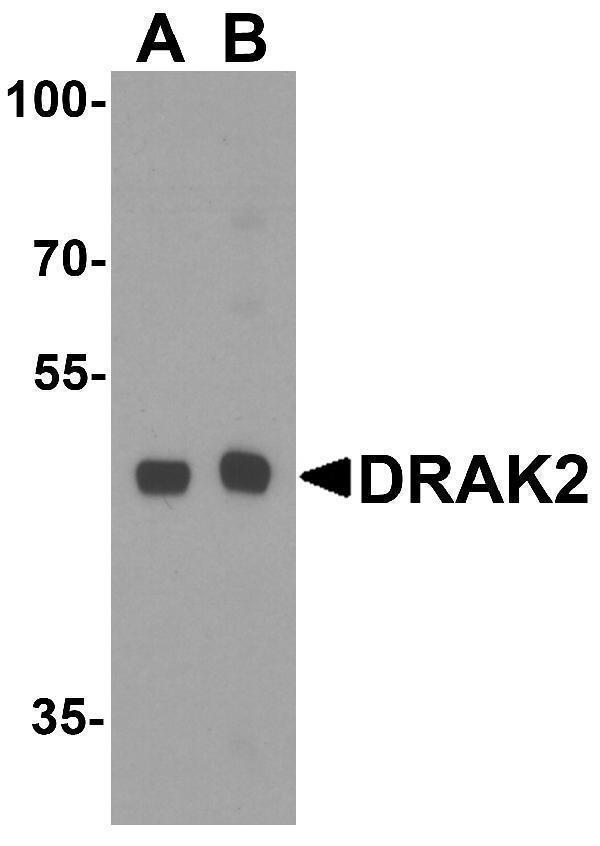
It has no cross responses to DAP or ZIP kinases. The approximately 70 kDa band is probably non-related to DRAK2 although it is peptide blockable.
Reactive Species
A08711 is reactive to STK17B in Human
Observed Molecular Weight
68 kDa
Calculated molecular weight
42.3 kDa
Background of STK17B
Apoptosis is mediated by death domain containing adapter molecules and a caspase family of proteases. Certain serine/threonine protein kinases, such as ASK-1 and RIP, are mediators of apoptosis. Two novel serine/threonine kinases that induce apoptosis were recently identified and designated DRAK1 and DRAK2 (for DAP kinase-related apoptosis-inducing protein kinases). DRAKs contain an N-terminal kinase domain and a C-terminal regulation domain. Overexpression of DRAK2 induces apoptosis. DRAKs have high sequence homology to DAP and ZIP kinases, and they represent a novel family of serine/threonine kinases, which mediates apoptosis through their catalytic activities. DRAK2 is located in nucleus and the messenger RNA was ubiquitously expressed in human tissues.
Antibody Validation
Boster validates all antibodies on WB, IHC, ICC, Immunofluorescence, and ELISA with known positive control and negative samples to ensure specificity and high affinity, including thorough antibody incubations.
Application & Images
Applications
A08711 is guaranteed for ELISA, ICC, WB Boster Guarantee
Assay Dilutions Recommendation
The recommendations below provide a starting point for assay optimization. The actual working concentration varies and should be decided by the user.
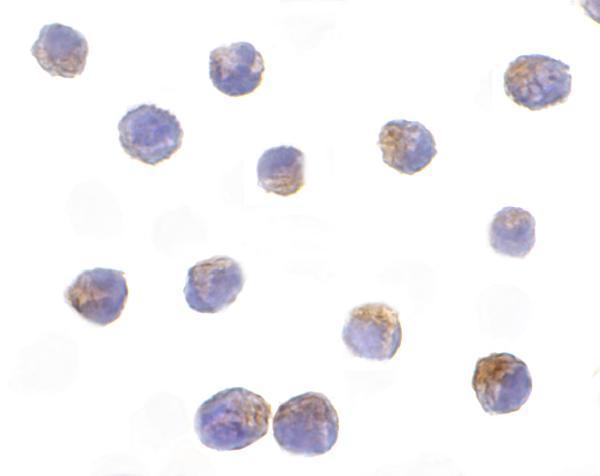
DRAK2 antibody can be used for detection of DRAK2 by Western blot 0.5 μg/mL. An approximately 45 kDa band can be detected. Antibody can also be used for immunocytochemistry starting at 10 μg/mL.
Antibody validated: Western Blot in human samples and Immunocytochemistry in human samples. All other applications and species not yet tested. Optimal dilutions for each application should be determined by the researcher.
Validation Images & Assay Conditions
Click image to see more details
Western blot analysis of DRAK2 in Raji cell lysate with DRAK2 antibody at (A) 1 and B (2) μg/mL.
Click image to see more details
Immunocytochemistry of DRAK2 in Jurkat cells with DRAK2 antibody at 10 μg/mL.
Specific Publications For Anti-DRAK2 STK17B Antibody (A08711)
Loading publications
Recommended Resources
Here are featured tools and databases that you might find useful.
- Boster's Pathways Library
- Protein Databases
- Bioscience Research Protocol Resources
- Data Processing & Analysis Software
- Photo Editing Software
- Scientific Literature Resources
- Research Paper Management Tools
- Molecular Biology Software
- Primer Design Tools
- Bioinformatics Tools
- Phylogenetic Tree Analysis
Customer Reviews
Have you used Anti-DRAK2 STK17B Antibody?
Share your experimental results or join a short interview to earn up to $1,000 in product credits or other rewards.
0 Reviews For Anti-DRAK2 STK17B Antibody
Customer Q&As
Have a question?
Find answers in Q&As, reviews.
Can't find your answer?
Submit your question