Product Info Summary
| SKU: | PB9223 |
|---|---|
| Size: | 100 μg/vial |
| Reactive Species: | Human, Mouse, Rat |
| Host: | Rabbit |
| Application: | Flow Cytometry, IF, IHC, ICC, WB |
Customers Who Bought This Also Bought
Product info
Product Name
Anti-IRS1 Antibody Picoband®
SKU/Catalog Number
PB9223
Size
100 μg/vial
Form
Lyophilized
Description
Boster Bio Anti-IRS1 Antibody Picoband® catalog # PB9223. Tested in Flow Cytometry, IF, IHC, ICC, WB applications. This antibody reacts with Human, Mouse, Rat. The brand Picoband indicates this is a premium antibody that guarantees superior quality, high affinity, and strong signals with minimal background in Western blot applications. Only our best-performing antibodies are designated as Picoband, ensuring unmatched performance.
Storage & Handling
Store at -20˚C for one year from date of receipt. After reconstitution, at 4˚C for one month. It can also be aliquotted and stored frozen at -20˚C for six months. Avoid repeated freeze-thaw cycles.
Cite This Product
Anti-IRS1 Antibody Picoband® (Boster Biological Technology, Pleasanton CA, USA, Catalog # PB9223)
Host
Rabbit
Contents
Each vial contains antibody formulated with stabilizing components, 0.9 mg NaCl, 0.2 mg Na2HPO4, and 0.05 mg NaN3.
*This antibody is supplied in a stabilized formulation.
Compatibility with conjugation reactions depends on the chemistry of the conjugation method used.
For conjugation methods that are not compatible with the stabilizing components present in this formulation, a carrier-free antibody format is required.
Clonality
Polyclonal
Isotype
Rabbit IgG
Immunogen
E.coli-derived human IRS1 recombinant protein (Position: S1041-Q1242). Human IRS1 shares 78% and 80% amino acid (aa) sequences identity with mouse and rat IRS1, respectively.
Cross-reactivity
No cross-reactivity with other proteins
Reactive Species
PB9223 is reactive to IRS1 in Human, Mouse, Rat
Observed Molecular Weight
132 kDa
Calculated molecular weight
131.6 kDa
Background of IRS1
Insulin receptor substrate 1 (IRS-1) is a signalling adapter protein that in humans is encoded by the IRS-1 gene. It is mapped to 2q36.3. This gene exhibited no intrinsic enzyme activity, and it can serve as a docking protein involved in binding and activating other signal transduction molecules after being phosphorylated on tyrosine by insulin receptor kinase. IRS1 plays a key role in transmitting signals from the insulin and insulin-like growth factor-1 (IGF-1) receptors to intracellular pathways PI3K/Akt and Erk MAP kinase pathways. IRS1 also has important biological function for both metabolic and mitogenic (growth promoting) pathways. In addition to those, IRS1 is a key regulator of PI3K within malignant cells.
Antibody Validation
Boster validates all antibodies on WB, IHC, ICC, Immunofluorescence, and ELISA with known positive control and negative samples to ensure specificity and high affinity, including thorough antibody incubations.
Application & Images
Applications
PB9223 is guaranteed for Flow Cytometry, IF, IHC, ICC, WB Boster Guarantee
Assay Dilutions Recommendation
The recommendations below provide a starting point for assay optimization. The actual working concentration varies and should be decided by the user.
Western blot, 0.1-0.5μg/ml, Human, Mouse, Rat
Immunohistochemistry (Paraffin-embedded Section), 0.5-1μg/ml, Human, Rat
Immunocytochemistry/Immunofluorescence, 2μg/ml, Human
Flow Cytometry (Fixed), 1-3μg/1x106 cells, Human
Positive Control
WB: A549 Whole Cell, MM453 Whole Cell, JURKAT Whole Cell
IHC: Mouse Intestine Tissue, Rat Intestine Tissue, Rat Skeletal Muscle Tissue, Human Intestinal Cancer Tissue, Human Lung Cancer Tissue
Validation Images & Assay Conditions
Click image to see more details
Anti-IRS1 antibody, PB9223, Western blotting
All lanes: Anti IRS1 (PB9223) at 0.5ug/ml
WB: Recombinant Human IRS1 Protein 0.5ng
Predicted bind size: 39KD
Observed bind size: 39KD
Click image to see more details
Anti-IRS1 antibody, PB9223, Western blotting
All lanes: Anti IRS1 (PB9223) at 0.5ug/ml
Lane 1: A549 Whole Cell Lysate at 40ug
Lane 2: MM453 Whole Cell Lysate at 40ug
Lane 3: JURKAT Whole Cell Lysate at 40ug
Predicted bind size: 132KD
Observed bind size: 132KD
Click image to see more details
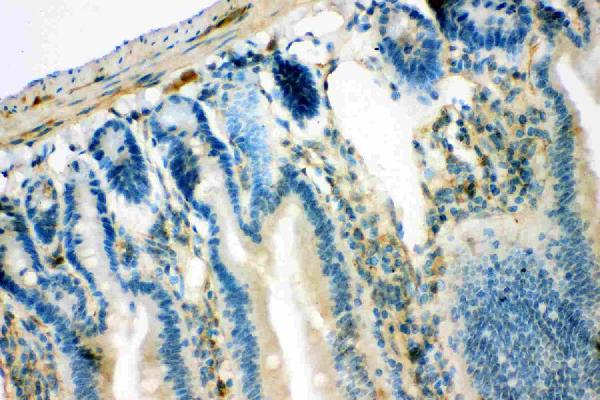
Anti-IRS1 antibody, PB9223, IHC(P)
IHC(P): Mouse Intestine Tissue
Click image to see more details
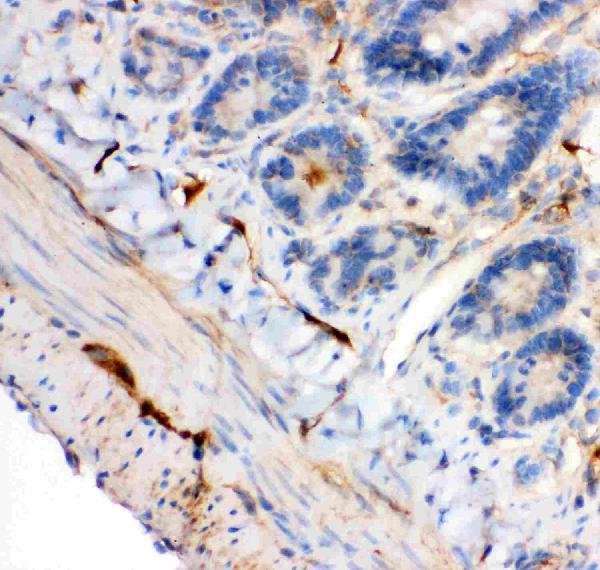
Anti-IRS1 antibody, PB9223, IHC(P)
IHC(P): Rat Intestine Tissue
Click image to see more details
Anti-IRS1 antibody, PB9223, IHC(P)
IHC(P): Rat Skeletal Muscle Tissue
Click image to see more details
Anti-IRS1 antibody, PB9223, IHC(P)
IHC(P): Human Intestinal Cancer Tissue
Click image to see more details
Anti-IRS1 antibody, PB9223, IHC(P)
IHC(P): Human Lung Cancer Tissue
Click image to see more details
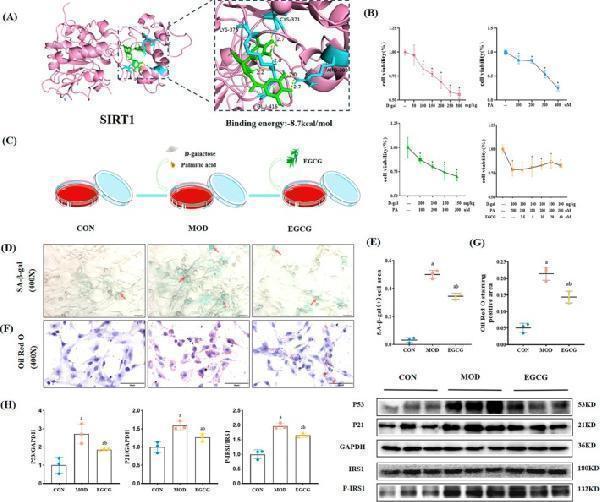
EGCG relieved senescence, IR, and lipid accumulation in the MPC5 model cells. (A) Molecular docking predicts the interaction of EGCG with SIRT1. (B) Determination of the optimal concentration of D‐galactose, PA, D‐galactose combined with PA and EGCG. n = 6. (C) The treatment of cell modeling in each group. (D, E) Representative SA‐β‐gal staining images of MPC5 cells and the ratio of SA‐β‐gal‐positive cells. 400×, n = 3. (F, G) Representative Oil Red O images of MPC5 cells and quantitative analysis of positive area. 400×, n = 3. (H) Representative WB images and quantification of the level of P21, P53, and P‐IRS1. n = 3. Compared with the CON group, a p < 0.05; compared with the MOD group, b p < 0.05. * symbol that the cell viability (%) of different group compared with the group of without any reagents, * p < 0.05.
Index in PubMed under a CC BY license. PMID: 40801050
Click image to see more details
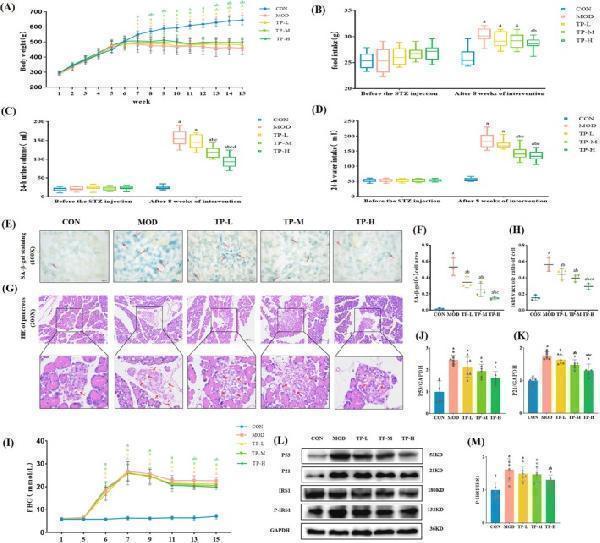
Effects of TP on the typical symptoms, IR, and senescence in the aged T2DM model rats. (A) Body weight ( n = 10). (B) Food intake ( n = 10). (C) 24 h urine volume ( n = 10). (D) 24 h water intake ( n = 10). (E, F) Representative SA‐β‐gal staining images in kidney tissues of rats and the area of SA‐β‐gal staining positive cells (100×, n = 3). (G, H) Representative HE images and quantitative analysis of islet vacuoles ratio to cells (200×, n = 3). (I) FBG ( n = 10). (J–M) Representative WB images and quantification of the expression of P21, P53, and P‐IRS1 ( n = 6). Compared with the CON group, a p < 0.05; compared with the MOD group, b p < 0.05; compared with the TP‐L group, c p < 0.05; compared with the TP‐M group, d p < 0.05.
Index in PubMed under a CC BY license. PMID: 40801050
Specific Publications For Anti-IRS1 Antibody Picoband® (PB9223)
Loading publications
Recommended Resources
Here are featured tools and databases that you might find useful.
- Boster's Pathways Library
- Protein Databases
- Bioscience Research Protocol Resources
- Data Processing & Analysis Software
- Photo Editing Software
- Scientific Literature Resources
- Research Paper Management Tools
- Molecular Biology Software
- Primer Design Tools
- Bioinformatics Tools
- Phylogenetic Tree Analysis
Customer Reviews
Have you used Anti-IRS1 Antibody Picoband®?
Share your experimental results or join a short interview to earn up to $1,000 in product credits or other rewards.
0 Reviews For Anti-IRS1 Antibody Picoband®
Customer Q&As
Have a question?
Find answers in Q&As, reviews.
Can't find your answer?
Submit your question
4 Customer Q&As for Anti-IRS1 Antibody Picoband®
Question
Our lab used your anti-IRS1 antibody for WB on liver in the past. I am using rat, and We are going to use the antibody for IHC next. I would like examining liver as well as leukemic t-cell in our next experiment. Do you have any suggestion on which antibody would work the best for IHC?
Verified Customer
Verified customer
Asked: 2020-02-26
Answer
I looked at the website and datasheets of our anti-IRS1 antibody and it seems that PB9223 has been validated on rat in both WB and IHC. Thus PB9223 should work for your application. Our Boster satisfaction guarantee will cover this product for IHC in rat even if the specific tissue type has not been validated. We do have a comprehensive range of products for IHC detection and you can check out our website bosterbio.com to find out more information about them.
Boster Scientific Support
Answered: 2020-02-26
Question
I would like using your anti-IRS1 antibody for positive regulation of glucose metabolic process studies. Has this antibody been tested with western blotting on jurkat whole cell lysate? We would like to see some validation images before ordering.
Verified Customer
Verified customer
Asked: 2020-02-25
Answer
We appreciate your inquiry. This PB9223 anti-IRS1 antibody is validated on a549 whole cell lysate, mm453 whole cell lysate, jurkat whole cell lysate, mouse intestine tissue, intestinal cancer tissue, rat intestine tissue, skeletal muscle tissue, lung cancer tissue. It is guaranteed to work for IHC, WB in human, mouse, rat. Our Boster guarantee will cover your intended experiment even if the sample type has not been be directly tested.
Boster Scientific Support
Answered: 2020-02-25
Question
We are currently using anti-IRS1 antibody PB9223 for rat tissue, and we are satisfied with the IHC results. The species of reactivity given in the datasheet says human, mouse, rat. Is it true that the antibody can work on pig tissues as well?
D. Parker
Verified customer
Asked: 2017-12-12
Answer
The anti-IRS1 antibody (PB9223) has not been tested for cross reactivity specifically with pig tissues, though there is a good chance of cross reactivity. We have an innovator award program that if you test this antibody and show it works in pig you can get your next antibody for free. Please contact me if I can help you with anything.
Boster Scientific Support
Answered: 2017-12-12
Question
We have observed staining in human eye. What should we do? Is anti-IRS1 antibody supposed to stain eye positively?
R. Edwards
Verified customer
Asked: 2013-09-18
Answer
According to literature eye does express IRS1. According to Uniprot.org, IRS1 is expressed in endometrium, skeletal muscle, eye, cervix carcinoma, leukemic t-cell, liver, among other tissues. Regarding which tissues have IRS1 expression, here are a few articles citing expression in various tissues:
Cervix carcinoma, Pubmed ID: 17081983, 18220336
Eye, Pubmed ID: 15489334
Leukemic T-cell, Pubmed ID: 19690332
Liver, Pubmed ID: 24275569
Skeletal muscle, Pubmed ID: 8513971
Boster Scientific Support
Answered: 2013-09-18