



Click image to see more details
-

-
-
-
-
+2
Product Info Summary
| SKU: | MA1071 |
|---|---|
| Size: | 100 μg/vial |
| Reactive Species: | Human, Mouse, Rat |
| Host: | Mouse |
| Application: | IHC, WB |
Customers Who Bought This Also Bought

Product info
Product Name
Anti-NEFH Antibody (Monoclonal, N52)
SKU/Catalog Number
MA1071
BM0100 is an alternative SKU for this antibody, used in previous lots.
Size
100 μg/vial
Form
Lyophilized
Description
Boster Bio Anti-NEFH Antibody (Monoclonal, N52) catalog # MA1071. Tested in IHC, WB applications. This antibody reacts with Human, Mouse, Rat.
Storage & Handling
Store at -20˚C for one year from date of receipt. After reconstitution, at 4˚C for one month. It can also be aliquotted and stored frozen at -20˚C for six months. Avoid repeated freeze-thaw cycles.
Cite This Product
Anti-NEFH Antibody (Monoclonal, N52) (Boster Biological Technology, Pleasanton CA, USA, Catalog # MA1071)
Host
Mouse
Contents
Mouse IgG in stabilizing components, 1.2% sodium acetate and 0.01mg NaN3.
Clonality
Monoclonal
Clone Number
N52
Isotype
Mouse IgG1
Immunogen
C-terminal segment of enzymatically dephosphorylated pig Neurofilament 200.
Cross-reactivity
No cross-reactivity with other proteins
Reactive Species
MA1071 is reactive to Nefh in Human, Mouse, Rat
Observed Molecular Weight
200 kDa
Calculated molecular weight
115.4 kDa
Background of Nefh
Neurofilaments are composed of 3 neuron-specific proteins with apparent molecular masses of 68 kD (NFL), 125 kD (NFM), and 200 kD (NFH) on SDS-gel electrophoresis. Genomic clones for the largest human neurofilament protein (NF-H) were isolated, the intron/exon boundaries mapped and the entire protein-coding regions (exons) sequenced. mutations in neurofilaments have been linked to some forms of Charcot-Marie-Tooth disease (CMT).
Antibody Validation
Boster validates all antibodies on WB, IHC, ICC, Immunofluorescence, and ELISA with known positive control and negative samples to ensure specificity and high affinity, including thorough antibody incubations.
Application & Images
Applications
MA1071 is guaranteed for IHC, WB Boster Guarantee
Recommend Dilution
| Application | Dilution | Species |
|---|---|---|
| Immunohistochemistry (Paraffin-embedded Section) | 1-2μg/ml | Human, mouse, rat |
| Immunohistochemistry (Frozen Section) | 1-2μg/ml | Human, mouse, rat, - |
| Western blot | 0.5ml | Human, mouse, rat |
Tested application
Suggested blocking solution with 5% non-fat milk or BSA; (*)Recommended protein loading: 20-40 µg per lane
Use TE buffer pH 9.0 for antigen retrieval; (*) citrate buffer pH 6.0 is an alternative.
Validation Images & Assay Conditions
Click image to see more details
IHC analysis of NEFH using anti-NEFH antibody (MA1071).
NEFH was detected in paraffin-embedded section of rat brain tissues. Heat mediated antigen retrieval was performed in EDTA buffer (pH 8.0, epitope retrieval solution). The tissue section was blocked with 10% goat serum. The tissue section was then incubated with 1μg/ml mouse anti-NEFH Antibody (MA1071) overnight at 4°C. Peroxidase Conjugated goat anti-mouse IgG was used as secondary antibody and incubated for 30 minutes at 37°C. The tissue section was developed using Strepavidin-Biotin-Complex (SABC)(Catalog # SA1021) with DAB as the chromogen.

Click image to see more details
Western blot analysis of NEFH using anti-NEFH antibody (MA1071).
Electrophoresis was performed on a 5-20% SDS-PAGE gel at 70V (Stacking gel) / 90V (Resolving gel) for 2-3 hours. The sample well of each lane was loaded with 50ug of sample under reducing conditions.
Lane 1: rat brain tissue lysates,
Lane 2: mouse brain tissue lysates.
After Electrophoresis, proteins were transferred to a Nitrocellulose membrane at 150mA for 50-90 minutes. Blocked the membrane with 5% Non-fat Milk/ TBS for 1.5 hour at RT. The membrane was incubated with mouse anti-NEFH antigen affinity purified monoclonal antibody (Catalog # MA1071)) at 0.5 μg/mL overnight at 4°C, then washed with TBS-0.1%Tween 3 times with 5 minutes each and probed with a goat anti-mouse IgG-HRP secondary antibody at a dilution of 1:10000 for 1.5 hour at RT. The signal is developed using an Enhanced Chemiluminescent detection (ECL) kit (Catalog # EK1001) with Tanon 5200 system. A specific band was detected for NEFH at approximately 200KD. The expected band size for NEFH is at 112KD.

Click image to see more details
IHC analysis of NEFH using anti-NEFH antibody (MA1071).
NEFH was detected in paraffin-embedded section of human glioma tissues. Heat mediated antigen retrieval was performed in EDTA buffer (pH 8.0, epitope retrieval solution). The tissue section was blocked with 10% goat serum. The tissue section was then incubated with 1μg/ml mouse anti-NEFH Antibody (MA1071) overnight at 4°C. Peroxidase Conjugated goat anti-mouse IgG was used as secondary antibody and incubated for 30 minutes at 37°C. The tissue section was developed using Strepavidin-Biotin-Complex (SABC)(Catalog # SA1021) with DAB as the chromogen.
Click image to see more details
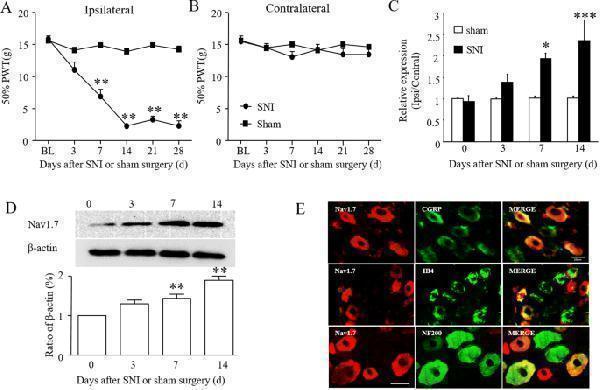
Spared nerve injury-induced mechanical hypersensitivity and Nav1.7 activation in rat injured DRGs. ( A , B ) Ipsilateral ( A ) and contralateral ( B ) paw withdrawal threshold (PWL) before or after SNI or sham surgery. ** P < 0.01 vs. the baseline (BL). n = 6 rats/group. Two-way ANOVA followed by post hoc Tukey, F 1,5 = 22.63 in ( A ), F 1,5 = 1.809 in ( B ). ( C ) Levels of SCN9A mRNA in L4-6 DRGs at days shown after SNI or sham surgery in rats. n = 3 rats per group per time point. One-way ANOVA followed by post hoc Tukey, F 3,8 = 51.67 for SNI group, F 3,8 = 2.026 for sham group. ( D ) Levels of Nav1.7 protein in L4-6 DRGs at days shown after SNI surgery in rats. One-way ANOVA followed by post hoc Tukey, F 3,8 = 0.9785 in contralateral side (Cont), F 3,8 = 109.7 in ipsilateral side (Ipsi) * P < 0.05, ** P < 0.01, *** P < 0.001 vs. the zero day. n = 3 for each time point. ( E ) Co-localization of Nav1.7 with CGRP, IB4, and NF200 in rat L5 DRG, respectively. Scale bar: 100 μm.
Index in PubMed under a CC BY license. PMID: 30425258
Click image to see more details
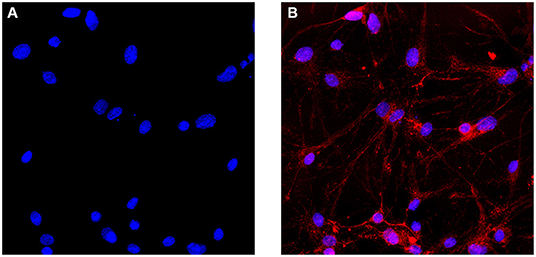
Immunofluorescence identification of SCNs. (A) Cell nuclei are identified with DAPI. (B) SCNs are stained with the anti-NF200 monoclonal antibody. More than 90% of the cultured cells show positive expression of NF200 on the day 7 of ex vivo culture. The number of NF200-positive neurons are counted per area and expressed as percentage of total number of cells (Scale bar: 40 μm).
Index in PubMed under a CC BY license. PMID: 33425964
Click image to see more details
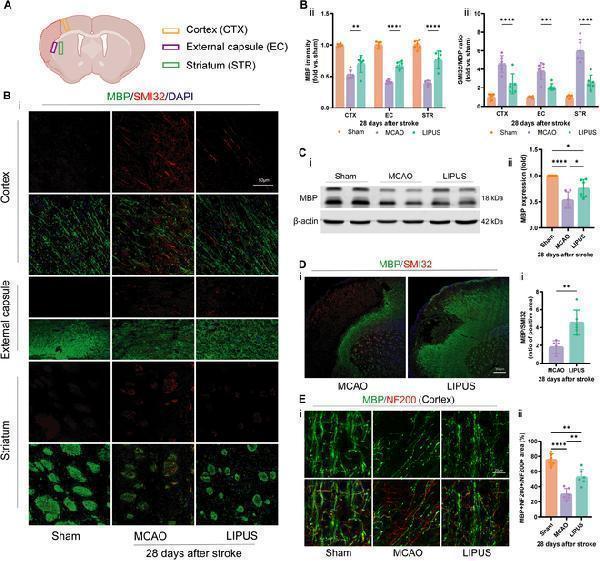
LIPUS improves cerebral WM integrity on day 28 after stroke. (A) Schematic of the localization of the peri-infarct cortex (CTX), external capsule (EC), and striatum (STR). (B) Double-labeled immunofluorescence staining of MBP (green) and SMI32 (red) in 3 brain regions, CTX, EC, and STR, on day 28 after dMCAO (i). Quantification of MBP immunoreactivity (ii) and the SMI32/MBP fluorescence intensity ratio (iii) are presented as the ratio of fold change compared to the Sham control, scale bar = 50 μm, n = 6 mice/group. (C) Representative images depicting that the Western blot analysis of MBPs was obtained for each group (i). The expression levels of the target proteins were normalized relative to β-actin (ii). (D) Representative immunostaining of MBP and SMI32 on day 28 after dMCAO (i), scale bar = 200 μm; (ii) quantification of the ratio of MBP to SMI32 staining-positive areas in ipsilateral injured brain tissue. Data were normalized to stained areas in the contralateral hemisphere, n = 6 mice/group. (E) Representative images of myelin coverage (i), calculated MBP+ myelin coverage area along NF200+ nerve fibers (ii), scale bar = 20 μm, n = 6 mice/group. Data are presented as means ± SD. Statistical analysis for (B) was conducted using 2-way ANOVA and then Tukey’s multiple comparisons test, while (C) and (E) were analyzed using one-way ANOVA and then Tukey’s multiple comparisons test. Analysis for (D) involved unpaired 2-tailed Student’s t test. * P < 0.05, ** P < 0.01, *** P < 0.001,**** P < 0.0001.
Index in PubMed under a CC BY license. PMID: 40290135
Specific Publications For Anti-NEFH Antibody (Monoclonal, N52) (MA1071)
Loading publications
Recommended Resources
Here are featured tools and databases that you might find useful.
- Boster's Pathways Library
- Protein Databases
- Bioscience Research Protocol Resources
- Data Processing & Analysis Software
- Photo Editing Software
- Scientific Literature Resources
- Research Paper Management Tools
- Molecular Biology Software
- Primer Design Tools
- Bioinformatics Tools
- Phylogenetic Tree Analysis
Customer Reviews
Have you used Anti-NEFH Antibody (Monoclonal, N52)?
Share your experimental results or join a short interview to earn up to $1,000 in product credits or other rewards.
0 Reviews For Anti-NEFH Antibody (Monoclonal, N52)
Customer Q&As
Have a question?
Find answers in Q&As, reviews.
Can't find your answer?
Submit your question
5 Customer Q&As for Anti-NEFH Antibody (Monoclonal, N52)
Question
How does your MA1071 NEFH antibody differ from SIGMA (ex-Millipore) Mouse Anti-Neurofilament 200 Kda Monoclonal antibody cat. no. MAB5262 clone: RT97? We intend to use it for immunohistochemistry on Fromalin Fixed tissues and paraffin embedded tissues.
Verified customer
Asked: 2019-11-06
Answer
The main difference would be the immunogen. Anti-NEFH antibody (Monoclonal, N52) MA1071 was raised against C-terminal segment of enzymatically dephosphorylated pig Neurofilament 200. (uniprot: P16884). While the Mouse Anti-Neurofilament 200 Kda Monoclonal antibody cat.no. MAB5262 clone: RT97 Immunogen is Rat brain protein preparation (uniprot: P12036). Our MA1071 antibody should work for mouse samples with IHC-P and IHC-F.
Boster Scientific Support
Answered: 2019-11-06
Question
Is MA1071 suitable for immunostaining of mouse long bone nerve fibers?
Verified customer
Asked: 2019-10-06
Answer
Yes, the Anti-NEFH Antibody (Monoclonal, N52) (MA1071) is suitable for the immunostaining of mouse long bone nerve fibers.
Boster Scientific Support
Answered: 2019-10-09
Question
Thank you for helping with my inquiry over the phone. Here are the WB image, lot number and protocol we used for brain using anti-NEFH antibody (Monoclonal, N52) MA1071. Let me know if you need anything else.
Verified Customer
Verified customer
Asked: 2019-10-03
Answer
We appreciate the data. You have provided everything we needed. Our lab team are working to resolve your inquiry as quickly as possible, and we appreciate your patience and understanding! Please let me know if there is anything you need in the meantime.
Boster Scientific Support
Answered: 2019-10-03
Question
We are currently using anti-NEFH antibody (Monoclonal, N52) MA1071 for human tissue, and we are satisfied with the IHC results. The species of reactivity given in the datasheet says human, mouse, rat. Is it true that the antibody can work on pig tissues as well?
P. Carter
Verified customer
Asked: 2018-01-19
Answer
The anti-NEFH antibody (Monoclonal, N52) (MA1071) has not been tested for cross reactivity specifically with pig tissues, but there is a good chance of cross reactivity. We have an innovator award program that if you test this antibody and show it works in pig you can get your next antibody for free. Please contact me if I can help you with anything.
Boster Scientific Support
Answered: 2018-01-19
Question
Does anti-NEFH antibody (Monoclonal, N52) MA1071 work on zebrafish IHC with brain?
Z. Li
Verified customer
Asked: 2017-08-31
Answer
Our lab technicians have not tested anti-NEFH antibody (Monoclonal, N52) MA1071 on zebrafish. You can run a BLAST between zebrafish and the immunogen sequence of anti-NEFH antibody (Monoclonal, N52) MA1071 to see if they may cross-react. If the sequence homology is close, then you can perform a pilot test. Keep in mind that since we have not validated zebrafish samples, this use of the antibody is not covered by our guarantee. However we have an innovator award program that if you test this antibody and show it works in zebrafish brain in IHC, you can get your next antibody for free.
Boster Scientific Support
Answered: 2017-08-31

