



Click image to see more details
Product Info Summary
| SKU: | M05177 |
|---|---|
| Size: | 100 μl |
| Reactive Species: | Human |
| Host: | Rabbit |
| Application: | IP, IHC, WB |
Customers Who Bought This Also Bought

Product info
Product Name
Anti-Placental lactogen CSH1 Monoclonal Antibody
SKU/Catalog Number
M05177
BM5761 is an alternative SKU for this antibody, used in previous lots.
Size
100 μl
Form
Liquid
Description
Boster Bio Anti-Placental lactogen CSH1 Monoclonal Antibody catalog # M05177. Tested in WB, IHC, IP applications. This antibody reacts with Human.
Storage & Handling
Store at -20°C for one year. For short term storage and frequent use, store at 4°C for up to one month. Avoid repeated freeze-thaw cycles.
Cite This Product
Anti-Placental lactogen CSH1 Monoclonal Antibody (Boster Biological Technology, Pleasanton CA, USA, Catalog # M05177)
Host
Rabbit
Contents
Rabbit IgG in stabilizing components, phosphate buffered saline, pH 7.4, 150mM NaCl, 0.02% sodium azide and 50% glycerol.
*This antibody is supplied in a stabilized formulation.
Compatibility with conjugation reactions depends on the chemistry of the conjugation method used.
For conjugation methods that are not compatible with the stabilizing components present in this formulation, a carrier-free antibody format is required.
Clonality
Monoclonal
Clone Number
AFGE-3
Isotype
Rabbit IgG
Immunogen
A synthesized peptide derived from human Placental lactogen Produced only during pregnancy and is involved in stimulating lactation, fetal growth and metabolism. Does not interact with GHR but only activates PRLR through zinc-induced dimerization.
Reactive Species
M05177 is reactive to CSH1 in Human
Observed Molecular Weight
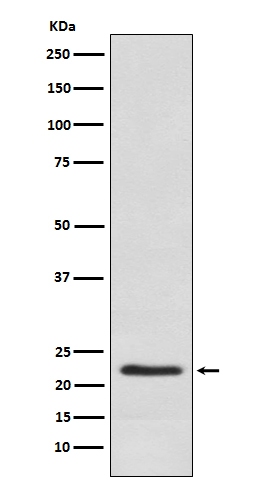
22 kDa
Antibody Validation
Boster validates all antibodies on WB, IHC, ICC, Immunofluorescence, and ELISA with known positive control and negative samples to ensure specificity and high affinity, including thorough antibody incubations.
Application & Images
Applications
M05177 is guaranteed for IP, IHC, WB Boster Guarantee
Recommend Dilution
WB 1:1000-1:5000
IHC 1:50-1:200
IP 1:50
Tested application
Suggested blocking solution with 5% non-fat milk or BSA; (*)Recommended protein loading: 20-40 µg per lane
Validation Images & Assay Conditions
Click image to see more details
Western blot analysis of Placental lactogen expression in Human placenta lysate.
Specific Publications For Anti-Placental lactogen CSH1 Monoclonal Antibody (M05177)
Loading publications
Recommended Resources
Here are featured tools and databases that you might find useful.
- Boster's Pathways Library
- Protein Databases
- Bioscience Research Protocol Resources
- Data Processing & Analysis Software
- Photo Editing Software
- Scientific Literature Resources
- Research Paper Management Tools
- Molecular Biology Software
- Primer Design Tools
- Bioinformatics Tools
- Phylogenetic Tree Analysis
Customer Reviews
Have you used Anti-Placental lactogen CSH1 Monoclonal Antibody?
Share your experimental results or join a short interview to earn up to $1,000 in product credits or other rewards.
0 Reviews For Anti-Placental lactogen CSH1 Monoclonal Antibody
Customer Q&As
Have a question?
Find answers in Q&As, reviews.
Can't find your answer?
Submit your question
1 Customer Q&As for Anti-Placental lactogen CSH1 Monoclonal Antibody
Question
We are currently using anti-Placental lactogen Monoclonal antibody M05177 for human tissue, and we are well pleased with the IP results. The species of reactivity given in the datasheet says human. Is it possible that the antibody can work on primate tissues as well?
Verified Customer
Verified customer
Asked: 2019-08-29
Answer
The anti-Placental lactogen Monoclonal antibody (M05177) has not been tested for cross reactivity specifically with primate tissues, though there is a good chance of cross reactivity. We have an innovator award program that if you test this antibody and show it works in primate you can get your next antibody for free. Please contact me if I can help you with anything.
Boster Scientific Support
Answered: 2019-08-29

