Product Info Summary
| SKU: | A00864-1 |
|---|---|
| Size: | 100 μg/vial |
| Reactive Species: | Human, Mouse, Rat |
| Host: | Rabbit |
| Application: | ELISA, WB |
Customers Who Bought This Also Bought
Product info
Product Name
Anti-STAM1 Antibody Picoband®
SKU/Catalog Number
A00864-1
Size
100 μg/vial
Form
Lyophilized
Description
Boster Bio Anti-STAM1 Antibody Picoband® catalog # A00864-1. Tested in ELISA, WB applications. This antibody reacts with Human, Mouse, Rat. The brand Picoband indicates this is a premium antibody that guarantees superior quality, high affinity, and strong signals with minimal background in Western blot applications. Only our best-performing antibodies are designated as Picoband, ensuring unmatched performance.
Storage & Handling
Store at -20˚C for one year from date of receipt. After reconstitution, at 4˚C for one month. It can also be aliquotted and stored frozen at -20˚C for six months. Avoid repeated freeze-thaw cycles.
Cite This Product
Anti-STAM1 Antibody Picoband® (Boster Biological Technology, Pleasanton CA, USA, Catalog # A00864-1)
Host
Rabbit
Contents
Each vial contains 4mg Trehalose, 0.9mg NaCl, 0.2mg Na2HPO4, 0.05mg NaN3.
Clonality
Polyclonal
Isotype
Rabbit IgG
Immunogen
E. coli-derived human STAM1 recombinant protein (Position: F9-Q254).
Cross-reactivity
No cross-reactivity with other proteins.
Reactive Species
A00864-1 is reactive to STAM in Human, Mouse, Rat
Observed Molecular Weight
59 kDa
Calculated molecular weight
59.2 kDa
Background of STAM
Signal transducing adapter molecule 1 is a protein that in humans is encoded by the STAM gene. This gene encodes a member of the signal-transducing adaptor molecule family. These proteins mediate downstream signaling of cytokine receptors and also play a role in ER to Golgi trafficking by interacting with the coat protein II complex. The encoded protein also associates with hepatocyte growth factor-regulated substrate to form the endosomal sorting complex required for transport-0 (ESCRT-0), which sorts ubiquitinated membrane proteins to the ESCRT-1 complex for lysosomal degradation. Alternatively spliced transcript variants have been observed for this gene.
Antibody Validation
Boster validates all antibodies on WB, IHC, ICC, Immunofluorescence, and ELISA with known positive control and negative samples to ensure specificity and high affinity, including thorough antibody incubations.
Application & Images
Applications
A00864-1 is guaranteed for ELISA, WB Boster Guarantee
Assay Dilutions Recommendation
The recommendations below provide a starting point for assay optimization. The actual working concentration varies and should be decided by the user.
Western blot, 0.1-0.5μg/ml
ELISA, 0.1-0.5μg/ml
Positive Control
WB: human HepG2 whole cell, human PANC-1 whole cell
Validation Images & Assay Conditions
Click image to see more details
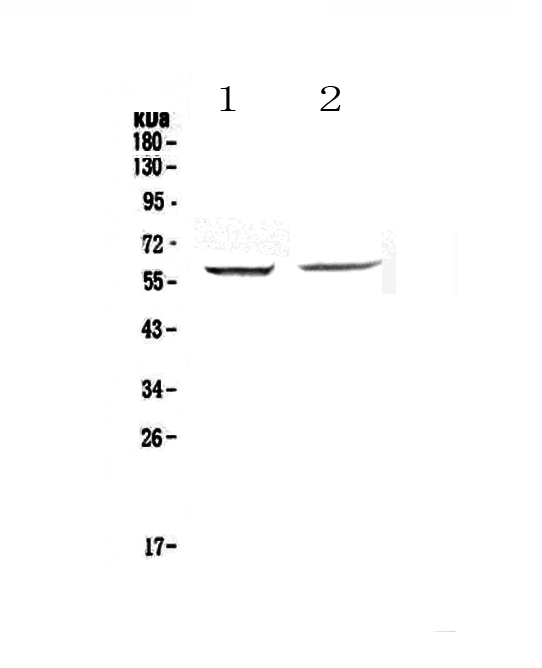
Western blot analysis of STAM1 using anti-STAM1 antibody (A00864-1).
Electrophoresis was performed on a 5-20% SDS-PAGE gel at 70V (Stacking gel) / 90V (Resolving gel) for 2-3 hours. The sample well of each lane was loaded with 50ug of sample under reducing conditions.
Lane 1: human HepG2 whole cell lysates,
Lane 2: human PANC-1 whole cell lysates.
After Electrophoresis, proteins were transferred to a Nitrocellulose membrane at 150mA for 50-90 minutes. Blocked the membrane with 5% Non-fat Milk/ TBS for 1.5 hour at RT. The membrane was incubated with rabbit anti-STAM1 antigen affinity purified polyclonal antibody (Catalog # A00864-1) at 0.5 μg/mL overnight at 4°C, then washed with TBS-0.1%Tween 3 times with 5 minutes each and probed with a goat anti-rabbit IgG-HRP secondary antibody at a dilution of 1:10000 for 1.5 hour at RT. The signal is developed using an Enhanced Chemiluminescent detection (ECL) kit (Catalog # EK1002) with Tanon 5200 system. A specific band was detected for STAM1 at approximately 59KD. The expected band size for STAM1 is at 59KD.
Click image to see more details
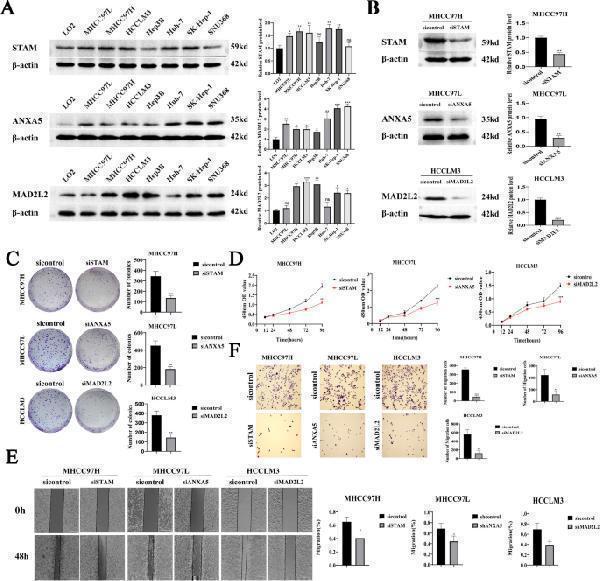
Expression of STAM, ANXA5 and MAD2L2 in HCC cell lines. A The expressions of STAM, ANXA5 and MAD2L2 in normal hepatocytes and hepatoma cell lines were detected using Western blotting. Knocking down STAM, ANXA5 and MAD2L2 inhibited the proliferation and migration of HCC cells. B The knockdown efficiency of STAM, ANXA5 and MAD2L2 was detected using Western Blotting. C Plate cloning experiment showed that the number of cloned cell clusters formed by hepatocellular carcinoma cells after knockdown of STAM, ANXA5 and MAD2L2 was significantly reduced; D The results of CCK8 experiment showed that inhibiting the expression of STAM, ANXA5 and MAD2L2 decreased the proliferative ability of HCC cells; E Scratch assay showed that knockdown of STAM, ANXA5 and MAD2L2 inhibited the migration of hepatocellular carcinoma cells; F Transwell experiment showed that the migration ability of hepatocellular carcinoma cells was weakened after inhibiting the expression of STAM, ANXA5 and MAD2L2 .* P < 0.05, ** P < 0.01, *** P < 0.001, there was no significant difference in ns
Index in PubMed under a CC BY license. PMID: 38049741
Specific Publications For Anti-STAM1 Antibody Picoband® (A00864-1)
Loading publications
Recommended Resources
Here are featured tools and databases that you might find useful.
- Boster's Pathways Library
- Protein Databases
- Bioscience Research Protocol Resources
- Data Processing & Analysis Software
- Photo Editing Software
- Scientific Literature Resources
- Research Paper Management Tools
- Molecular Biology Software
- Primer Design Tools
- Bioinformatics Tools
- Phylogenetic Tree Analysis
Customer Reviews
Have you used Anti-STAM1 Antibody Picoband®?
Share your experimental results or join a short interview to earn up to $1,000 in product credits or other rewards.
0 Reviews For Anti-STAM1 Antibody Picoband®
Customer Q&As
Have a question?
Find answers in Q&As, reviews.
Can't find your answer?
Submit your question
3 Customer Q&As for Anti-STAM1 Antibody Picoband®
Question
Is this A00864-1 anti-STAM1 antibody reactive to the isotypes of STAM?
Verified Customer
Verified customer
Asked: 2020-02-14
Answer
The immunogen of A00864-1 anti-STAM1 antibody is E. coli-derived human STAM1 recombinant protein (Position: F9-Q254). Could you tell me which isotype you are interested in so I can help see if the immunogen is part of this isotype?
Boster Scientific Support
Answered: 2020-02-14
Question
I am interested in to test anti-STAM1 antibody A00864-1 on rat liver for research purposes, then I may be interested in using anti-STAM1 antibody A00864-1 for diagnostic purposes as well. Is the antibody suitable for diagnostic purposes?
Verified Customer
Verified customer
Asked: 2019-06-28
Answer
The products we sell, including anti-STAM1 antibody A00864-1, are only intended for research use. They would not be suitable for use in diagnostic work. If you have the means to develop a product into diagnostic use, and are interested in collaborating with us and develop our product into an IVD product, please contact us for more discussions.
Boster Scientific Support
Answered: 2019-06-28
Question
We are currently using anti-STAM1 antibody A00864-1 for rat tissue, and we are happy with the ELISA results. The species of reactivity given in the datasheet says human, mouse, rat. Is it true that the antibody can work on primate tissues as well?
Verified Customer
Verified customer
Asked: 2018-07-05
Answer
The anti-STAM1 antibody (A00864-1) has not been tested for cross reactivity specifically with primate tissues, though there is a good chance of cross reactivity. We have an innovator award program that if you test this antibody and show it works in primate you can get your next antibody for free. Please contact me if I can help you with anything.
Boster Scientific Support
Answered: 2018-07-05