SULT1C2 antibody (A07212-2) performs well in ELISA, Flow Cytometry, WB and shows reactivity with Human, Mouse, Rat.

  • Validated for inter-lot consistency, specificity, and reproducibility
  • Committed to quality since 1993
Filter:
a07212 2 sult1c2 primary antibodies fcm testing 1a07212 2 sult1c2 primary antibodies wb testing 1

Anti-SULT1C2 Antibody Picoband®

SULT1C2 antibody

Reactive SpeciesHostApplication
Human, Mouse, RatRabbitELISA, Flow Cytometry, WB

SKU: A07212-2

Size: 100 μg

Bundle to save: I do not want free secondary ab
Price:
$370/100 μg

In stock. Ships Next Business Day.

Quantity: 1

1
Get A Quote
Guarantee / Product Promise

Tested Applications

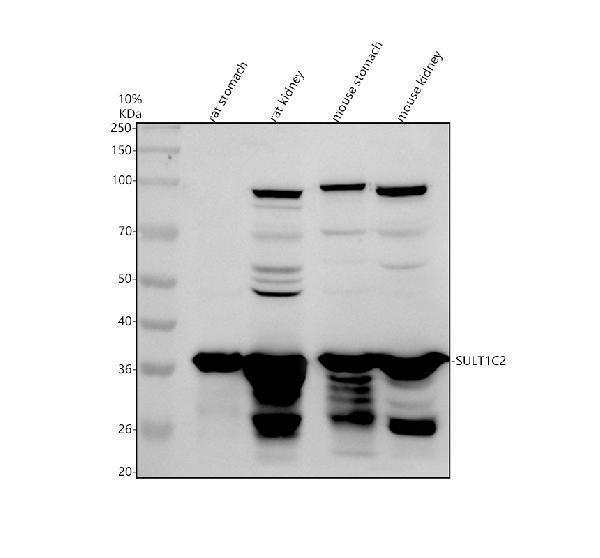
SULT1C2 antibody was positively detected by WB in:

rat stomach tissue, rat kidney tissue, mouse stomach tissue, mouse kidney tissue

Suggested blocking solution with 5% non-fat milk or BSA; (*)Recommended protein loading: 20-40 ug per lane

SULT1C2 antibody was positively detected by FC in:

RT4 cell

Recommend Dilution

Application
Dilution
Species
Western blot
0.25-0.5 μg/ml
Human, Mouse, Rat
Flow Cytometry (Fixed)
1-3 μg/1x106 cells
Human
ELISA
0.1-0.5 μg/ml

* It is recommended to optimize the amount of this reagent in each experimental system to achieve the best results.

Note: For flow cytometry (FCM), suitable for fixed cells only. Not suitable for FACS or surface flow cytometry using live cells.

Reactive Data

Filter:
Boster Guarantee:What is this?
WB
ELISA
Rat
Tested
Recommend
Mouse
Tested
Recommend
Human
Recommend
Monkey
Predicted
Predicted

Product Information

Product Name
Anti-SULT1C2 Antibody Picoband®
View all SULT1C2 Antibodies
Form
Lyophilized
Uniprot
Gene ID
Storage & Handling
At -20°C for one year from date of receipt. After reconstitution, at 4°C for one month. It can also be aliquotted and stored frozen at -20°C for six months. Avoid repeated freezing and thawing.
Host
Rabbit
Contents
Each vial contains 4 mg Trehalose, 0.9 mg NaCl, 0.2 mg Na2HPO4.
Clonality
Polyclonal
Immunogen
E.coli-derived human SULT1C2 recombinant protein (Position: M1-Q251). Human SULT1C2 shares 82.9% and 84.1% amino acid (aa) sequence identity with mouse and rat SULT1C2, respectively.
Reconstitution
Adding 0.2 ml of distilled water will yield a concentration of 500 μg/ml.
Observed Molecular Weight
35 kDa
Calculated Molecular Weight

34.9 kDa

Background of SULT1C2
Sulfotransferase enzymes catalyze the sulfate conjugation of many hormones, neurotransmitters, drugs, and xenobiotic compounds. These cytosolic enzymes are different in their tissue distributions and substrate specificities. The gene structure (number and length of exons) is similar among family members. This gene encodes a protein that belongs to the SULT1 subfamily, responsible for transferring a sulfo moiety from PAPS to phenol-containing compounds. Two alternatively spliced transcript variants encoding different isoforms have been described for this gene.
Cite This Product
Anti-SULT1C2 Antibody Picoband® (Boster Biological Technology, Pleasanton CA, USA, Catalog # A07212-2)

Protocols

Western Blot protocol for SULT1C2 antibody
Flow Cytometry (FC) protocol for SULT1C2 antibody

Review

Have you used Anti-SULT1C2 Antibody Picoband®?

Submit a review and receive $370 in product credits, a $185 Amazon gift card, or our carefully curated gift bundles.

Product Promise

We promise Anti-SULT1C2 Antibody Picoband® performs excellently in relevant applications for ELISA, Flow Cytometry, WB. If it doesn't perform as promised, we will refund the product. Learn more


In stock
Order Product
A07212-2
Buy one primary antibody get one 0.5ml HRP or Biotin secondary antibody for free.
*Sample sizes are prepared on demand and will take extra lead time. (cannot be conjugated)
$370.00

Troubleshooting

troubleshooting-box-image

Download troubleshooting handbooks for IHC, Western blot and ELISA for FREE.

Download Free PDFs Now

Boster Guarantee

Guaranteed product quality

Guaranteed product quality

We promise all of our products perform as described in datasheets.

This product is for Research Use Only. Not for use in diagnostic procedures.

Update date: Oct 11, 2026