This website uses cookies to ensure you get the best experience on our website.


- Table of Contents
Cutting-edge AI isn’t just for tech giants or big pharma—it’s becoming a practical tool for everyday scientists. If you’re an individual researcher or part of a small lab team, you’ve probably felt the pain of endless trial-and-error and information overload. Antibody experiments (and biological research in general) are notoriously time-consuming and expensive. You might spend months finding a working antibody or fine-tuning an assay, only to discover someone else already did something similar, or that a hidden flaw threw you off track. These frustrations contribute to the well-known reproducibility problems in science, where subtle issues (like an antibody’s off-target binding or a missed protocol detail) can derail results. Enter AI—not as hype, but as a bench-side assistant that can help cut through those challenges. In this post, we’ll discuss in a down-to-earth way how AI tools are boosting the productivity of individual scientists and small research teams right now. We’ll focus on how you can use AI to save time, stretch your grant dollars, and get more reliable results, highlighting concrete examples along the way.
Cutting-edge AI isn’t just for tech giants or big pharma—it’s becoming a practical tool for everyday scientists. If you’re an individual researcher or part of a small lab team, you’ve probably felt the pain of endless trial-and-error and information overload. Antibody experiments (and biological research in general) are notoriously time-consuming and expensive. You might spend months finding a working antibody or fine-tuning an assay, only to discover someone else already did something similar, or that a hidden flaw threw you off track. These frustrations contribute to the well-known reproducibility problems in science, where subtle issues (like an antibody’s off-target binding or a missed protocol detail) can derail results. Enter AI—not as hype, but as a bench-side assistant that can help cut through those challenges. In this post, we’ll discuss in a down-to-earth way how AI tools are boosting the productivity of individual scientists and small research teams right now. We’ll focus on how you can use AI to save time, stretch your grant dollars, and get more reliable results, highlighting concrete examples along the way.
One of the first places AI can help is in the planning phase of your experiments. As a researcher, you often face “decision overload” at the start of a project. Which targets or epitopes should you focus on? Which candidate antibodies or compounds should you test first? What experimental conditions are likely to work? AI tools shine at sifting through large amounts of data and past knowledge to guide these decisions:
In a recent case study, a small biotech research team reported using an AI-guided design approach to improve an antibody lead. The AI model suggested a set of mutations to the antibody’s binding loops that a human designer wouldn’t have intuitively picked. They synthesized a handful of the AI’s suggestions and tested them. Remarkably, one of these AI-designed antibodies had about 28-fold higher binding affinity to the target than the best antibody obtained from their conventional methods. To put that in perspective, achieving such an improvement through traditional directed evolution took multiple cycles of mutation and screening; the AI-based method did it in one round of design. This example shows how even a lean team can leverage AI to super-charge the molecule design process, potentially saving many months of labor and considerable expense on materials.
Once you’re at the bench running experiments, AI can act like an extra pair of skilled hands (or eyes) to speed things up and make your data readouts more reliable:
If your work involves visual data—gels, blots, microscope images—an AI can analyze those faster and more consistently than a person. For instance, consider Western blots or microscopy immunofluorescence images. Instead of you painstakingly examining band intensities or cell staining patterns (and worrying about your own bias or variability), computer vision algorithms can do it. Modern image analysis tools, often powered by deep learning, can detect bands on a blot automatically, measure their intensity, subtract background noise, and even flag if a band looks faint or anomalous. Similarly, for tissue staining, an AI can scan an entire slide and quantify how many cells are stained, how strong the signal is in different regions, etc., in a standardized way. The benefit for you as an individual researcher is huge: you get objective, quantifiable results without spending hours at the microscope or image editor. It also reduces interpretation errors—two people might disagree on what counts as a “positive” band, but the algorithm will apply the same criteria every time. This consistency means fewer arguments in the lab meeting and more confidence in your conclusions. Plus, by catching subtle differences or artifacts that you might miss when you’re tired, AI image analysis can prevent mistakes. (No more accidentally cherry-picking the “good-looking” bands—AI will see them all.)
Many labs are now using AI to virtually screen candidates and reduce the experimental load. For example, before testing a panel of antibody variants in the lab, you can use a prediction model to score each variant’s likely affinity or specificity. If you have access to a large dataset or even a pre-trained model from the community, it might tell you which 5 out of 100 variants are worth assaying. In essence, these models act like a virtual high-throughput screen, done on your computer in minutes, which guides your real high-throughput screen so you only spend money on the top hits. If you’re a small lab without fancy robotics, this is extremely useful—you can computationally sift through thousands of possibilities using resources as simple as a laptop or cloud service, then test just a manageable number in the lab. This approach has already shown success in fields like drug discovery, and it’s becoming accessible for antibody or protein work too. The time and cost savings come from not pursuing dead-ends. If an AI model helps you avoid even one wild goose chase (like an antibody that would have bound everything nonspecifically), it might save weeks of wasted effort.
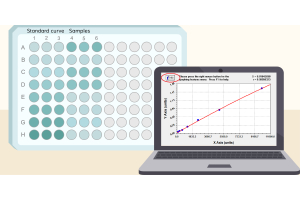
Another exciting use of AI is in fine-tuning experimental protocols in real-time. Think of an ELISA or PCR where you might normally run several rounds tweaking conditions to get a nice curve. AI-driven software can use your initial results to suggest improved conditions automatically. For instance, after your first ELISA attempt, an algorithm can analyze the curve and say, “It looks like the signal is saturating too early; try a lower concentration of capture antibody and a longer incubation.” This is a form of closed-loop optimization: the experiment informs the AI, the AI suggests a tweak, you run it, and repeat. For a busy scientist, having this kind of guided optimization means you reach usable results with fewer total runs. Instead of an entire week of adjusting and retesting, maybe you dial things in after two days. That’s not only time saved; it’s also fewer kits and samples consumed. Especially when materials are expensive or scarce, efficient optimization can be a budget saver.
Maybe your work involves high-throughput methods like next-gen sequencing of antibody repertoires or multi-parameter flow cytometry. The data tables from these can be enormous and daunting to analyze. AI and machine learning tools can help find patterns in those big datasets far beyond simple spreadsheet analysis. They might cluster antibodies by sequence patterns that correlate with function, or identify a rare but important population of cells in a flow dataset that a manual gate would overlook. This means that as an individual researcher, you can extract deeper insights from complex data without needing a full-time bioinformatician on staff. User-friendly interfaces are emerging that let you apply pretrained models or perform analysis with a few clicks. By catching patterns early, you might discover a promising antibody sequence hidden in the noise, or notice a trend that leads you to a new hypothesis—all much faster than by brute-force analysis.
To illustrate, consider a small academic lab that struggled with a notoriously tricky antibody in Western blotting. The antibody was giving multiple bands, and the grad student wasn’t sure which band was the real target or if the extra bands were errors. Instead of running endless control experiments, they turned to an AI-based analysis tool combined with literature mining. The AI automatically compared the suspicious band pattern with known artifacts reported in the literature. Interestingly, it flagged that a well-known antibody for that protein (one they were using) has a tendency to bind a random 55 kDa protein in mouse tissue, something reported in scattered papers. Armed with this insight (which the student might never have found on their own, since the warning was buried in a supplementary figure of an old paper), the lab immediately switched to an alternate antibody and adjusted their blocking protocol. This saved them from following a false lead—without the AI alert, they might have spent weeks investigating a meaningless band. The case underscores how AI can act as a safety net in experiments, catching errors or artifacts early so you don’t squander time and reagents on avoidable mistakes.
In research, knowledge is power—but it’s often locked away in dense papers, or in the heads of senior lab members, or in someone’s forgotten lab notebook. AI tools can help you tap into that collective knowledge and avoid reinventing the wheel:
Troubleshooting and Support:
A notable example of AI pulling together scattered knowledge comes from a project that created a knowledge base of problematic antibodies by scanning thousands of papers. In one case, this AI system brought to light a recurring issue with a common antibody used in Alzheimer’s research: across different publications, scientists had mentioned that this antibody (used to detect amyloid-beta) often bound an unrelated 55 kDa protein in certain mouse models, causing spurious results. Previously, these insights were isolated tidbits—one buried in the results section of Paper A, another in the discussion of Paper B. The AI reading system connected the dots and produced an alert for anyone considering that antibody. An individual researcher using this tool would be warned in advance about the off-target band and could either choose a different antibody or include a control to check for it. This example shows how AI can prevent repeat mistakes by making sure you benefit from the “hive mind” of science. In essence, it levels the playing field: even if you’re new to a field or in a smaller lab, you can have access to hard-won wisdom (like which reagents to be careful with) that normally only experts or long-time insiders might know.
All these applications of AI boil down to a simple outcome: helping you do more science with less sweat and fewer resources. It’s worth summarizing the tangible benefits that individual scientists and small teams are seeing:
All these applications of AI boil down to a simple outcome: helping you do more science with less sweat and fewer resources. It’s worth summarizing the tangible benefits that individual scientists and small teams are seeing:
While we’re enthusiastic about AI’s benefits, it’s also important to be realistic. AI is not a magic button that instantly solves all lab problems—it’s a tool. Like any tool, it has to be learned and used properly. Sometimes an AI prediction will be wrong, or a fancy algorithm might output something bizarre due to garbage-in data. That means you shouldn’t turn off your scientific critical thinking. Use AI recommendations as suggestions, not gospel. For example, if an AI tells you “Antibody A is likely to work better than Antibody B,” treat that as an hypothesis to test, not a fact. Maybe start with A, but keep B as a backup if A fails. In practice, researchers who get the most out of AI are those who integrate it into their workflow while still doing proper controls and validations. Think of AI as your super-informed colleague: often right and very fast, but not infallible.
For those wondering how to actually get started with AI in the lab, the good news is you don’t need to build everything from scratch. Many user-friendly tools and platforms exist. Some are commercial (integrated into lab software or analysis platforms), and many are open-source or free for academic use. If you’re new to this, a practical approach is:
AI is becoming a powerful ally for scientists at the bench, leveling the playing field for individual researchers and small teams. It helps take some of the guesswork and grunt work out of research, allowing you to concentrate more on the big ideas and creative aspects of science. We’ve seen how AI can plan experiments, streamline data analysis, integrate scattered knowledge, and ultimately save time and money while improving results. Importantly, these benefits are not theoretical—they’re being realized right now by forward-thinking scientists, as shown by the examples of AI-designed antibodies and automated literature alerts preventing mistakes. Adopting AI in your workflow doesn’t mean you stop doing real science; it means you’re doing science with augmented insight and efficiency. In a way, it’s like having a tireless intern, a brilliant librarian, and a seasoned methodologist all rolled into one digital assistant.
Looking at the bigger picture, the influence of AI in research is only going to grow. As more data becomes available and tools become easier to use, even more aspects of lab work will be accelerated and refined. For individual researchers, this is empowering—you can achieve in months what used to take years, and focus on innovation rather than drudgery. For team leaders, it means your group can accomplish more with the same manpower, which is especially valuable if resources are limited. Of course, human creativity, curiosity, and expertise remain irreplaceable. AI provides the light, but we still chart the course. By pairing our scientific judgment with AI’s analytical muscle, we get the best of both worlds. So if you haven’t already, it’s a great time to explore how AI might help in your own experiments. It could be as simple as trying a new analysis app or as ambitious as building a predictive model for your project—but either way, it’s about making your research faster, smarter, and a bit less of a grind. In the end, AI won’t do your science for you, but it can certainly help you do your science better. Happy experimenting!