This website uses cookies to ensure you get the best experience on our website.


- Table of Contents
Variable and constant regions give antibodies their precision and power. Explore how each component contributes to antigen recognition, immune signaling, and the development of therapeutic antibodies used in modern medicine.
The antibody structure enables each molecule to recognize a specific target. This target is usually a unique part of a foreign substance, such as a virus, bacterium, or toxin. Once identified, the antibody helps initiate the appropriate immune response to neutralize or eliminate the threat.
Precision and action work together because of the protein's shape. Each antibody has a variable fragment that binds specifically to its target. This precise binding ensures that the immune system responds only to harmful invaders, thereby preventing it from reacting to harmless substances. After binding, antibodies can block the target’s function, mark it for destruction, or activate other parts of the immune system. These actions help the body defend itself efficiently against a wide range of threats.
Monoclonal antibodies have become one of the most widely used formats in drug development over the past two decades. In recent years, regulatory agencies have continued to approve more mAbs each year, underscoring their importance in research and clinical practice. Many of these therapies perform better after scientists adjust their variable or constant domains. Comparing the two regions, we can see why antibodies bind so accurately and why this accuracy is crucial in both research and clinical care.
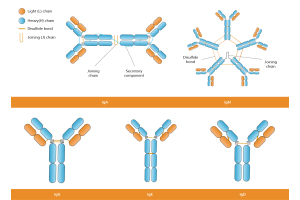
Antibodies, also known as immunoglobulins, are Y-shaped proteins built from two identical heavy and light chains. Disulfide bonds and disulfide bridges hold the chains together, giving the molecule stability and flexibility. Each chain contains a variable region at the tip and a constant region closer to the base. The variable region forms the antigen-binding site, whereas the constant region controls downstream immune activity.
Antigen recognition starts in the variable region, where sequence diversity produces unique binding surfaces.
Variable regions sit at the ends of both heavy and light chains. Within them, three complementarity-determining regions (CDRs) on each chain create the contact points for an antigen. Framework segments surround the CDRs, supporting the loops that enable binding. These hypervariable regions are critical for ensuring specificity.
When an antibody encounters its target, the six CDRs come together to form a grip on the antigen, much like a lock and key. That tight fit determines affinity, which influences how well the antibody can neutralize or flag the threat, an essential part of the antibody-antigen interaction.
Once the variable region locks onto a target, the constant region calls in reinforcements.
Constant regions extend from the hinge region of the antibody to the base of the heavy and light chains. In heavy chains, the constant segment determines the antibody isotypes, such as IgM antibodies IgG or IgA, each with distinct immune functions.
The constant region interacts with Fc fragment receptors on immune cells, activates the complement cascade, and influences serum half-life. For instance, IgG1 antibodies bind to Fcγ receptors on macrophages, guiding phagocytosis, while IgG4 has reduced effector activity, making it useful in chronic inflammatory settings.
Although neighbors within the same molecule, the two regions differ in almost every way.
| Feature | Variable Region | Constant Region |
|---|---|---|
| Primary role | Antigen recognition | Immune signalling, stability |
| Sequence variability | High | Low within an antibody class |
| Location | Tips for heavy chains and light chains | Lower arms and stem of the Y-shape |
| Flexibility | Greater to accommodate diverse targets | More rigid to maintain structural integrity |
| Engineering focus | Affinity tuning, specificity of antibody | Half-life, effector modulation |
Knowledge of the region function guides everything from laboratory assays to drug design.
Researchers often isolate variable regions to construct Fab fragments, single-chain variants, or nanobodies for use in imaging and diagnostic tests. Smaller antibody fragments retain antigen-binding activity specificity while reducing background noise.
Drug developers adjust constant regions to change how an antibody behaves in the body. For example, modifying Fc fragment domains of IgG molecules can extend half-life via neonatal Fc receptor recycling. Conversely, reducing Fc receptor binding can dampen inflammatory responses in therapeutic antibodies used to treat autoimmune diseases.
Tailoring both regions lets scientists create bispecific antibodies, antibody-drug conjugates, and chimeric antigen receptor constructs. Each relies on precise control of antigen binding and effector functional activity to improve safety and potency. Some designs also incorporate the J chain, especially in polymeric antibodies like IgM and IgA, influencing their quaternary structure and immune function.
Variable and constant regions work together, yet their tasks remain distinct. The variable portion seeks out the threat, while the constant portion signals for help. A clear understanding of both parts enables researchers to fine-tune antibodies for use in science, diagnostics, and treatment.
This includes optimizing the hinge region for structural flexibility, improving hypervariable regions for more accurate antigen recognition, and refining the amino acid sequence of polypeptide chains for better therapeutic performance. Such strategies continue to shape recombinant antibody production platforms, which rely on a detailed understanding of molecular structure to ensure quality and reproducibility. Together, these insights improve the design and delivery of more effective antibody responses across a range of applications.