Custom Antibodies vs. Catalog Antibodies: A Strategic Choice for Non-Model Organism Research

· Boster Bio

For researchers working with non-model organisms (e.g., zebrafish, Drosophila), choosing between custom-made antibodies and commercial catalog antibodies is not just a procurement decision—it is a reproducibility and study-design decision. Evidence from the antibody validation community emphasizes that performance hinges on epitope-level specificity, application-matched validation, and long-term lot consistency rather than whole-protein homology alone [Nature, Nature Methods].

In practice, “custom antibody vs catalog antibody” often comes down to whether your ortholog’s critical epitope is conserved and whether the reagent has been validated in your exact organism and application (WB, IF, IHC, whole-mount IF, IP/ChIP, Flow). Recent discussions on antibody characterization and reproducibility further argue for context-specific validation and sequence-defined supply when projects span multiple years or require publishable robustness [eLife, 2022; 11:e72863].

This article provides a research-grade framework to decide when to prioritize a species-specific, bespoke antibody and when a well-validated off-the-shelf reagent suffices. It also outlines pricing norms—including an affordable custom antibody $600 entry point—so principal investigators and biotech decision-makers can weigh time-to-data, total cost of results, and reproducibility.

Catalog Antibodies: The Illusion of Convenience

Catalog antibodies are widely used because they are inexpensive and readily available. However, in non-model organisms (e.g., zebrafish, Drosophila, or Xenopus), these off-the-shelf antibodies can present significant challenges. Antibody binding relies on short epitopes rather than whole-protein similarity. Even when proteins share over 80% homology, differences in epitope structure can lead to false negatives, weak signals, or total binding failure.

Common Issues with Catalog Antibodies

  • False negatives or inconsistent detection results.
  • High background noise in WB or IHC.
  • Lost time troubleshooting failed assays.
  • Reviewer skepticism due to lack of species-specific validation (Nature, 2024).

What initially seems like a quick solution can result in wasted budgets, delayed publications, and reduced scientific credibility.

Custom Antibodies: Tailored Solutions for Complex Research

In contrast, custom-made antibodies (also referred to as bespoke antibodies) are designed around the precise sequence of your target protein, delivering higher specificity and reproducibility. Modern platforms—such as Boster Bio’s Custom Antibody Service — have made such solutions affordable and accessible even for smaller labs.

Key Advantages of Custom Antibodies

  • Epitope Specificity & Accuracy — Designed directly for zebrafish or drosophila targets, eliminating cross-species uncertainty. Recognizes 6–12 aa epitopes instead of relying on full-sequence similarity.
  • Application Optimization — Antigen design is tailored for your assays (WB, IF, IHC, Flow, or whole-mount IF).
  • Reduced Cross-Species Risk — Prevents misleading background or false positives from homologous proteins.
  • Reproducibility & Stability — Sequence-defined antibodies ensure lot-to-lot consistency for multi-year projects.
  • Cost Efficiency & Strategic Value — While upfront costs may appear higher, avoiding failed experiments ultimately saves both time and money (eLife, 2024).

Catalog vs. Custom Antibodies: Direct Comparison

Criteria Catalog Antibodies Custom Antibodies
Availability Immediate delivery Weeks to months of production
Specificity Uncertain, relies on cross-reactivity High, epitope- and species-specific
Validation Rarely validated in non-model organisms Validated for your target applications
Reproducibility Variable results, lot-to-lot differences Stable, consistent, sequence-defined
Cost Lower upfront, but high trial-and-error cost Affordable at $600, saves long-term expenses
Risk High risk of weak/no binding or non-specific bands Reduced risk with tailored antigen design

Experimental Evidence: Catalog vs. Custom in Zebrafish

To illustrate real-world impact, we evaluated catalog antibodies with >80% sequence homology against zebrafish proteins HMGB1 and SOD1, and compared them with custom antibodies designed specifically for zebrafish. The results were striking:

  • HMGB1: The catalog antibody ( Cat# A00066-1 ) failed to produce a detectable signal in zebrafish, whereas the custom zebrafish antibody ( Cat# AZQ6NX86 ) generated strong, clear, and highly specific bands.
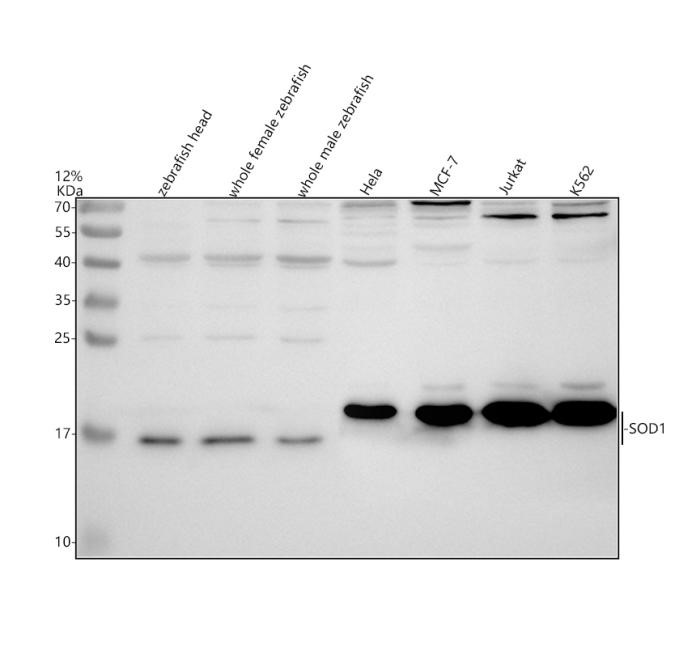
  • SOD1: The catalog antibody ( Cat# PA1345 ) detected the target but yielded weak signals with multiple nonspecific bands. In contrast, the custom zebrafish antibody ( Cat# AZO73872 ) demonstrated high sensitivity and produced clean, reproducible results.

Western blot analysis of HMGB1 using anti-HMGB1 antibody (A00066-1).

Western blot of HMGB1 with A00066-1

Electrophoresis was performed on a 12% SDS-PAGE gel at 80V (Stacking gel) / 120V (Resolving gel) for 2 hours. The sample well of each lane was loaded with 30 ug of sample under reducing conditions. Lane 1: zebrafish head tissue lysates, Lane 2: whole female zebrafish tissue lysates, Lane 3: whole male zebrafish tissue lysates, Lane 4: zebrafish embryo tissue lysates, Lane 5: human Hela whole cell lysates, Lane 6: human 293T whole cell lysates, Lane 7: human K562 whole cell lysates, Lane 8: human Jurkat whole cell lysates. After electrophoresis, proteins were transferred to a nitrocellulose membrane at 150 mA for 50-90 minutes. Blocked the membrane with 5% non-fat milk/TBS for 1.5 hour at RT. The membrane was incubated with rabbit anti-HMGB1 antigen affinity purified polyclonal antibody (A00066-1) at 0.5 μg/mL overnight at 4°C, then washed with TBS-0.1%Tween 3 times with 5 minutes each and probed with a goat anti-rabbit IgG-HRP secondary antibody at a dilution of 1:5000 for 1.5 hour at RT. The signal is developed using an ECL Plus Western Blotting Substrate (Catalog # AR1196-200) with Tanon 5200 system. A specific band was detected for HMGB1 at approximately 25 kDa. The expected band size for HMGB1 is at 25 kDa.

Western blot analysis of HMGB1a/b using anti-HMGB1a/b antibody (AZQ6NX86).

Western blot of zebrafish HMGB1a/b with AZQ6NX86

Electrophoresis was performed on a 10% SDS-PAGE gel at 80V (Stacking gel) / 120V (Resolving gel) for 2 hours. The sample well of each lane was loaded with 30 ug of sample under reducing conditions. Lane 1: zebrafish head tissue lysates, Lane 2: whole female zebrafish tissue lysates, Lane 3: whole male zebrafish tissue lysates, Lane 4: zebrafish embryo tissue lysates. After electrophoresis, proteins were transferred to a nitrocellulose membrane at 150 mA for 50-90 minutes. Blocked the membrane with 5% non-fat milk/TBS for 1.5 hour at RT. The membrane was incubated with rabbit anti-HMGB1a/b antigen affinity purified polyclonal antibody (AZQ6NX86) at 0.5 μg/mL overnight at 4°C, then washed with TBS-0.1%Tween 3 times with 5 minutes each and probed with a goat anti-rabbit IgG-HRP secondary antibody at a dilution of 1:5000 for 1.5 hour at RT. The signal is developed using an ECL Plus Western Blotting Substrate (Catalog # AR1196-200) with Tanon 5200 system. A specific band was detected for HMGB1a/b at approximately 23 kDa. The expected band size for HMGB1a/b is at 23 kDa.

Western blot analysis of SOD1 using anti-SOD1 antibody (PA1345).

Western blot of SOD1 with PA1345

Electrophoresis was performed on a 12% SDS-PAGE gel at 80V (Stacking gel) / 120V (Resolving gel) for 2 hours. The sample well of each lane was loaded with 30 ug of sample under reducing conditions. Lane 1: zebrafish head tissue lysates, Lane 2: whole female zebrafish tissue lysates, Lane 3: whole male zebrafish tissue lysates, Lane 4: human Hela whole cell lysates, Lane 5: human MCF-7 whole cell lysates, Lane 6: human Jurkat whole cell lysates, Lane 7: human K562 whole cell lysates. After electrophoresis, proteins were transferred to a nitrocellulose membrane at 150 mA for 50-90 minutes. Blocked the membrane with 5% non-fat milk/TBS for 1.5 hour at RT. The membrane was incubated with rabbit anti-SOD1 antigen affinity purified polyclonal antibody (PA1345) at 0.5 μg/mL overnight at 4°C, then washed with TBS-0.1%Tween 3 times with 5 minutes each and probed with a goat anti-rabbit IgG-HRP secondary antibody at a dilution of 1:5000 for 1.5 hour at RT. The signal is developed using an ECL Plus Western Blotting Substrate (Catalog # AR1196-200) with Tanon 5200 system. A specific band was detected for SOD1 at approximately 16, 18 kDa. The expected band size for SOD1 is at 16 kDa.

Western blot analysis of SOD1 using anti-SOD1 antibody (AZO73872).

Western blot of SOD1 with AZO73872

Electrophoresis was performed on a 12% SDS-PAGE gel at 80V (Stacking gel) / 120V (Resolving gel) for 2 hours. The sample well of each lane was loaded with 30 ug of sample under reducing conditions. Lane 1: zebrafish head tissue lysates, Lane 2: whole female zebrafish lysates, Lane 3: whole male zebrafish lysates, Lane 4: zebrafish embryo tissue lysates. After electrophoresis, proteins were transferred to a nitrocellulose membrane at 150 mA for 50-90 minutes. Blocked the membrane with 5% non-fat milk/TBS for 1.5 hour at RT. The membrane was incubated with rabbit anti-SOD1 antigen affinity purified polyclonal antibody (AZO73872) at 0.5 μg/mL overnight at 4°C, then washed with TBS-0.1%Tween 3 times with 5 minutes each and probed with a goat anti-rabbit IgG-HRP secondary antibody at a dilution of 1:5000 for 1.5 hour at RT. The signal is developed using an ECL Plus Western Blotting Substrate (Catalog # AR1196-200) with Tanon 5200 system. A specific band was detected for SOD1 at approximately 16 kDa. The expected band size for SOD1 is at 16 kDa.

These comparisons highlight the risks of relying on cross-reactivity and emphasize the clear advantages of custom antibody design when precision is essential.

Boster Bio’s $600 Custom Antibody Service: Making Precision Accessible

Boster Bio has rewritten this equation. By streamlining antigen design, bundling services, and scaling production, we now offer custom antibody packages starting at $600 — a fraction of industry norms.

Key Advantages for PIs and Biotech Leaders

  • Radical Affordability. At $600, the service is accessible even for pilot or exploratory studies. In many cases, this is less than the cumulative cost of three or four failed catalog antibodies.
  • Target-Specific Design. From zebrafish retinal proteins to drosophila isoforms, every project begins with tailored antigen design. Our scientists prioritize epitope accessibility and sequence uniqueness to minimize cross-reactivity, and optimize for your applications (WB, IHC, IF, Flow). Where beneficial, recombinant antigens are used to enhance immunogenicity and align with species relevance, PTMs, and project goals.
  • Full-Service Package. Gene synthesis and protein expression — often billed elsewhere at $1,500+ — are included at no extra cost, lowering both financial and logistical barriers.
  • Reliability & Continuity. Sequence-defined antibodies reduce lot variability and insulate your projects from catalog discontinuations.

What was once a luxury for elite labs is now practical for any team working with zebrafish, drosophila, or other non-model organisms.

Voices from the Research Community

Jared Talbot, Assistant Professor, University of Maine

“I was willing to take a shot on you and your production system because you convinced me that you were taking the process really seriously, let us do some funny things in our design and we're being very thoughtful and you offered it at a reasonable price where it's really worth the gamble for me and the gamble definitely paid off.”
(Interview video: Watch here )

Gary Wessel, Professor, Brown University

“As I started out saying there must be something wrong, that correspondence really does reinforce the strength of the relationship and the validation that Boster really is doing a good job. ”
(Interview video: Watch here )

Eric De Vrieze, Assistant Professor, Radboud University (Netherlands)

“I'm always surprised that no one knows about your services. It's just a little bit more expensive than the risk we take buying a human antibody that sometimes work and sometimes not. I was always surprised that you, we never made any comments on that. You just trusted me and my colleagues that came up with the edges of design. “
(Interview video: Watch here )

More Feedback from Researchers

Jakub Famulski, University of Kentucky
Dr. Famulski required a zebrafish-specific antibody against CDHR1a. Catalog antibodies for human homologs failed. With Boster Bio’s antibody (Catalog# DZ07988), his lab achieved clean labeling of photoreceptor outer segments in 5-day zebrafish embryos. “A zebrafish-specific antibody for CDHR1a that WORKS!”

Svetlana Dzitoyeva, University of Colorado Denver
Working on maternal-to-zygotic transition, Dr. Dzitoyeva used Boster Bio’s antibody against Me31B (Catalog# DZ33938-1) in WB. The outcome: clean, sharp bands and consistent reproducibility.

Collectively, these voices underscore a consistent pattern: when catalog antibodies prove inadequate, Boster’s custom antibody development offers the reliability, reproducibility, and species-specific performance required to meet the standards of contemporary research.

Conclusion: Investing in Certainty

In the competitive world of modern science, unreliable reagents can derail entire projects. Catalog antibodies may offer speed, but they frequently underperform in non-model organisms. Custom antibodies—especially via Boster Bio’s affordable $600 service —deliver the specificity, reproducibility, and long-term value research programs require.

For PIs and biotech decision-makers, the choice is clear: stop gambling on cross-reactivity. Start investing in certainty with species-specific custom design.