This website uses cookies to ensure you get the best experience on our website.


- Table of Contents

ELISA (Enzyme-Linked Immunosorbent Assay) remains one of the most widely used methods for protein quantification in immunology, oncology, neuroscience, biomarker discovery, and translational research. Researchers use ELISA to measure cytokines, chemokines, growth factors, hormones, signaling proteins, and disease biomarkers across a wide range of sample types.
However, choosing an ELISA kit is often more complicated than selecting the target protein alone.
Two ELISA kits for the same analyte may differ significantly in:
These differences can directly affect data quality, quantitative reliability, and experimental reproducibility.
This guide summarizes the key factors researchers should evaluate before selecting an ELISA kit.
Researchers can explore Boster Bio’s full portfolio of ELISA kits, including PicoKine®, Quick ELISA kits, High Sensitivity ELISA kits, EZ-Set® antibody pairs, and multiplex ELISA solutions.
The first step in ELISA kit selection is ensuring that the kit matches the intended target.
Researchers should confirm:
Many biomarkers belong to closely related protein families. Selecting a kit using only an abbreviation or target name may lead to choosing the wrong assay.
For example, cytokines, growth factors, and signaling proteins often contain homologous family members with similar names or structures.
Questions worth asking include:
Species matching is equally important. A kit validated for human samples may not necessarily perform identically in mouse or rat studies.
After confirming the target analyte and species, researchers should determine which ELISA format best fits the target and experimental goal.
Different ELISA formats are designed for different analytes and applications. Choosing the correct format early helps avoid selecting a kit that does not match the experimental purpose.
| ELISA Format | Best Suited For | When to Choose It |
|---|---|---|
| Sandwich ELISA | Cytokines, growth factors, protein biomarkers | When measuring proteins with multiple epitopes and high specificity is required |
| Competitive ELISA | Small molecules, hormones, metabolites | When the analyte is too small for two antibodies to bind simultaneously |
| Direct ELISA | Simple antigen detection | When a faster and simpler workflow is preferred |
| Indirect ELISA | Antibody detection, immune response studies | When detecting antibodies against a known antigen |
For most protein biomarkers, cytokines, and growth factors, sandwich ELISA is commonly preferred because it offers high specificity and sensitivity using matched antibody pairs.
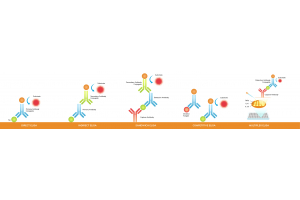
In a typical sandwich ELISA workflow, a capture antibody immobilizes the target analyte on the plate, while a detection antibody binds a separate epitope to enable signal generation and quantification. The quality and specificity of both the capture antibody and detection antibody can significantly influence assay performance.
Competitive ELISA is often used for small analytes or targets with limited epitopes.
For a detailed comparison of ELISA workflows, advantages, limitations, and applications, see Boster Bio’s guide to ELISA types including indirect, direct, sandwich, competitive, and multiplex ELISA.
For multi-marker studies, researchers can also review Boster Bio’s multiplex ELISA kits.
Sample compatibility should be evaluated before sensitivity.
Common ELISA sample types include:
A kit validated in one matrix may not perform identically in another.
Real biological samples are more complex than assay buffers and may introduce:
Before purchasing, researchers should review the Samples section of the product datasheet.
For Boster Bio ELISA kits, this section may include sample-related information such as:
These data help researchers estimate whether their samples are likely to fall within the assay range before running experiments.
For example, the datasheet for the Human Tryptase/TPSAB1,B2 ELISA Kit (EK0898) indicates that serum and plasma samples were evaluated at a 1:1 dilution, with an internal sample testing concentration of 2.5–5 ng/mL.
This information helps researchers estimate whether their samples are likely to fall within the assay range and whether additional dilution may be needed.
Example datasheet: Human Tryptase/TPSAB1,B2 ELISA Kit EK0898 datasheet
Questions researchers should ask:
| Question | Why It Matters |
|---|---|
| Has this sample type been validated? | Reduces matrix-related uncertainty |
| Is sample dilution guidance provided? | Supports assay planning |
| Are internal sample testing concentrations available? | Helps estimate expected sample levels |
| Are real sample data available? | Supports biological relevance |
| Is pilot testing recommended? | Useful when concentrations are unknown |
Useful resources:
After confirming the target, format, and sample type, researchers should review the kit’s sensitivity and detection range.
Sensitivity refers to the lowest concentration at which the kit can detect the presence of the target protein.
However, sensitivity does not always mean accurate quantification.
For example:
Results between 3 pg/mL and 15.6 pg/mL suggest that the analyte may be detectable but not accurately quantifiable within the standard curve range.
Researchers may report these values as:
Values below sensitivity (for example <3 pg/mL) are generally reported as undetectable.
This distinction becomes particularly important when studying:
For low-abundance targets, researchers may consider Boster Bio’s High Sensitivity ELISA kits. Many high-sensitivity assays are supplied with a lyophilized standard that can be reconstituted before use to generate the calibration curve. Proper preparation of the lyophilized standard and use of the recommended standard diluent help support consistent quantification across experiments.
Detection range represents the concentration window where the assay can reliably quantify the analyte.
Researchers should evaluate whether expected sample concentrations are likely to fall within this range.
For example, if the detection range is 15.6–1000 pg/mL, samples should ideally fall within this interval after preparation or dilution.
If most samples are below the range, the analyte may be detectable but not reliably quantifiable.
If concentrations exceed the range, additional dilution may be required.
Sensitivity is often one of the first specifications researchers compare when selecting an ELISA kit. However, sensitivity alone does not determine assay quality. A kit may detect a low concentration of analyte, but still perform poorly if precision, matrix compatibility, specificity, or lot consistency have not been adequately evaluated.
A stronger way to compare ELISA kits is to review the overall validation profile. This helps researchers understand not only whether the assay can detect the target, but whether it can produce reproducible and reliable quantitative results in real sample conditions.
| Validation Parameter | What to Review | Why It Matters |
|---|---|---|
| Precision | Intra-assay and inter-assay variation | Shows whether replicate and repeated runs are consistent |
| Recovery | Spike-and-recovery performance in relevant matrices | Helps assess whether serum, plasma, lysate, or other matrices affect measurement |
| Dilution linearity | Whether diluted samples remain proportional after dilution correction | Supports quantitative reliability when samples need dilution |
| Specificity / Cross-reactivity | Reactivity with related proteins, isoforms, or species | Helps confirm that the kit detects the intended target |
| Stability | Reagent storage and handling performance | Supports reliable results after storage and routine handling |
| Lot consistency | Lot-to-lot QC or batch consistency information | Important for long-term, repeated, or multi-batch studies |
For reproducibility, researchers should pay particular attention to precision. Intra-assay precision evaluates variation within the same plate or run, while inter-assay precision evaluates consistency across different runs. This becomes important when comparing results across time points, batches, or repeated experiments.
For real-sample performance, recovery and dilution linearity are especially useful. Recovery helps show whether the sample matrix affects measurement, while dilution linearity helps determine whether a diluted sample still gives a proportional and reliable result after correcting for the dilution factor.
For biological interpretation, specificity and cross-reactivity are critical. This is especially relevant for cytokine families, growth factor families, conserved proteins, and targets with related isoforms. Researchers should check whether the kit has been evaluated against related proteins or potential interfering factors when this information is available.
For long-term projects, stability and lot consistency also matter. If a study extends over months or requires multiple kit lots, reagent stability and lot-to-lot consistency can affect comparability across experiments.
Researchers can review Boster Bio’s ELISA validation information for details on validation criteria and assay evaluation methods.
In addition to summary validation metrics, some manufacturers provide a full validation report that includes precision, recovery, dilution linearity, specificity, and stability assessments. Reviewing a Full Validation Report can help researchers better understand assay performance under real experimental conditions.
Before ordering, researchers should review:
Sample volume becomes particularly important when working with animal studies, rare specimens, or clinical samples.
If workflow speed is a priority, researchers may compare standard kits with Quick ELISA kits.
If researchers need to build or optimize their own ELISA system, EZ-Set® ELISA antibody pairs may provide more flexibility. Researchers may choose between coated ELISA kits and Uncoated ELISA kits depending on the level of assay customization required. While coated ELISA kits provide pre-prepared plates for convenience, coated ELISA kits may offer less flexibility than Uncoated ELISA kits for assay development and optimization.
A reliable ELISA kit should support accurate quantitative analysis.
Researchers should review:
Questions worth asking:
After experiments, researchers may use Boster Bio’s ELISA data analysis resources or the online ELISA data analysis tool for curve generation and analysis.
Publication support cannot replace validation but may provide additional confidence.
Researchers should review:
Published applications may help estimate whether the kit has been used in similar research contexts.
Choosing an ELISA kit also means choosing the supplier behind the assay. Beyond product specifications, researchers should consider whether the supplier provides clear documentation, validation data, quality control information, and practical technical support.
Researchers often compare offerings from multiple suppliers, including R&D Systems, when evaluating assay specifications, validation documentation, technical support, and product availability.
This is especially important for long-term or repeated studies, where lot-to-lot consistency and product continuity may affect result comparability.
Researchers can also review the ELISA protocol, ELISA optimization tips, ELISA troubleshooting tips, and ELISA testing service for additional support.
Quality is one of the most important factors when choosing an ELISA kit, but budget is also a practical consideration. Researchers often need to balance assay performance, validation quality, sample compatibility, and cost—especially when planning multiple targets, repeated experiments, or long-term studies.
After confirming that a kit matches the target, species, sample type, detection range, and validation requirements, current promotions may help reduce assay costs without changing the scientific selection criteria.
Boster Bio currently offers a promotion on selected high-demand ELISA kits through the Top ELISA Kits Discount. Researchers can review the promotion page to see whether their target of interest is included.
When using a promotional offer, researchers should still confirm that the selected kit fits the experimental requirements outlined above.
Before purchasing:
A good ELISA kit is not simply the kit with the lowest detection limit.
The best choice is the kit that matches your:
Careful evaluation before purchasing can improve experimental confidence and support more reliable biomarker quantification.
To begin selection, explore Boster Bio’s ELISA kits, review ELISA validation information, or visit the ELISA Technical Resource Center.