This website uses cookies to ensure you get the best experience on our website.


- Table of Contents
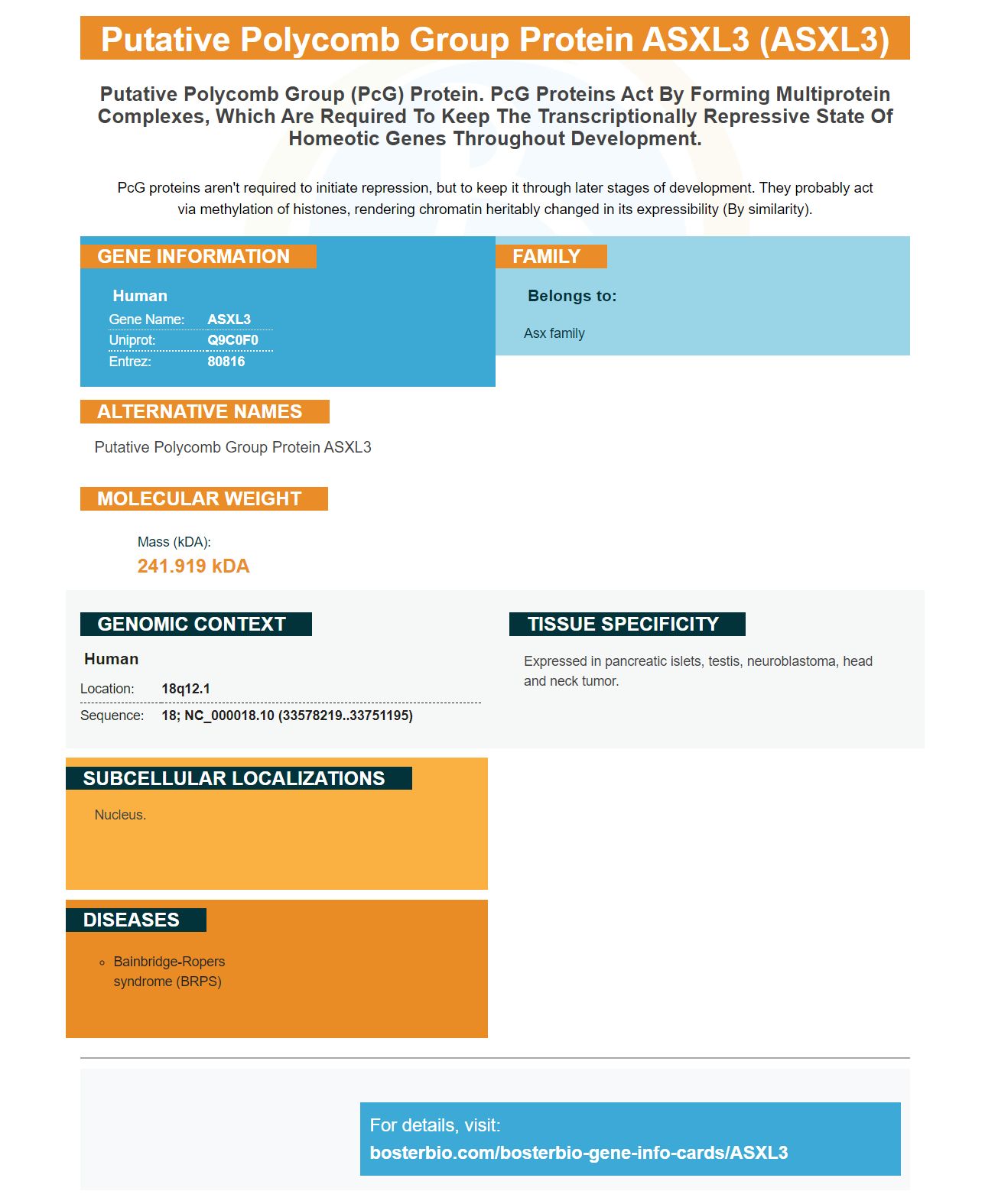
Facts about Putative Polycomb group protein ASXL3.
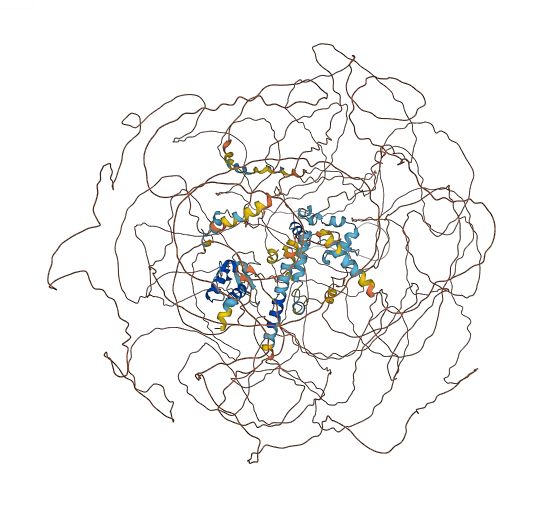
PcG proteins aren't required to initiate repression, but to keep it through later stages of development. They probably act via methylation of histones, rendering chromatin heritably changed in its expressibility (By similarity).
| Human | |
|---|---|
| Gene Name: | ASXL3 |
| Uniprot: | Q9C0F0 |
| Entrez: | 80816 |
| Belongs to: |
|---|
| Asx family |

Putative Polycomb group protein ASXL3
Mass (kDA):
241.919 kDA

| Human | |
|---|---|
| Location: | 18q12.1 |
| Sequence: | 18; NC_000018.10 (33578219..33751195) |
Expressed in pancreatic islets, testis, neuroblastoma, head and neck tumor.
Nucleus.



PMID: 15138607 by Katoh M., et al. Identification and characterization of ASXL3 gene in silico.
PMID: 23383720 by Bainbridge M.N., et al. De novo truncating mutations in ASXL3 are associated with a novel clinical phenotype with similarities to Bohring-Opitz syndrome.