This website uses cookies to ensure you get the best experience on our website.


- Table of Contents
Designing a Western blot for Bpifa1? The guide has the expected band size, antibodies backed by real blot images, the controls to run alongside, and protocols taken from published papers.
Open the BPIFA1 Western Blot Guide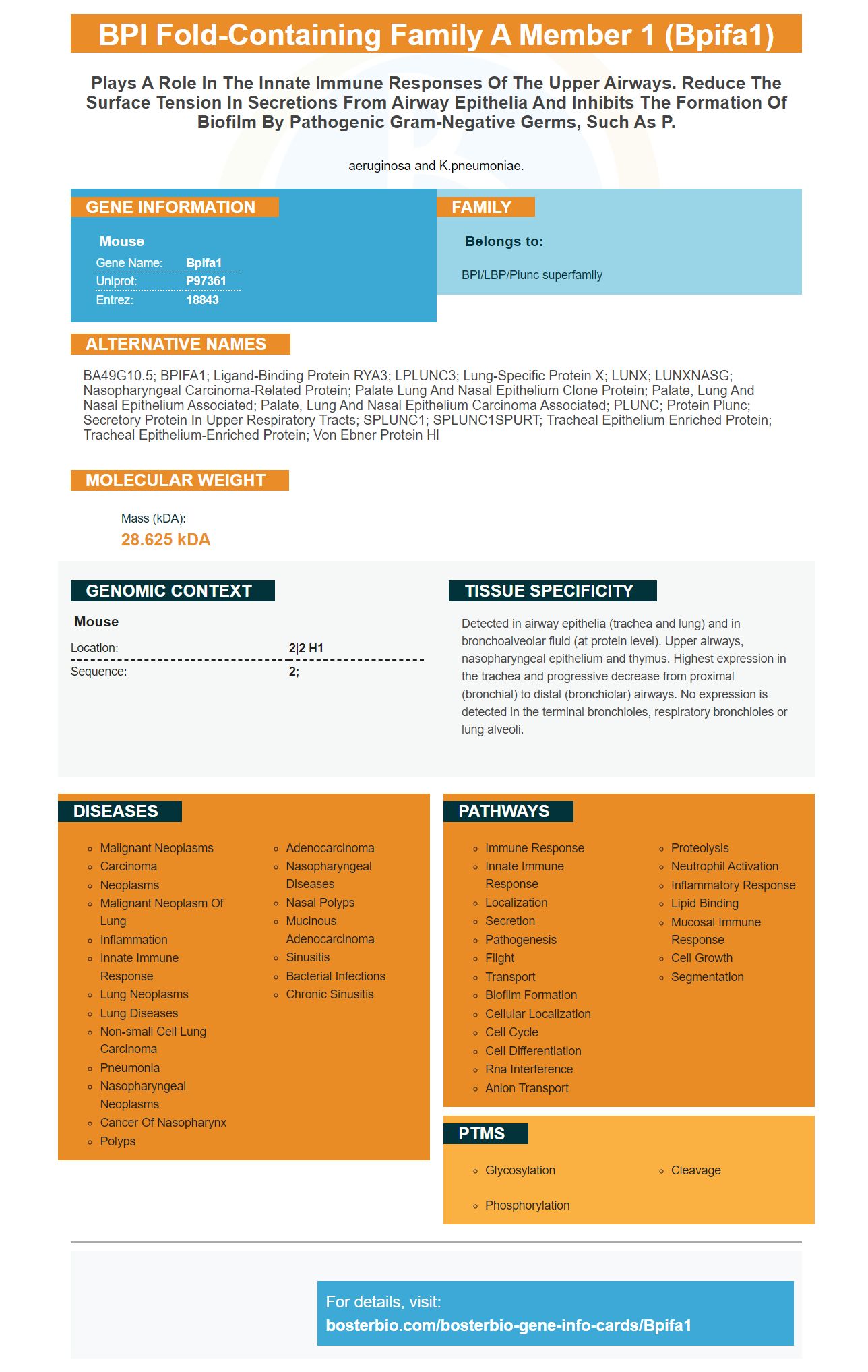
Facts about BPI fold-containing family A member 1.
aeruginosa and K.pneumoniae.
| Mouse | |
|---|---|
| Gene Name: | Bpifa1 |
| Uniprot: | P97361 |
| Entrez: | 18843 |
| Belongs to: |
|---|
| BPI/LBP/Plunc superfamily |

bA49G10.5; BPIFA1; ligand-binding protein RYA3; LPLUNC3; Lung-specific protein X; LUNX; LUNXNASG; Nasopharyngeal carcinoma-related protein; Palate lung and nasal epithelium clone protein; palate, lung and nasal epithelium associated; palate, lung and nasal epithelium carcinoma associated; PLUNC; protein Plunc; Secretory protein in upper respiratory tracts; SPLUNC1; SPLUNC1SPURT; tracheal epithelium enriched protein; Tracheal epithelium-enriched protein; Von Ebner protein Hl
Mass (kDA):
28.625 kDA

| Mouse | |
|---|---|
| Location: | 2|2 H1 |
| Sequence: | 2; |
Detected in airway epithelia (trachea and lung) and in bronchoalveolar fluid (at protein level). Upper airways, nasopharyngeal epithelium and thymus. Highest expression in the trachea and progressive decrease from proximal (bronchial) to distal (bronchiolar) airways. No expression is detected in the terminal bronchioles, respiratory bronchioles or lung alveoli.



PMID: 10224143 by Weston W.M., et al. Differential display identification of plunc, a novel gene expressed in embryonic palate, nasal epithelium, and adult lung.
PMID: 11396972 by LeClair E.E., et al. Genomic organization of the mouse plunc gene and expression in the developing airways and thymus.