This website uses cookies to ensure you get the best experience on our website.


- Table of Contents
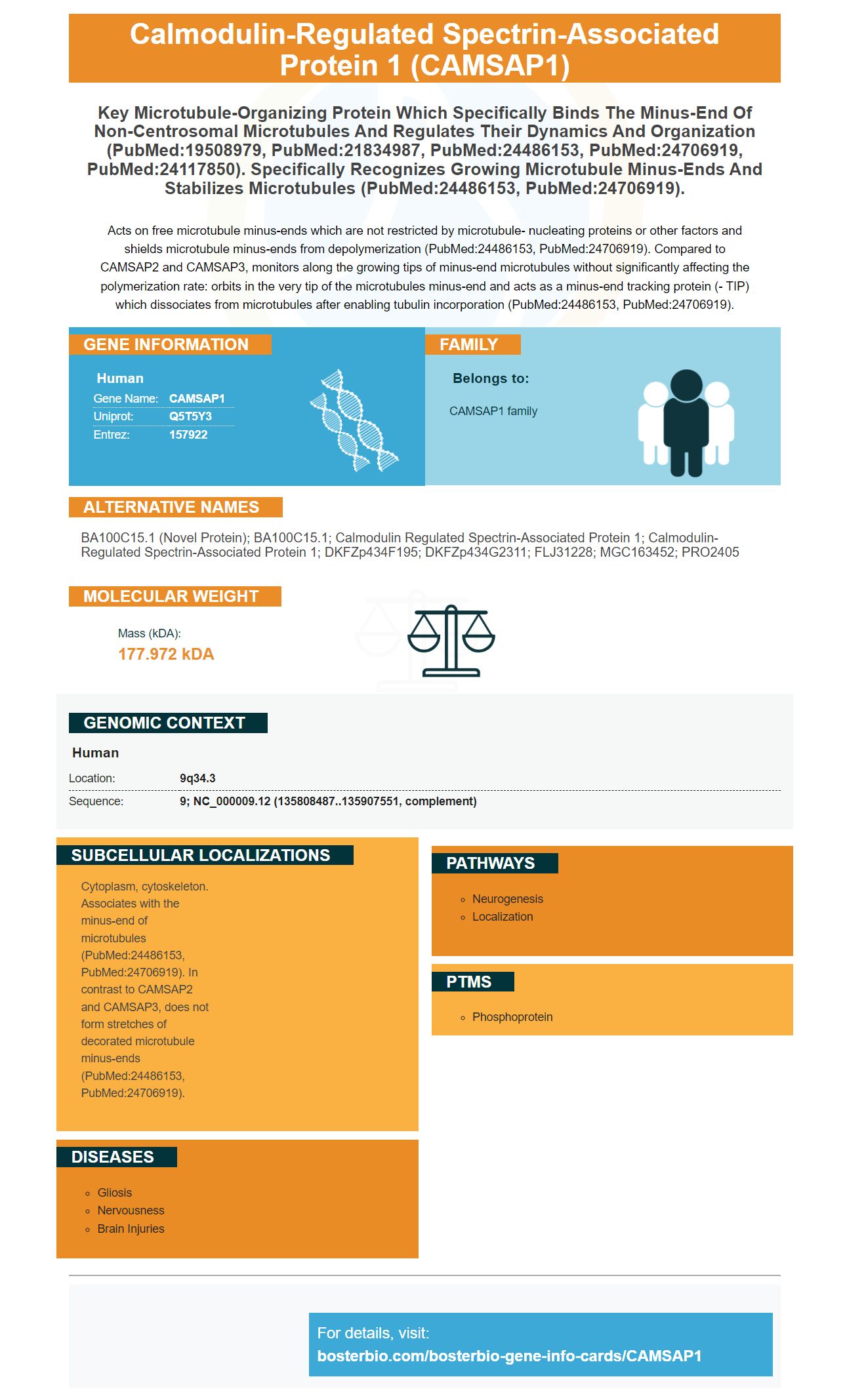
Facts about Calmodulin-regulated spectrin-associated protein 1.
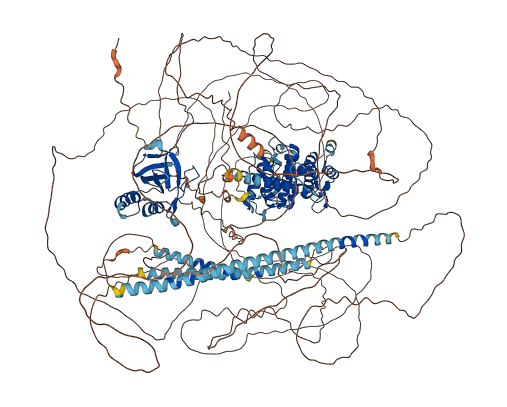
Acts on free microtubule minus-ends which are not restricted by microtubule- nucleating proteins or other factors and shields microtubule minus-ends from depolymerization (PubMed:24486153, PubMed:24706919). Compared to CAMSAP2 and CAMSAP3, monitors along the growing tips of minus-end microtubules without significantly affecting the polymerization rate: orbits in the very tip of the microtubules minus-end and acts as a minus-end tracking protein (- TIP) which dissociates from microtubules after enabling tubulin incorporation (PubMed:24486153, PubMed:24706919).
| Human | |
|---|---|
| Gene Name: | CAMSAP1 |
| Uniprot: | Q5T5Y3 |
| Entrez: | 157922 |
| Belongs to: |
|---|
| CAMSAP1 family |

bA100C15.1 (novel protein); bA100C15.1; calmodulin regulated spectrin-associated protein 1; calmodulin-regulated spectrin-associated protein 1; DKFZp434F195; DKFZp434G2311; FLJ31228; MGC163452; PRO2405
Mass (kDA):
177.972 kDA

| Human | |
|---|---|
| Location: | 9q34.3 |
| Sequence: | 9; NC_000009.12 (135808487..135907551, complement) |
Cytoplasm, cytoskeleton. Associates with the minus-end of microtubules (PubMed:24486153, PubMed:24706919). In contrast to CAMSAP2 and CAMSAP3, does not form stretches of decorated microtubule minus-ends (PubMed:24486153, PubMed:24706919).



PMID: 19508979 by Baines A.J., et al. The CKK domain (DUF1781) binds microtubules and defines the CAMSAP/ssp4 family of animal proteins.
PMID: 21834987 by Bai S.W., et al. Identification and characterization of a set of conserved and new regulators of cytoskeletal organisation, cell morphology and migration.