This website uses cookies to ensure you get the best experience on our website.


- Table of Contents
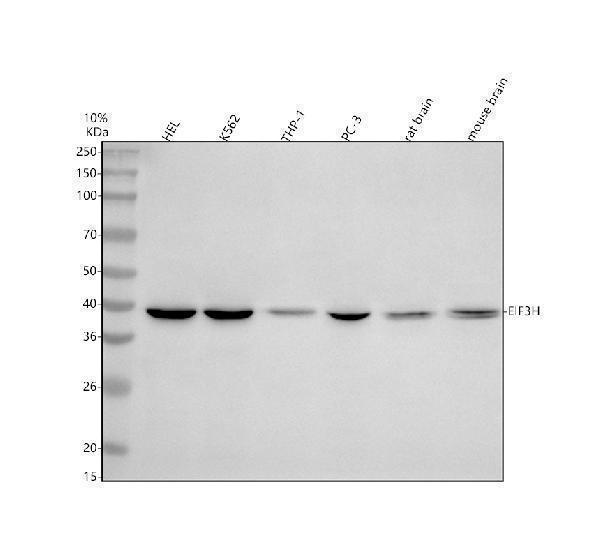
Designing a Western blot for EIF3H? The guide has the expected band size, antibodies backed by real blot images, the controls to run alongside, and protocols taken from published papers.
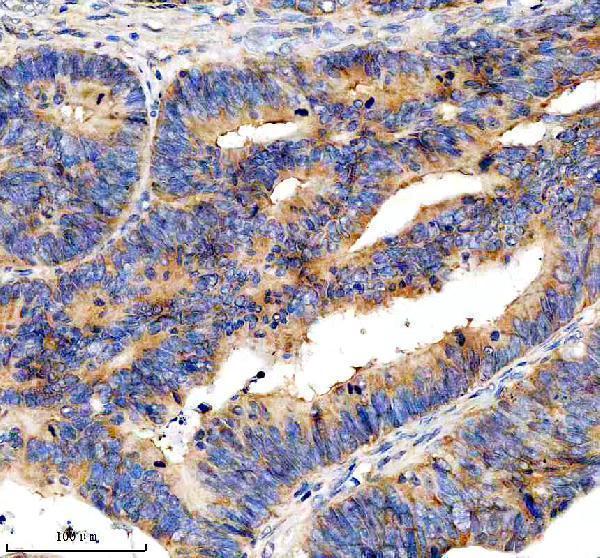
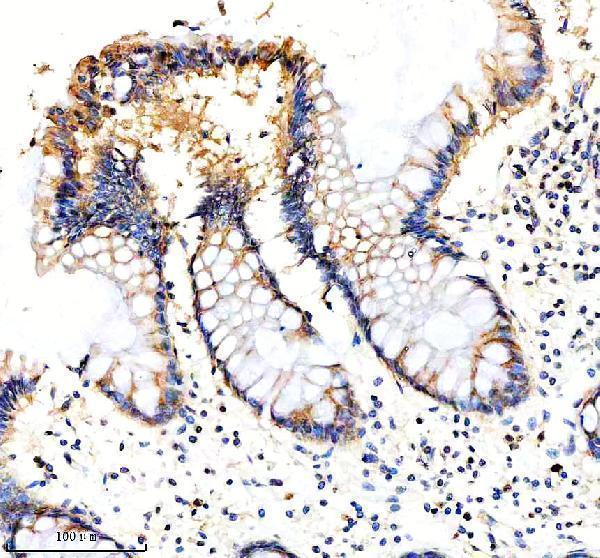
Open the EIF3H Western Blot GuideDesigning an IHC experiment for EIF3H? The guide has the expected staining pattern, antigen retrieval and fixation, antibodies backed by real IHC images, the tissue controls to run alongside, and protocols taken from published papers.
Open the EIF3H IHC Guide
Facts about Eukaryotic translation initiation factor 3 subunit H.

The eIF-3 complex stimulates mRNA recruitment to the 43S PIC and scanning of the mRNA for AUG recognition. The eIF-3 complex is also required for disassembly and recycling of post-termination ribosomal complexes and subsequently prevents premature joining of the 40S and 60S ribosomal subunits prior to initiation (PubMed:17581632).
| Human | |
|---|---|
| Gene Name: | EIF3H |
| Uniprot: | O15372 |
| Entrez: | 8667 |

| Belongs to: |
|---|
| eIF-3 subunit H family |

eIF-3-gamma; eIF3-gamma; eIF3h; eIF3-p40; EIF3S3eIF3 p40 subunit; Eukaryotic translation initiation factor 3 subunit 3; eukaryotic translation initiation factor 3 subunit H; eukaryotic translation initiation factor 3, subunit 2 (beta, 36kD); eukaryotic translation initiation factor 3, subunit 3 (gamma, 40kD); eukaryotic translation initiation factor 3, subunit 3 gamma, 40kDa; eukaryotic translation initiation factor 3, subunit H; MGC102958
Mass (kDA):
39.93 kDA

| Human | |
|---|---|
| Location: | 8q23.3-q24.11 |
| Sequence: | 8; NC_000008.11 (116642130..116755823, complement) |
Cytoplasm.



PMID: 9341143 by Asano K., et al. Structure of cDNAs encoding human eukaryotic initiation factor 3 subunits. Possible roles in RNA binding and macromolecular assembly.
PMID: 16286006 by Holz M.K., et al. mTOR and S6K1 mediate assembly of the translation preinitiation complex through dynamic protein interchange and ordered phosphorylation events.